When stakeholder expectations aren't managed, conflict follows. You'll learn how to classify, negotiate, and build consensus before the project starts.
1. Engage vs. Align — Two Different Sides of Stakeholder Management
Many PMs confuse "engagement" with "alignment." Here is the clear distinction:
Engage (Task 4) | Align (Task 5) | |
|---|---|---|
Question | "How do we get stakeholders to participate?" | "How do we get stakeholders to agree?" |
Focus | Participation — stakeholders are present and have a voice | Consensus — stakeholders are pointing in the same direction |
Outcome | Stakeholders know about and care about the project | Stakeholders understand trade-offs and commit to shared goals |
Example | Inviting the CEO to a sprint review | CEO and CTO agree to prioritize speed over features |
Engagement can happen without alignment — for example: all stakeholders attend the meeting, but each one has different expectations about the deliverable. Alignment ensures everyone understands and accepts the same set of goals, constraints, and trade-offs.
PMBOK® 8, Section 3.4: "Desired outcomes should be clearly described, iteratively assessed, and updated throughout the project life cycle using quality gates, feedback loops, and regular reviews." — Alignment is a continuous process, not a one-time event.
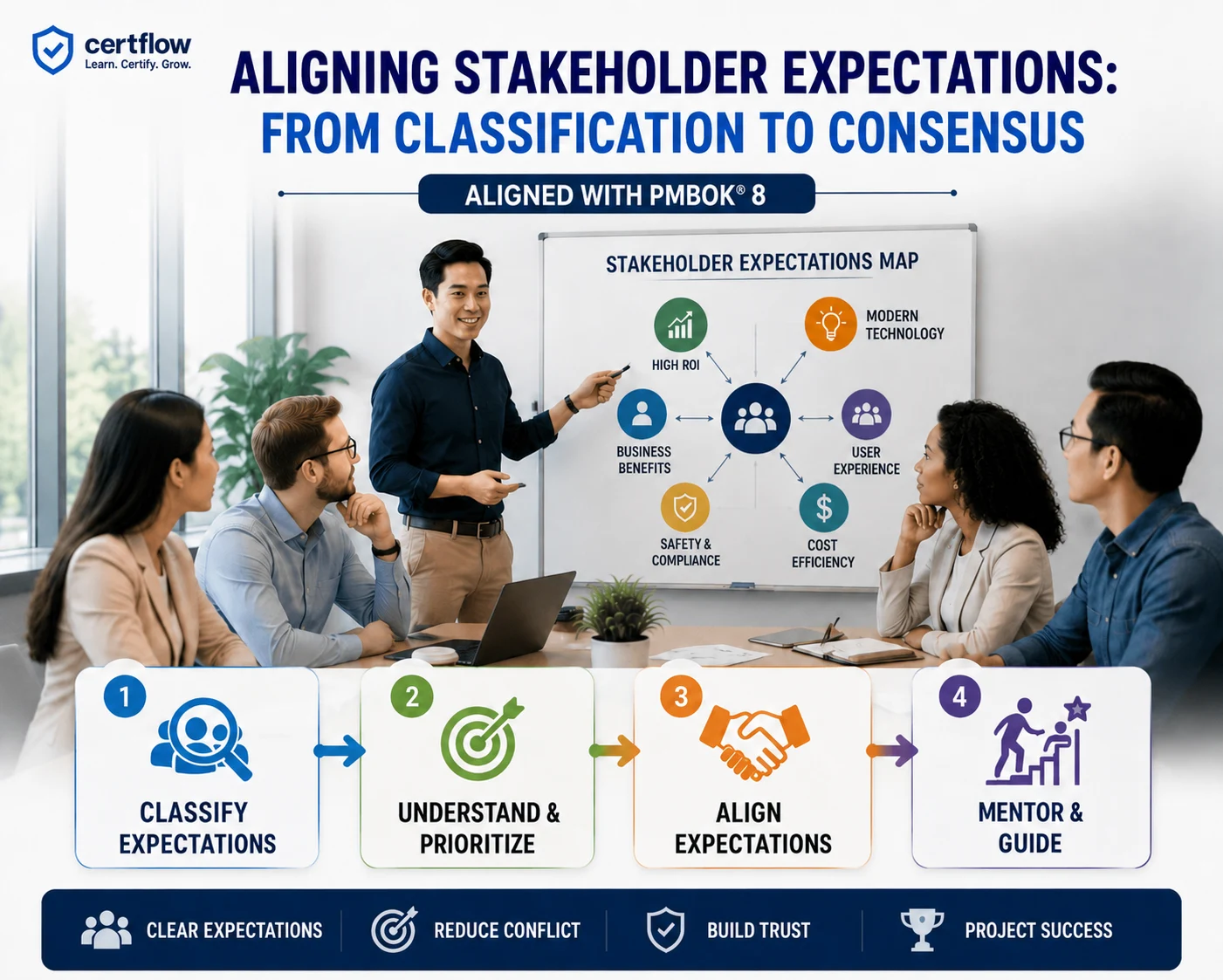
2. The 4-Step Framework for Aligning Expectations
Step | Enabler | Core Question | When |
|---|---|---|---|
1 | Categorize stakeholders | Which group does this stakeholder belong to, and what approach is needed? | Project start + when changes occur |
2 | Identify expectations | What do they truly expect — including what they haven't said yet? | Continuously |
3 | Facilitate alignment discussions | When expectations conflict, how do we find common ground? | When disagreements arise |
4 | Mentoring opportunities | Who needs guidance to participate more effectively? | At all times — developing people |
3. Step 1: Strategic Stakeholder Categorization
Categorization is not about "labeling" stakeholders — it is about choosing the right approach strategy for each group. PMBOK 8 provides four models:
Power/Interest Grid — The Most Fundamental Model
Low Interest | High Interest | |
|---|---|---|
High Power | Keep Satisfied — Executives, regulators. Brief reports, escalate only when necessary. | Manage Closely — Sponsor, key client. Involve in decisions, meet frequently. |
Low Power | Monitor — Peripheral stakeholders. Check in periodically. | Keep Informed — End users, team. Frequent updates, listen to feedback. |
Salience Model — For Complex Projects
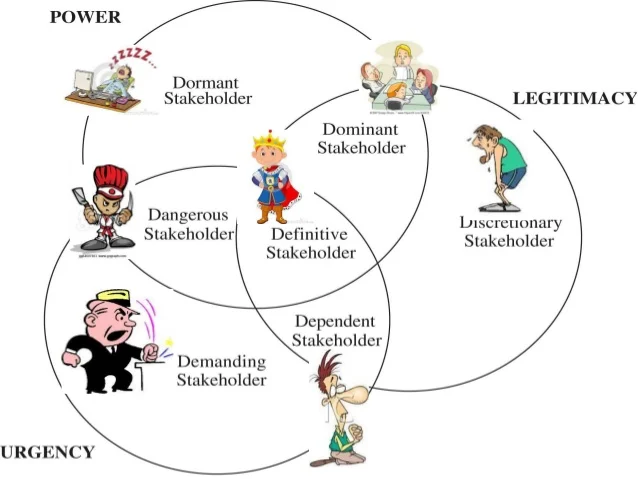
PMBOK 8: "Describes classes based on assessments of power, urgency, and legitimacy (or proximity). Useful for large, complex communities or complex networks of relationships." When the Power/Interest Grid is too simple for 50+ stakeholders — the Salience Model adds a third dimension for more precise classification.
Directions of Influence
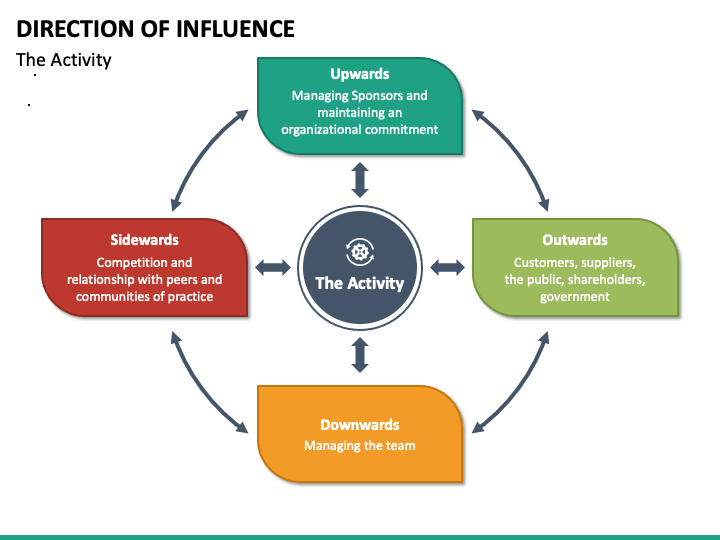
Upward (senior management, sponsor) — the PM needs to influence upward to secure resources and approval. Downward (team, specialists) — the PM empowers and guides. Outward (suppliers, regulators, public) — the PM manages expectations. Sideward (other PMs, middle managers) — the PM negotiates shared resources. Each direction requires a different approach and language.
Stakeholder Cube — 3D for Highly Complex Projects
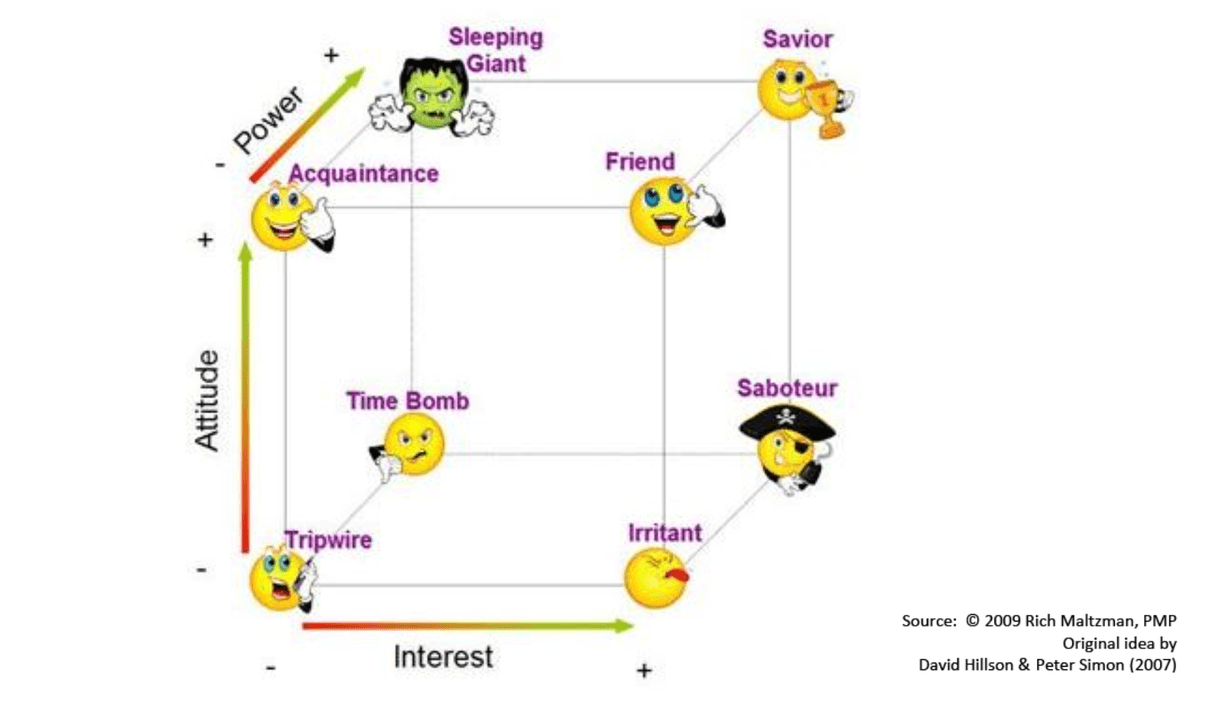
PMBOK 8: "Combines grid elements into a three-dimensional model... provides multiple dimensions that improve depiction of the stakeholder community."
💡PMP Tip: When an exam question says "the PM needs to determine how to engage each stakeholder group" — the correct answer typically begins with "categorize/classify stakeholders FIRST, then develop strategies." Never "one approach for all."
4. Step 2: Identifying Expectations — Both Stated and Unstated
Stakeholder expectations have two layers:
Stated Expectations (Explicit) | Unstated Expectations (Hidden) | |
|---|---|---|
Source | Contracts, requirements docs, acceptance criteria, SLAs, user stories | Implicit assumptions, cultural norms, past experiences, political dynamics |
Example | "The system must handle 10,000 transactions/second" | "I assumed training would be included" or "I want to be consulted before every decision" |
Risk if ignored | Deliverable does not meet specs → formal rejection | Stakeholder is "surprised" at go-live → resistance, conflict, loss of trust |
Techniques for Eliciting Expectations
- Interviews — PMBOK 8: "Formal or informal approach to elicit information by talking directly. Useful for obtaining confidential information." One-on-one is the best way to uncover unstated expectations because stakeholders are more open without group pressure.
- Focus Groups — PMBOK 8: "Brings together prequalified stakeholders and SMEs to learn about their expectations and attitudes." Suitable when you need to assess collective reactions.
- Questionnaires & Surveys — Use when the audience is large, geographically dispersed, and quantitative data is needed.
- Observation/Conversation — PMBOK 8: "A direct way of viewing individuals in their environment to see how they perform jobs. Also known as 'job shadowing.'" Observing behavior reveals more than words — a stakeholder may say "OK" but their body language says "I disagree."
- The 3 most common unstated expectations: "I want to be consulted before decisions are made" (power). "I want the project to not affect my department" (territorial protection). "I want to be recognized for the success" (recognition). These are the expectations few people voice but that most significantly affect support.
5. Step 3: Facilitating Discussions to Converge Expectations
This is the hardest enabler — it requires the PM to be a facilitator, a negotiator, and a diplomat all at once.
Facilitation — The Art of Guiding Discussions
PMBOK 8 defines it clearly:
PMBOK® 8, Section 5: "Facilitation is the ability to effectively guide a group event to a successful decision, solution, or conclusion." The facilitator ensures: effective participation, mutual understanding, all contributions considered, full buy-in, and agreed-upon actions.
The PM facilitates — not dictates. The difference: a facilitator helps the group arrive at the answer; a dictator delivers the answer and requires the group to accept it.
Negotiation — When Expectations Conflict
PMBOK 8: "Negotiation is a discussion aimed at reaching an agreement... to achieve support that supports the work of the project. Negotiation can build trust and harmony."
The PM negotiates continuously: with the sponsor on scope/budget, with functional managers on resources, with clients on priorities, with vendors on contract terms, with the team on workload. Negotiation is not about "who wins" — it is about finding an agreement that all parties can commit to.
Alignment Requires 3 Elements
- Transparency — Everyone knows each other's expectations. No hidden agendas.
- Trade-off discussions — When expectations conflict, hold open discussions about trade-offs: "If we prioritize speed, what do we sacrifice? If we prioritize quality, how does that affect the timeline?"
- Commitment — Stakeholders commit to the agreed outcome, even if it does not fully meet their original expectations.
Common Alignment Forums
Predictive | Adaptive |
|---|---|
Project kickoff meetings | Sprint planning (agree on sprint goals) |
Phase gate reviews | Sprint reviews / demos (align on product direction) |
Steering committee meetings | Retrospectives (align on process improvement) |
Requirements workshops | Backlog refinement (align on priorities) |
Scope validation sessions | Product roadmap sessions |
6. Step 4: Leveraging Mentoring Opportunities
This is a special enabler — the ECO includes mentoring within stakeholder alignment because PMI emphasizes: an effective PM not only manages expectations but also develops the capability of stakeholders and the team so they can manage expectations better themselves.
Coaching vs. Mentoring — A Clear Distinction
PMBOK 8 defines both:
Coaching | Mentoring | |
|---|---|---|
Goal | Solve a specific problem, achieve a specific goal | Career development, sharing long-term experience |
Timeframe | Short-term, focused | Long-term, ongoing relationship |
Approach | "Try this approach to solve that problem" | "I've been through this situation — here's what I learned..." |
PMBOK 8 | "More related to achieving specific goals" | "A more long-term, ongoing relationship-building practice" |
Mentoring in the Context of Alignment
PM mentors stakeholders: Helping a new Product Owner understand how to write effective user stories. Guiding a junior PM on managing sponsor expectations. Coaching a functional manager on an agile mindset. Helping a team lead develop facilitation skills.
PM seeks mentoring for themselves: Leveraging senior stakeholders with experience. Learning domain knowledge from SMEs. Building a network of mentors within the organization.
Connecting to motivation theory: PMBOK 8 cites Daniel Pink: Mastery — "The desire to do excellent work, learn, and achieve goals." Mentoring directly serves the Mastery need — helping stakeholders develop capability and become more invested in the project. When people are developed, they naturally become more engaged and aligned.
PMP Tip: When an exam question describes "a junior team member struggling with stakeholder communication" or "a new product owner who doesn't understand the process" — the best answer is almost always to mentor/coach them, NOT to do it for them or escalate to management.
7. When Stakeholders Don't Agree — Decision-Making Frameworks
When facilitation and negotiation are not enough, the PM needs group decision-making frameworks:
Method | Description | Advantages | Limitations |
|---|---|---|---|
Unanimity | 100% agreement | Maximum commitment | Very difficult to achieve, time-consuming |
Majority | >50% agreement | Faster than unanimity | Minority may not be committed |
Plurality | The option with the most votes wins | Suitable when there are >2 options | Can win without achieving majority |
Autocratic | One person decides | Fastest | No buy-in, risk of bias |
- Multicriteria Decision Analysis — PMBOK 8: "A technique that utilizes a decision matrix to provide a systematic analytical approach for establishing criteria to evaluate and rank many ideas." Very useful when stakeholders have many conflicting options — a criteria-based approach enables transparent and data-driven decisions.
- Nominal Group Technique — PMBOK 8: "A structured method to equalize participation and minimize the dominance of more vocal members, ensuring that all ideas are considered." Especially useful when there is a power imbalance — senior stakeholders tend to dominate discussions, and this technique prevents that.
8. PMP Exam Tips on Stakeholder Alignment
📍Tip 1 — Categorize FIRST: When a question asks "how to align different stakeholder groups" — the correct answer usually begins with "categorize stakeholders based on their characteristics, then develop tailored alignment strategies." Never "same approach for all."
📍Tip 2 — Facilitate, don't dictate: When expectations conflict — the PM facilitates the discussion, does NOT decide which stakeholder is right. "Facilitate a discussion to reach consensus" is almost always the correct answer. "PM decides and communicates" is almost always wrong.
📍Tip 3 — New stakeholder = reassess with ALL: When a question introduces a new stakeholder with a different vision — the correct answer is "engage them AND facilitate reassessment with all key stakeholders." NOT "ask them to accept the existing vision" (too rigid) or "change the vision to match" (too hasty).
📍Tip 4 — Mentor, don't bypass: When a stakeholder lacks experience and causes misalignment — mentor/coach them. Doing it for them (bypassing) creates dependency. Escalating too early damages trust.
9. Ten Scenario-Based Practice Questions
Question 1
You are managing a digital transformation. The CTO wants cutting-edge AI features, the CFO wants to minimize costs, the Head of Sales wants revenue-boosting features, and end users want simplicity. Each believes their priority should be primary.
What should you do FIRST?
A. Ask the sponsor to rank priorities.
B. Categorize stakeholders by power and interest, identify each one's specific expectations and underlying motivations, then facilitate a prioritization workshop.
C. Create a compromise giving each stakeholder 25% of the budget.
D. Schedule a joint meeting immediately to discuss priorities.
Question 2
During a requirements workshop, the Operations Director says: "We need real-time inventory tracking across 12 warehouses." The IT Manager responds: "That's technically impossible within our budget." The room goes silent.
How should you facilitate this?
A. Side with IT since technical constraints are factual.
B. Acknowledge both perspectives, then explore the Operations Director's underlying need and IT's specific constraints to find creative alternatives that might satisfy both.
C. Table the discussion for follow-up research.
D. Escalate to the steering committee.
Question 3
A newly appointed VP joins your project at the 6-month mark and says: "I wasn't part of the original discussions. I have a completely different view of success."
What is the MOST appropriate response?
A. Explain the existing vision and ask the VP to align with it.
B. Immediately revise the vision to incorporate the VP's perspective.
C. Engage the VP in dialogue to understand their perspective, then facilitate a reassessment with all key stakeholders.
D. Document concerns in the issue log and continue.
Question 4
A junior product owner consistently writes vague user stories with unclear acceptance criteria, causing confusion during sprint planning and rework. The PO is enthusiastic but lacks agile experience.
What is the BEST approach?
A. Rewrite the stories yourself to keep the project on track.
B. Ask the Scrum Master to coach the PO.
C. Personally mentor the PO through writing effective stories — provide examples, give feedback over several sprints, and develop their capability.
D. Escalate to the PO's manager about quality issues.
Question 5
The project sponsor expects completion by December 31. The technical lead estimates March is needed for acceptable quality. You believe February is realistic with scope trade-offs. The sponsor says: "December is non-negotiable."
How should you handle this?
A. Commit to December since the sponsor has authority.
B. Tell the sponsor February is realistic and they must accept it.
C. Present data transparently: what's achievable by December (reduced scope), quality risks, and what February delivers. Facilitate a trade-off discussion and let the sponsor make an informed decision.
D. Crash the schedule and add resources.
Question 6
Your project has 50+ stakeholders across departments. The Power/Interest grid feels too simplistic — some stakeholders with low formal power can mobilize significant informal influence.
What should you do?
A. Add notes about informal influence to the Power/Interest grid.
B. Switch to the Salience Model, which adds urgency and legitimacy/proximity dimensions for more nuanced classification.
C. Create individual plans for all 50+ stakeholders.
D. Focus only on the top 10 most powerful stakeholders.
Question 7
After a prototype demo, marketing is already planning a launch campaign assuming the final product matches the prototype. Engineering plans significant changes based on user testing. Marketing and engineering haven't communicated about this.
What should you do?
A. Ask engineering to minimize changes to match marketing's expectations.
B. Ask marketing to wait until engineering finalizes design.
C. Immediately facilitate a cross-functional alignment meeting where both teams share their plans and agree on a realistic product vision and timeline.
D. Send an email summarizing the situation to both teams.
Question 8
A senior executive frequently changes their expectations about deliverables. What they wanted last month differs from this month. Team members are frustrated, feeling their work is wasted. The executive says: "I'll know what I want when I see it."
What is the MOST effective strategy?
A. Implement an iterative approach with frequent demos and feedback loops, so the executive can see working increments and crystallize expectations through experience.
B. Insist on formal requirements sign-off before development.
C. Escalate the executive's behavior to the sponsor.
D. Document all changes and present a cost-of-change report.
Question 9
You are a PM on a large program. Another PM managing a related project approaches you — their sponsor makes demands conflicting with your deliverables. Both projects share dependencies. The other PM is less experienced and seems overwhelmed.
What should you do?
A. Protect your project's interests and let them handle their own issues.
B. Escalate to the program manager since cross-project conflicts are their domain.
C. Help the other PM through mentoring, jointly analyze the conflicting demands, and if needed, facilitate a discussion with both sponsors to align across the program.
D. Suggest the other PM take a stakeholder management course.
Question 10
At a steering committee meeting, you present green status. Afterward, a committee member privately says: "I think you're too optimistic. The vendor told me they're behind, and I've heard QA concerns that weren't in your report."
How should you respond?
A. Thank them and explain your report is based on verified data.
B. Investigate the concerns immediately, verify vendor status and QA feedback, update your assessment if needed, and proactively communicate findings to the committee.
C. Ask the member to raise concerns formally at the next meeting.
D. Speak to the vendor and QA about proper communication channels.
Answer Key
Question 1: Answer: B
— The ECO requires "categorize stakeholders" then "identify expectations" BEFORE "facilitate discussions." Without understanding each stakeholder's power, interest, and motivations, facilitation will be unstructured. Equal budget split (C) is arbitrary. A meeting without preparation (D) risks unstructured conflict.
Question 2: Answer: B
— PMBOK 8 facilitation: "participants achieve mutual understanding, all contributions considered." The key is uncovering the underlying need — perhaps "real-time" means "within 15 minutes" not "instant." That's a very different technical requirement. Siding with either (A) kills alignment. Tabling (C) loses momentum.
Question 3: Answer: C
— A new VP IS a key stakeholder. Ignoring their input (A, D) risks losing support. Immediately changing (B) without consulting others violates the collaborative principle. Engage AND reassess with ALL stakeholders — that's true alignment.
Question 4: Answer: C
— The ECO specifically includes "organize and act on mentoring opportunities." The PO is enthusiastic but inexperienced — classic mentoring situation. PMBOK 8: "Mentoring is a long-term, ongoing relationship-building practice." Don't bypass them (A), delegate without engagement (B), or escalate (D). Invest in their development.
Question 5: Answer: C
— PMBOK 8's Be an Accountable Leader: integrity means data-driven, transparent decisions. The PM presents facts and facilitates — the sponsor decides. Capitulating (A) ignores reality. Dictating (B) ignores authority. Crashing (D) adds costs without informed consent.
Question 6: Answer: B
— PMBOK 8: Salience Model is "useful for large, complex communities of stakeholders." The third dimension captures the nuances the 2D grid misses. Individual plans (C) for 50+ is impractical. Ignoring less-powerful stakeholders (D) is how "hidden blockers" derail projects.
Question 7: Answer: C
— This is a textbook expectation misalignment between two groups. PMBOK 8 facilitation: ensures "mutual understanding." Email (D) informs but doesn't align. Asking one side to accommodate the other unilaterally (A, B) creates resentment. The PM bridges the silos through facilitated dialogue.
Question 8: Answer: A
— "I'll know when I see it" is a classic adaptive scenario. PMBOK 8: in adaptive projects, "the team collaborates with the customer to determine which features are worth the investment." Iterative delivery directly addresses this. Formal sign-off (B) doesn't work when the stakeholder can't articulate requirements upfront. Escalating (C) damages the relationship.
Question 9: Answer: C
— The ECO requires "organize and act on mentoring opportunities." The other PM needs mentoring AND the cross-project conflict directly affects your project. PMBOK 8 Networking: "provides access to informal organizations to solve problems and increase stakeholder support." Isolating (A) ignores interdependency. Training (D) doesn't solve the immediate problem.
Question 10: Answer: B
— The committee member's expectation is transparency and accuracy. PMBOK 8 Be an Accountable Leader: "integrity — willingness to acknowledge risk and share bad news early." Dismissing (A) damages trust. Demanding formal channels (C, D) is defensive. The PM should investigate immediately, update if warranted, and communicate proactively — this builds the trust that makes alignment possible.
10. Conclusion
Align Stakeholder Expectations follows Engage Stakeholders — moving from "participation" to "consensus." Three key takeaways:
1. Categorize before strategize — Not every stakeholder needs the same approach. Use the Power/Interest Grid for simple projects, the Salience Model for complex ones, and Directions of Influence for political navigation. Correct categorization → correct strategy → faster alignment.
2. Facilitate, don't dictate — and find unstated expectations — True alignment comes from open discussions about trade-offs, not from the PM deciding and announcing. And don't forget: hidden expectations (power, recognition, territorial protection) have more impact than stated ones.
3. Mentoring creates lasting alignment — When stakeholders have the capability to participate effectively (write good user stories, understand agile, know how to communicate), alignment happens more naturally. Investing in mentoring is investing in long-term alignment.
PMBOK® 8, Section 3.6: "Reliable project schedules are the result of collaborative discussions among the project team, senior management, and other stakeholders. Accountable leadership should ensure that those discussions include the appropriate parties and that there is alignment."
Frequently Asked Questions (FAQ)
How do you uncover hidden stakeholder expectations?
Hidden expectations are often left unsaid because stakeholders assume they are obvious. Techniques: (1) In-depth interviews with open-ended questions: "What does success look like to you?"; (2) Observation — watch how they actually work; (3) Prototype feedback — reactions to a prototype reveal hidden expectations; (4) Review lessons learned from similar previous projects.
How do you use the MoSCoW method to prioritize requirements?
MoSCoW categorizes requirements into: Must have (essential; cannot deploy without it), Should have (important but a workaround exists), Could have (nice-to-have if time/budget allows), Won't have (out of scope this time but possible in the future). This technique helps stakeholders agree on priority when you cannot deliver everything.
When stakeholders conflict over requirements, how should the PM handle it?
The PMBOK 8 approach: (1) Facilitate a joint session — bring conflicting stakeholders into the same room rather than mediating separately. (2) Focus on interests, not positions — ask "Why do you need that?" instead of arguing about "what." (3) Document trade-offs clearly. (4) Escalate to the Sponsor if consensus cannot be reached — this is a business decision, not a technical one.
You now have a solid grasp of aligning stakeholder expectations — it is time to practice with real exam questions.
Next article: Managing Stakeholder Expectations: From Identification to Monitoring
Stakeholder Engagement: 6 Strategic Steps According to PMBOK 8
The Art of Stakeholder Management and Keeping Everyone Moving in the Same Direction
Building a Shared Vision and Leading Projects According to PMBOK 8
Try Free PMP Practice Questions →
Official References: