Stakeholder expectations will drift if you ignore them. You will learn how to monitor engagement levels and adjust your approach using PMBOK 8 methods.
1. Why "on spec" can still mean "off expectations"?
An IT team finishes deploying a new HR system. Every requirement in the documentation has been met. UAT passed. Go-live on time. But two weeks later, the HR department complains: "The system technically works but doesn't fit the way we work. The new workflow takes twice as long as the old one." The HR team signed off on the requirements but is now dissatisfied.
What happened? Requirements were met, but expectations were not. Requirements are formal (features A, B, C). Expectations include everything the stakeholder tacitly assumed that no one wrote down: "the new system must be at least as fast as the old one."
PMBOK® 8, Section 3.5: "Project quality entails satisfying relevant stakeholders' expectations AND fulfilling project and product requirements." — Expectations and requirements are TWO different things, and the PM must manage both.
This is the essence of Task 6: Manage Stakeholder Expectations — not just delivering to spec, but ensuring customers are genuinely satisfied with the outcome.
2. Internal vs. External Customers — Two Groups, Two Mindsets
Task 6 emphasizes the word "customer" — distinct from "stakeholder" in general. Customers are those who receive and use deliverables. And PMBOK 8 requires the PM to manage expectations of both internal and external customers.
Aspect | Internal Customers | External Customers |
|---|---|---|
Who? | Departments, teams, employees within the organization that use the output | Clients, end users, external partners |
Typical expectations | Minimal disruption, adequate training, workflow integration, process improvement | Product quality, on-time delivery, value for money, good UX |
Feedback channels | Internal surveys, retrospectives, town halls, 1-on-1s | Customer reviews, support tickets, NPS, UAT, focus groups |
Risk if ignored | Resistance to change, low adoption, internal politics | Contract disputes, lost revenue, reputation damage |
Approach | Change management, training, collaborative design | SLA management, customer success, satisfaction tracking |
⚠️ Important: PMBOK 8 (Section 2.5.1): "Stakeholder satisfaction should be prioritized and integrated into project objectives. The key is maintaining continuous communication with all stakeholders, including customers, end users, managers, executives, and team members, to understand their needs, address issues as they occur, and manage conflicting interests."
3. The Continuous Expectations Management Cycle
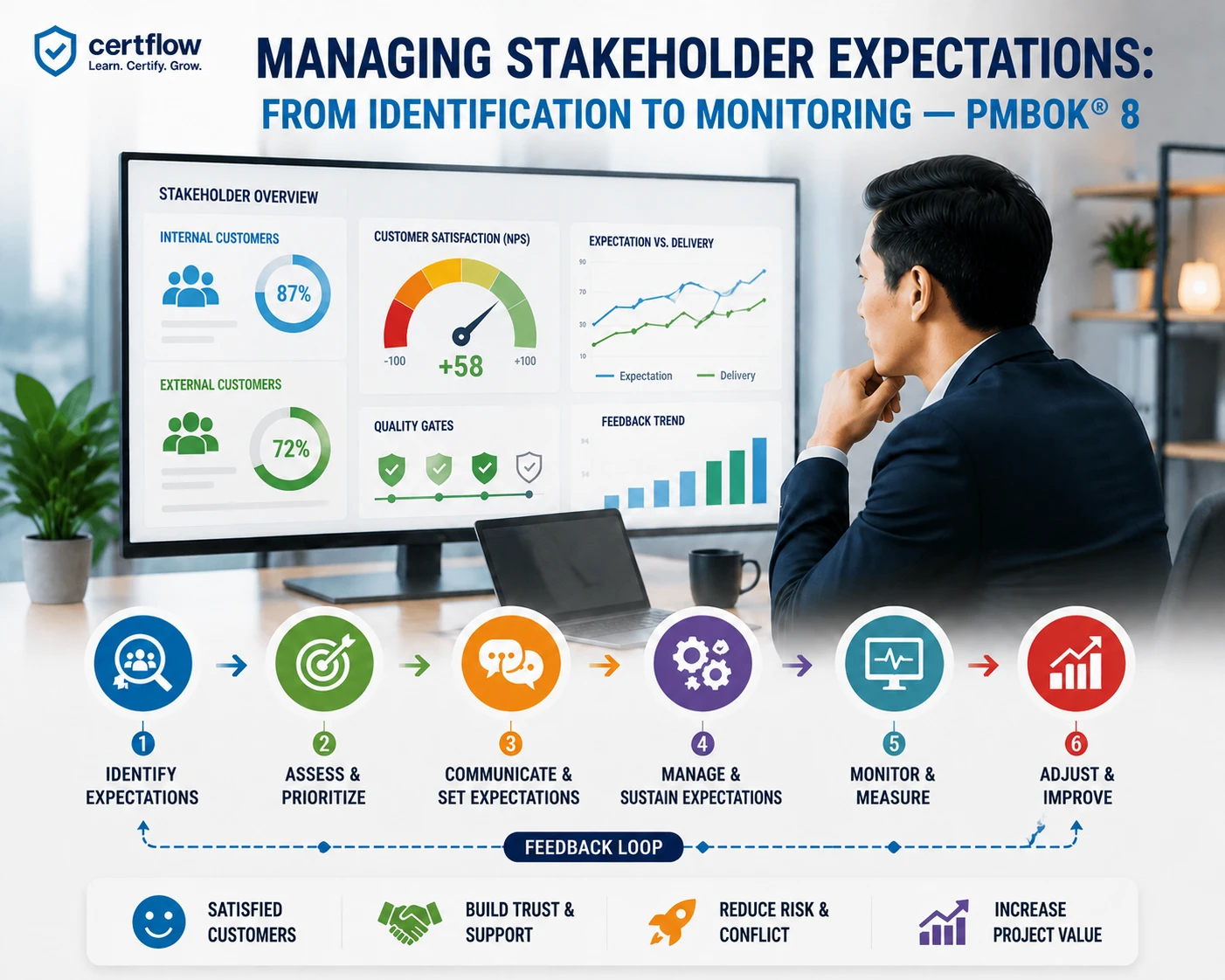
The ECO identifies 3 enablers that form an ongoing cycle:
Step | Enabler | Core question | Frequency |
|---|---|---|---|
1 | Identify expectations | What do customers truly expect — both stated and unstated? | Project start + when changes occur |
2 | Align and maintain outcomes | Do deliverables match expectations? Where are the gaps? | Continuously through checkpoints |
3 | Monitor and respond | Are customers satisfied? What adjustments are needed? | Continuously + when signals appear |
After Step 3, return to Step 1: because expectations change over time — markets shift, new stakeholders emerge, lessons learned from previous increments. Managing expectations is a marathon, not a sprint.
4. Step 1: Identify Expectations — Stated vs. Unstated
This is the most critical step — because if you identify incorrectly, everything that follows goes off course.
Stated Expectations | Unstated Expectations | |
|---|---|---|
Source | Requirements docs, contracts, acceptance criteria, DoD, user stories, SLAs | Implicit assumptions, past experiences, cultural norms, industry standards |
Example | "System must handle 10,000 transactions/sec" | "I assume training will be included" or "New system should be at least as fast as the old one" |
Discovered via | Document review, requirements workshops | Interviews, observation, focus groups, prototyping |
Risk | Formal rejection if specs not met | Informal resistance, low adoption, trust erosion |
Elicitation techniques for each customer group
- Internal customers: Process mapping (understand current workflows to identify expectations), shadowing/observation (watch how they actually work), internal workshops, retrospectives, and stakeholder interviews — especially asking: "If the new system worked perfectly, how would your workday be different?"
- External customers: Customer talks and tests — PMBOK 8 describes this as a new tool: "Collaborative processes involving direct interaction and feedback from customers during development and testing. These practices ensure that the final product aligns with customer expectations by engaging customers early and throughout the project life cycle." Additionally: surveys, UAT, beta programs, prototype demos, market research.
- The 3 most dangerous unstated expectations:
(1) "I assume I'll be consulted before decisions are made" — the need for power.
(2) "I assume the project won't affect my team" — territorial protection.
(3) "I expect to receive credit for the success" — recognition. Nobody says it aloud, but the impact is enormous.
5. Step 2: Maintain Alignment Between Outcomes and Expectations
"Maintain" is the key word — alignment is not an event but a continuous process requiring multiple checking mechanisms.
Alignment mechanisms in Predictive
- Phase gates / Quality gates: PMBOK 8: "The project's performance and progress are compared to business documents that specify expectations. A decision (go/no-go) is made." This is a formal checkpoint where the customer confirms: "yes, this is what we need."
- Validate Scope: PMBOK 8 describes this as the process of formalizing acceptance — tools include Customer talks and tests, Inspection, Decision-making, Process analysis, Review meetings. Primary output: Accepted Deliverables.
- Change Control: When expectations change, formal change requests ensure alignment is assessed before implementation — impact analysis on scope, schedule, cost, and risk.
Alignment mechanisms in Adaptive
- Sprint Reviews / Demos: Customers see working increments and provide direct feedback. PMBOK 8: "A sprint review or iteration review is held at the end of a sprint to demonstrate the work accomplished."
- Definition of Done (DoD): PMBOK 8: "Checklist of all criteria required so that a deliverable can be considered ready for customer use." DoD = an objective measure of "good enough?"
- Continuous Delivery: PMBOK 8: "Incrementally delivering value to production on an ongoing basis... fostering responsiveness to customer feedback and evolving market trends."
- Backlog Refinement: Continuous alignment through reprioritization based on feedback.
When outcomes drift from expectations
The PM must detect this early and act in 5 steps:
1. Confirm: have expectations changed? (the customer may have changed their mind without saying so)
2. Assess the root cause: insufficient resources? wrong approach? scope creep? communication gap?
3. Present options with clear trade-offs
4. Reach consensus on corrective actions
5. Update plans and communicate broadly
🌟 PMBOK® 8, Section 3.4: "If misalignment persists or the project is unlikely to deliver the intended value, it may be best to terminate the effort." — Stopping a project when the value proposition no longer holds is a responsible decision, not a failure.
6. Step 3: Monitor Satisfaction and Respond Promptly
PMBOK 8: "Assessing the effectiveness of stakeholder engagement efforts, identifying necessary adjustments, and refining strategies."
Two types of indicators the PM must track
Leading Indicators (Early signals) | Lagging Indicators (Measurable results) | |
|---|---|---|
Meaning | Warning of AN UPCOMING PROBLEM | Confirmation that A PROBLEM HAS OCCURRED |
Examples | Stakeholder attends fewer meetings, slow email responses, fewer questions in reviews, negative body language | Declining NPS, formal complaints, rejected deliverables, contract penalties triggered |
Action | Proactively investigate — don't wait | React and remediate — prevention is too late |
Monitoring metrics from PMBOK 8
- Net Promoter Score (NPS®): PMBOK 8 (Table 2-9) lists NPS as the outcome check metric for the Stakeholders Domain. "On a scale of 0-10, how likely are you to recommend this product?" Promoters (9-10) - Detractors (0-6) = NPS.
- Change request volume: PMBOK 8: "Review the number of change requests to requirements and collect feedback on increments." A high volume of consecutive change requests signals expectations misalignment.
- Acceptance metrics: First-pass acceptance rate (how many deliverables are accepted on the first try?), complaints volume, rework percentage.
🌟 PMBOK® 8, Section 2.1.6.5 warns: "Measuring only a project team's output of deliverables can encourage the project team to focus on creating a large volume of deliverables rather than focusing on deliverables that would provide higher customer satisfaction." — Measure the right things (satisfaction), not just many things (velocity).
"Respond as needed" — Escalation Framework
Level | Situation | Action |
|---|---|---|
1 — Minor gap | Small deviation, easily correctable | PM directly adjusts communication, process, or deliverable details |
2 — Significant gap | Multiple complaints, pattern of misalignment | Alignment workshop, root cause analysis, corrective action plan |
3 — Critical | Fundamental expectation mismatch, project value questioned | Escalate to sponsor/steering committee, consider major change or termination |
7. Comparison: Predictive vs. Adaptive
Aspect | Predictive | Adaptive |
|---|---|---|
Expectations captured | Requirements doc, scope statement, acceptance criteria | Product backlog, user stories, DoD, sprint goals |
Alignment checkpoints | Phase gates, milestone reviews, formal inspections | Sprint reviews, demos, daily standups, retrospectives |
Change management | Formal CCB process, impact analysis, baseline updates | Backlog reprioritization, continuous feedback integration |
Feedback frequency | Periodic (phase-end, milestone) | Continuous (every sprint, often daily) |
Customer involvement | Key points: requirements, reviews, UAT, acceptance | Continuous: planning, refinement, reviews, demos |
Risk to expectations | "Big reveal" at end may disappoint — expectations evolved since sign-off | "Feature fatigue" if too many changes — customer loses sight of vision |
PMBOK 8 highlight — Customer talks and tests: "These practices are integral to ensuring that the final product aligns with customer expectations. By engaging customers early and throughout the project life cycle, organizations can enhance transparency, build trust, and improve the overall quality of deliverables." — Applies to BOTH predictive and adaptive.
8. PMP Exam Tips for Manage Expectations
📍Tip 1 — Leading indicators: When a question describes a stakeholder who "stops attending," "delays approvals," or "becomes quiet" — the correct answer is to PROACTIVELY investigate, NOT wait for a formal complaint. The PM must recognize early signals and act before it's too late.
📍Tip 2 — Expectations ≠ Requirements: When a deliverable meets all specs but the customer is unsatisfied — the issue is EXPECTATIONS were not managed, NOT that requirements were wrong. The correct answer usually involves "investigate what the customer actually expected" or "identify unstated expectations."
📍Tip 3 — Outcome > Output metrics: When a question asks "what should the PM measure to track customer satisfaction?" — the correct answer is always outcome metrics (NPS, adoption rate, satisfaction score), NOT output metrics (velocity, deliverables count, features completed). PMBOK 8 explicitly warns about the output-only measurement trap.
📍Tip 4 — Both internal AND external: When a question only mentions external customers but an answer option relates to internal stakeholders — remember Task 6 covers BOTH. Internal customers (teams who will use deliverables) also need their expectations managed.
9. Ten Scenario-Based Practice Questions
Question 1
The internal finance team expects the new ERP to auto-generate compliance reports, but this feature was never in the approved requirements. They assumed it would be included because "every ERP system does that." The project is 70% complete.
What should you do FIRST?
A. Add the compliance report feature since it's a reasonable expectation.
B. Explain the feature isn't in scope and they need to submit a change request.
C. Acknowledge the gap, investigate the root cause of the miscommunication, assess impact, and present options with trade-offs to the finance team and sponsor.
D. Escalate to the sponsor since this could affect budget and timeline.
Answer: C — This is a classic unstated expectation. PMBOK 8: quality means meeting expectations AND requirements. The PM should acknowledge (not dismiss), investigate (root cause), then present options. Simply adding (A) bypasses governance. Demanding a formal CR (B) is procedurally correct but misses the human element.
Question 2
During the last three sprint reviews, the external client has accepted the increment without comments. However, the client's product manager has stopped attending, sending a junior analyst instead. The analyst approves everything without questions.
What does this signal, and what should you do?
A. The client is satisfied — continue as normal since deliverables are accepted.
B. Recognize this as a leading indicator of disengagement. Reach out to the product manager to understand why they stopped attending and whether expectations are being met.
C. Send a formal email noting the designated PM should attend per the agreement.
D. Make sprint reviews more engaging with better demos.
Answer: B — Decreasing attendance is a classic LEADING INDICATOR. Acceptance without engagement is a red flag — the client may have mentally checked out or is building frustration quietly. PMBOK 8: Monitor Stakeholder Engagement involves "assessing effectiveness and identifying adjustments." Better demos (D) assume the problem is presentation, which may not be the root cause.
Question 3
After launching a software project, customer support tickets increase 40%. End users complain about confusing navigation and missing help documentation. The product owner was happy with velocity and all sprint goals were met.
What does this reveal?
A. The QA process failed — usability issues should have been caught.
B. End user expectations were not adequately identified and monitored. The team measured OUTPUT metrics (velocity) but not OUTCOME metrics (satisfaction, usability).
C. The product owner should have included usability requirements — this is their responsibility.
D. Customer support should create FAQ documentation.
Answer: B — PMBOK 8 warns: "Measuring only output of deliverables can encourage focus on large volume rather than higher customer satisfaction." End users ARE customers whose expectations were overlooked. The PM must ensure outcome metrics are tracked, not just velocity.
Question 4
Your project is developing a mobile app for a retail company. Marketing expects social media sharing features, IT expects enterprise-grade security, and end users expect a simple, fast experience. Enterprise security makes the app slower; social features increase the attack surface.
How should you manage these competing expectations?
A. Prioritize security since it has the highest risk impact.
B. Build all features — let the technical team optimize performance.
C. Facilitate a cross-functional workshop to make trade-offs visible, use data to inform the discussion, and collaboratively define a balanced solution.
D. Ask the sponsor to decide which group's expectations take priority.
Answer: C — When expectations conflict, the PM facilitates transparent trade-off discussions. PMBOK 8 emphasizes data-driven decision-making. Choosing sides unilaterally (A), promising everything (B), or delegating to sponsor (D) all fail the alignment test.
Question 5
Three months into an 18-month project, customer satisfaction survey scores the external client at 6/10, citing "lack of visibility into progress" and "unclear timelines." Your project is actually on track with all milestones met.
What is the MOST likely root cause?
A. The survey results are inaccurate since the project is objectively on track.
B. The communication plan isn't effectively conveying progress to the client. Investigate how and what information the client receives, then redesign to match their need for visibility.
C. The client has unrealistic expectations about reporting — set boundaries.
D. Assign a dedicated liaison to handle client communications.
Answer: B — Being on track doesn't mean the client FEELS informed. PMBOK 8: communication "should be tailored based on the needs and best fit." The gap is between reality and perception — a communication problem, not a performance problem. Dismissing the survey (A) or blaming the client (C) damages trust.
Question 6
After a pilot deployment, internal business users report the system "technically works" but doesn't fit their actual workflow. They had approved all requirements and prototypes during development.
What went wrong?
A. Users approved requirements, so the project delivered what was agreed. Offer training to adapt.
B. Approved requirements don't guarantee real-world satisfaction. Conduct workflow observation sessions to identify friction points, then make targeted adjustments.
C. This is a change management issue — refer users to the change management team.
D. Request additional budget for a full redesign.
Answer: B — Requirements approval ≠ expectation satisfaction. PMBOK 8: "Customer talks and tests ensure the final product aligns with customer expectations by engaging customers early and throughout." Prototypes in a lab ≠ production workflow. Observation reveals what approvals miss. Telling users to adapt (A) ignores their legitimate experience.
Question 7
Your SLA requires system response under 3 seconds. Six months after launch, the client reports regular exceedances during peak hours. Your team confirms the issue. The client threatens contract penalties.
What is the BEST response?
A. Dispute the measurements and request detailed logs.
B. Acknowledge transparently, assemble a technical team for root cause, provide a remediation plan with timeline, and implement monitoring to prevent recurrence.
C. Remind the client the system met acceptance criteria during UAT — this is operational, not project.
D. Offer to renegotiate the SLA to a 5-second threshold.
Answer: B — PMBOK 8 Be an Accountable Leader: "integrity — willingness to share bad news early." Disputing (A) damages trust. Deflecting to operations (C) abandons accountability. Renegotiating (D) may come later but fixing the root cause first shows good faith.
Question 8
The sponsor tells you privately: "The CEO is unhappy with the project but hasn't said anything publicly yet. She thinks we're spending too much for too little value." Your project is within approved budget and scope.
How should you respond?
A. Prepare a cost-benefit analysis for the next steering committee meeting.
B. Proactively request a meeting with the CEO (through the sponsor) to understand her specific concerns, present current value metrics, and explore whether the value proposition needs recalibration.
C. Continue as planned — perception will improve when she sees final deliverables.
D. Reduce budget by cutting non-essential features to demonstrate cost efficiency.
Answer: B — The CEO has UNSTATED dissatisfaction — a critical leading indicator. Waiting (C) risks termination. Cutting budget reactively (D) may cut value. A presentation (A) is good but assumes the problem is information — the CEO might have different value expectations. Understand the concern FIRST, then present solutions.
Question 9
Your quarterly release product has seen NPS drop from 45 to 28 after Release 2. Analysis shows features matched the roadmap exactly. Customer support data shows a spike in performance degradation complaints.
What is the BEST course of action?
A. Prioritize performance fixes in Release 3.
B. Investigate the root cause immediately, communicate transparently with affected customers, implement fixes as priority (possibly a hotfix before Release 3), and establish monitoring to prevent recurrence.
C. Wait for Release 3 data before making changes.
D. The issue is infrastructure, not the project — escalate to operations.
Answer: B — NPS dropping from 45 to 28 is SIGNIFICANT, requiring IMMEDIATE response. PMBOK 8: "address issues as they occur." Feature roadmap compliance is output; NPS is outcome — and outcome says customers are unhappy. The PM must own the customer experience. Waiting (C) or deflecting (D) lets the problem worsen.
Question 10
A government project to digitize citizen services projected $10M in annual savings. After Year 1, actual savings are $2M. However, citizen satisfaction improved 40% and 95% of transactions are now online vs. 30% before.
How should business value be evaluated?
A. The project failed — actual savings ($2M) are only 20% of projected ($10M).
B. Evaluate value holistically: while financial savings are below target, the project delivered significant intangible value (satisfaction +40%, digital adoption 30%→95%). Present a comprehensive assessment including both quantitative and qualitative metrics.
C. The projections were flawed — revise the business case retroactively.
D. The project over-promised financially — escalate about the gap.
Answer: B — PMBOK 8: "Value can be described using measurable metrics OR qualitative observations such as testimonials and societal benefits." The $10M gap is real and needs addressing, but the 40% satisfaction improvement and 65% adoption increase represent enormous public value. A comprehensive assessment acknowledges both the shortfall AND unexpected benefits.
Answer Key
Question 1: C
10. Conclusion
Managing Stakeholder Expectations moves beyond "engagement" and "alignment" into continuous execution — sustaining the satisfaction of both internal and external customers throughout the project life cycle. Three key takeaways:
- Expectations ≠ Requirements — manage both — Requirements are formal, measurable, and signed off. Expectations include everything stakeholders tacitly assume. A deliverable that meets 100% of specs but fails expectations means an unsatisfied customer — and an unsuccessful project.
- Outcome metrics > Output metrics — Velocity, features completed, and milestones met are necessary but not sufficient. NPS, adoption rate, satisfaction scores, and support ticket volume are what tell you whether customers are genuinely satisfied. PMBOK 8 explicitly warns: measuring output while ignoring outcome is a dangerous trap.
- Leading indicators > Lagging indicators — When NPS drops, complaints rise, or deliverables are rejected — those are lagging indicators: the problem has already occurred. Great PMs recognize leading indicators earlier: declining attendance, slow responses, negative body language, disappearing questions. Proactive > Reactive.
PMBOK® 8, Section 3.5: "Project quality entails satisfying relevant stakeholders' expectations and fulfilling project and product requirements. Quality focuses on meeting acceptance criteria for deliverables AND ensuring project processes are appropriate and as effective as possible."
Now that you understand stakeholder expectations management — it's time to practice with real exam questions.
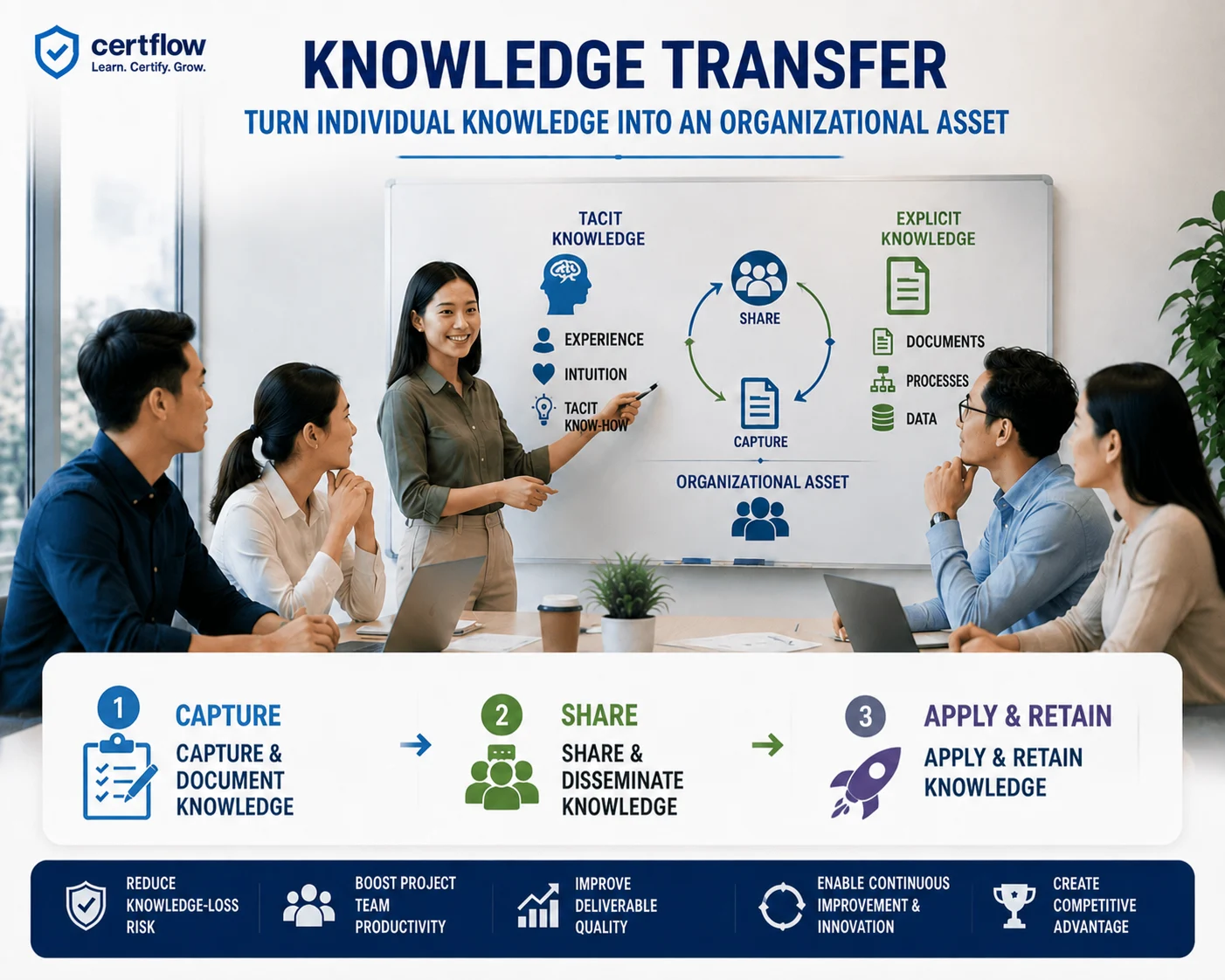
Next article: Knowledge Transfer: Turning Individual Knowledge into Organizational Assets
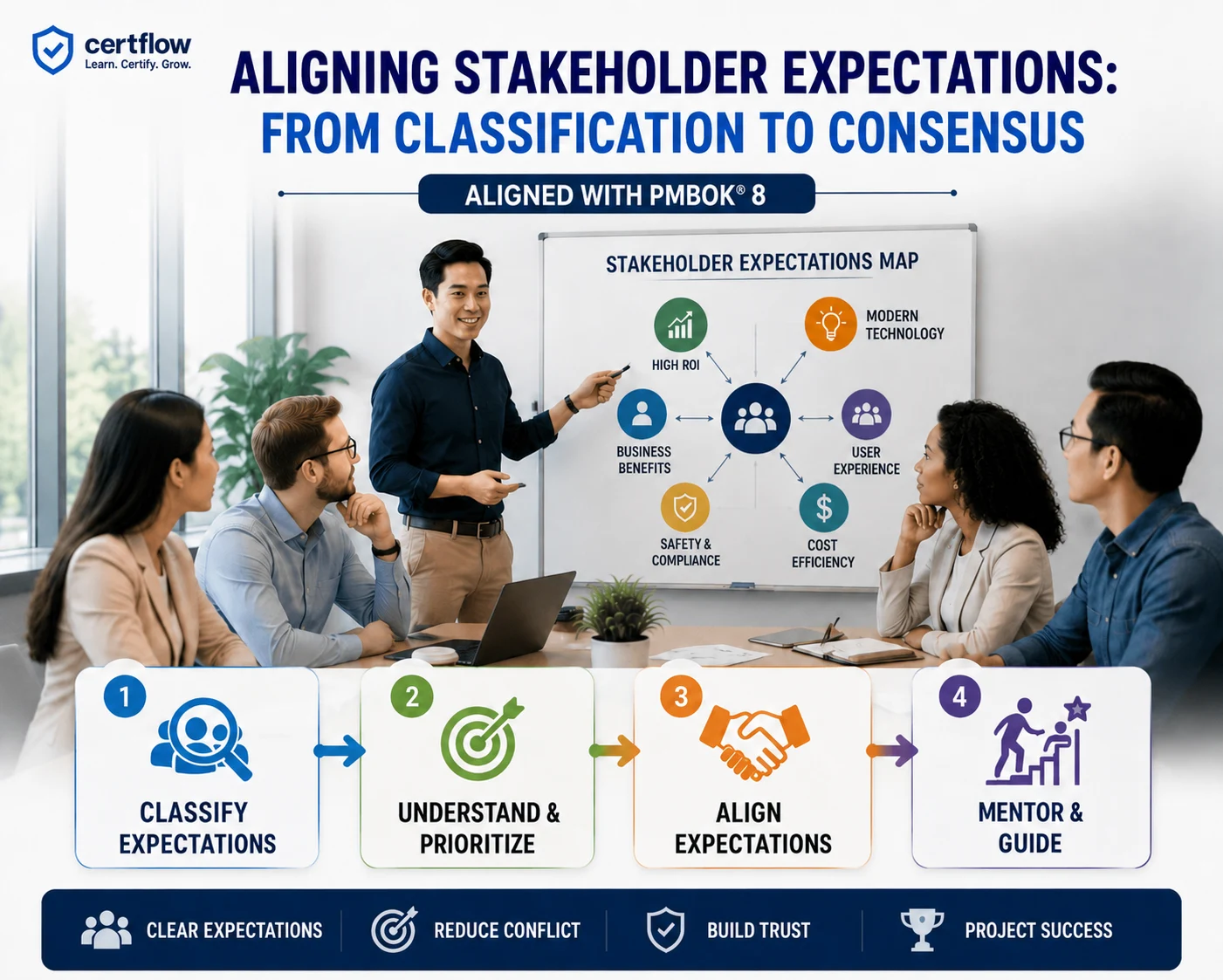
Aligning stakeholder expectations from classification to consensus
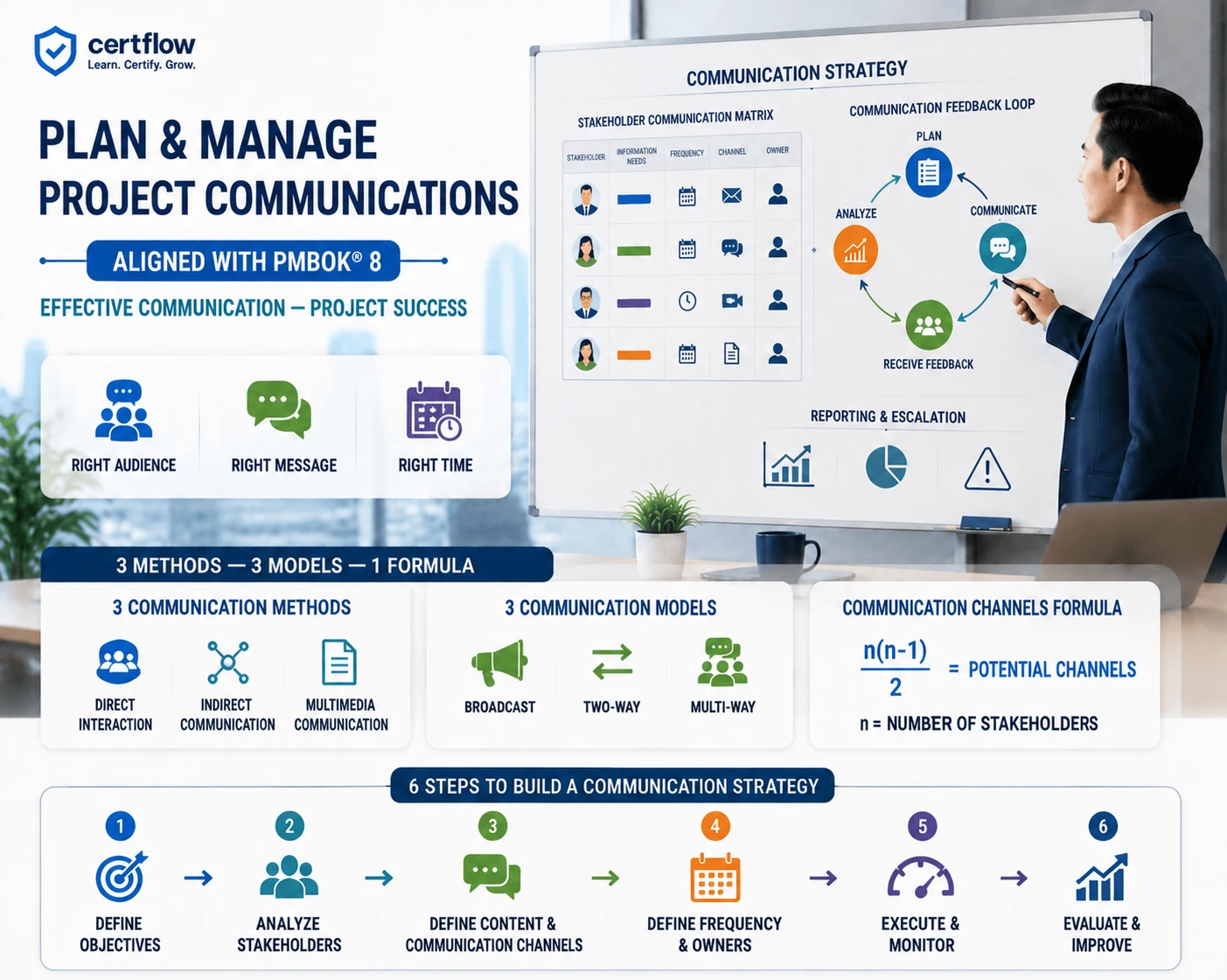
Project communication management: 90% of a PM's time is communication
Building shared vision and project leadership according to PMBOK 8
Try Free PMP Practice Questions →
Official References: