The 3 communication processes in PMBOK 8 — Plan, Manage, Monitor — and how to apply them in real IT projects to prevent information-flow failures.
An ERP implementation runs for 18 months with a clear scope, adequate budget, and an experienced team — yet fails because end users don't know which features are complete, testers never received updated requirements, and the sponsor only learned about the delay after the deadline passed. The cause wasn't technical. The cause was the absence of a structured communication management system.
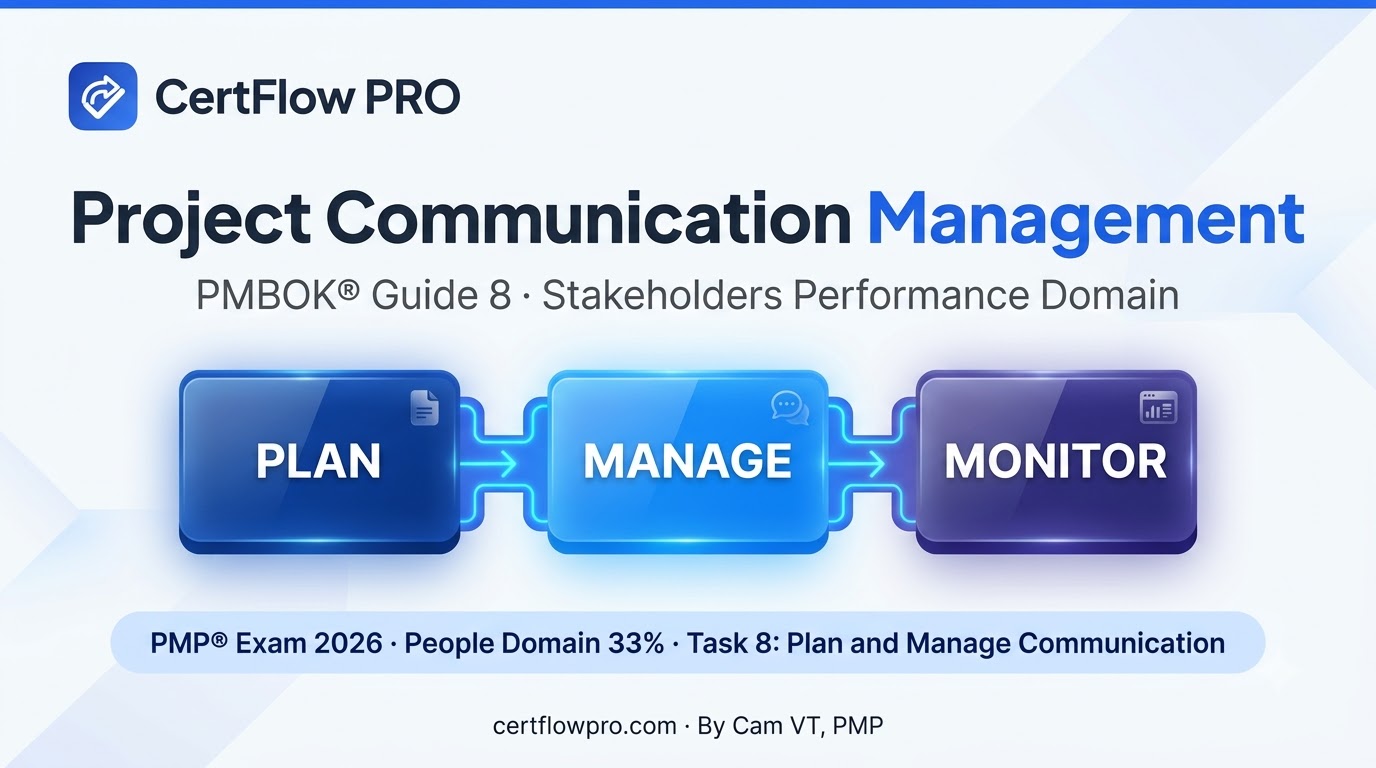
Project communication management is the set of processes for planning, executing, and monitoring information flow between stakeholders — inside and outside the team — so the right people receive the right information at the right time. In the PMBOK® Guide Eighth Edition (2025), communication management is organized into three processes within the Stakeholders Performance Domain (Section 2.5).
This article explains all three processes, how to apply them in real IT projects, and how communication differs across Predictive, Agile, and Hybrid delivery models — giving you both the PMI® conceptual foundation and actionable practices you can use immediately.
Key takeaways:
PMBOK 8 defines three communication processes: Plan Communications Management, Manage Communications, and Monitor Communications — all within the Stakeholders Performance Domain (Section 2.5).
Planning communication before the project starts prevents the "who tells whom, when, and how" question from becoming an ad-hoc decision.
Manage Communications is execution: ensuring information is created, distributed, stored, and handled correctly. Monitor Communications is the check: verifying that the plan still works.
Agile doesn't skip communication management — it replaces formal documents with structured face-to-face events (daily standup, sprint review, retrospective).
On the PMP® 2026 exam, the People Domain accounts for 33% of questions, and Task 8 is "Plan and manage communication" — understanding these processes is essential for scenario questions.
Why IT Projects Fail Because of Communication
Most experienced PMs can recall at least one project that failed for non-technical reasons. Developers built exactly what was described in the spec — but not what the client actually needed, because a requirements change was never communicated. The sponsor approved additional budget too late — because the status report showed "On Track" until the week before the deadline. QA found a critical bug in UAT — because the updated spec was never shared with the testing team.
These situations aren't coincidental. They result from the absence of structured communication management — not a lack of "talking." PMI identifies communication management as a set of structured processes, not a personal skill.
PMI's Pulse of the Profession research consistently finds that organizations with effective communication practices complete projects within budget at significantly higher rates than those without. Good communication is necessary, but a good communication system is what makes it reliable.
The 3 Communication Processes in PMBOK 8
PMBOK® Guide Eighth Edition (2025) organizes the Stakeholders Performance Domain into 7 processes that span the project lifecycle. Three of them directly manage communication:
Plan Communications Management
Definition (PMBOK 8, §2.5.2.3): "The process of planning how to communicate with stakeholders, both inside and outside the team." This process determines who needs what information, when, in what format and through which channel, and who is responsible for sending it.
The key output is the Communications Management Plan — a component of the Project Management Plan. This doesn't have to be a lengthy document; for a small project, a one-page table identifying each stakeholder, their information needs, frequency, and channel is sufficient.
Key tools and techniques: Communication requirements analysis, Communication technology selection (email, Slack, Confluence?), Communication models (sender-receiver model), Communication methods (push/pull/interactive), and Communication styles assessment (how each stakeholder prefers to receive information).
Manage Communications
Definition (PMBOK 8, §2.5.2.5): "The process of ensuring timely and appropriate collection, creation, distribution, storage, retrieval, management, monitoring, and ultimate disposition of project information." Key benefit: "enables an efficient and effective information flow between the project team and stakeholders."
This is the execution process: writing reports, running meetings, sending updates, filing documents in the right place, handling feedback. Manage Communications runs throughout the Executing process group and covers all stakeholders — from sponsors and clients to team members and vendors.
Key tools: Project management information system (PMIS — Jira, Confluence, SharePoint), Project reporting, and Interpersonal and team skills including Active listening, Meeting management, Networking, and Political awareness.
Monitor Communications
Definition (PMBOK 8, §2.5.2.7): "The process of ensuring the information needs of the project and its stakeholders are met." Key benefit: "optimal information flow as defined in the communications management plan and the stakeholder engagement plan."
If Manage Communications is execution, Monitor Communications is the quality check on that execution. This process runs throughout the project and answers: Is information reaching the right people? Are stakeholders responding? Does the Communications Management Plan still fit the project's current reality, or does it need updating?
Outputs include Work performance information and Change Requests — when the communication plan needs updating, that update is a formal change through the Integrated Change Control process.
Planning Communication: Don't Skip This Step
Plan Communications Management determines who needs what information, when, in what format and through which channel, and who is responsible for sending it. This process runs early in the project and produces the Communications Management Plan — a component of the Project Management Plan. What many PMs overlook: planning early also means conducting a communication requirements analysis — examining each stakeholder group to determine what information they need, at what sensitivity level (internal vs. external, sensitive vs. public), and at what frequency. Too much information is also harmful: a developer receiving 20 irrelevant emails daily starts ignoring everything.
A detailed guide on building the Communications Management Plan — including a template and step-by-step requirements analysis — is in the communication management planning article (Task 8 ECO). The sections that follow focus on the two processes most often skipped: Manage and Monitor Communications.
Executing Communication: Tools and Methods
Manage Communications is not "send emails." It covers the full information lifecycle: collection → creation → distribution → storage → retrieval → management → monitoring → disposition.
In a real IT project, this includes:
Project reporting: Progress reports, risk reports, budget reports — delivered on the schedule committed to in the Communications Management Plan.
Project management information system (PMIS): Jira for tasks and bugs, Confluence for documentation, SharePoint or Google Drive for file storage, Slack/Teams for quick messaging.
Meetings: Daily standups, sprint planning, sprint reviews, stakeholder status meetings — each with a clear agenda and recorded action items.
Nonverbal communication: In video calls, body language and speaking pace convey more than words. Active listening — not just waiting for your turn to speak — is an explicitly listed technique under Manage Communications.
PMBOK 8 (§2.5.3) explicitly addresses AI and large language models as a tailoring consideration: PMs should evaluate each project to determine when AI can support communication (meeting summaries, document translation, automated reporting) and must apply appropriate security and ethics measures, including engaging the cybersecurity team where compliance requirements apply.
Monitoring Communication: When to Recalibrate
Monitor Communications answers: "Is our communication plan still working?" The plan was created at project start based on initial stakeholder information. As the project progresses, stakeholders change, requirements change — communication needs change too.
Signs that the Communications Management Plan needs review:
Stakeholders complain they lack information — or conversely, that they're overwhelmed with irrelevant updates.
Important decisions are delayed because decision-makers didn't receive information in time.
The issue log shows a spike in "miscommunication" or "unclear requirements" issues.
New stakeholders have been added (compliance team, security team) but weren't included in the original communication plan.
PMBOK 8 (Table 2-9) defines the check result for communications management as: "Review the communications management plan periodically and tailor it appropriately based on the needs of stakeholders." "Periodically" means at least each phase gate or whenever there is a significant stakeholder change — not at project end.
Predictive vs. Agile vs. Hybrid: How Communication Differs
Aspect | Predictive (Waterfall) | Agile (Scrum/Kanban) | Hybrid |
|---|---|---|---|
Plan Communications Management | Created once at project start; detailed and formal | Lightweight (Team Agreement in a wiki); continuously updated | Formal plan for senior stakeholders; lighter for delivery team |
Progress reporting | Periodic status reports (weekly/monthly), PDF or email | Burn-down chart, Jira board, sprint review — real-time visibility | Automated dashboard + sprint review for sponsor |
Primary communication mode | Push: reports and emails sent to stakeholders | Interactive: daily standup, retrospective, planning sessions in person or video | Mixed: interactive within the team, push for external stakeholders |
Stakeholder meeting frequency | Milestone reviews (less frequent) | Sprint review every 1–2 weeks; direct demo to Product Owner | Sprint reviews internally + monthly steering committee |
Monitor Communications | Via formal change control | Retrospective — team self-evaluates and adjusts communication norms each sprint | Retrospective + formal review at phase gate |
Documentation | Comprehensive; documents as proof of completion | Minimal ("just enough"); working software over comprehensive documentation | Formal documents for deliverables; lighter for internal processes |
PMBOK 8 (§2.5.3) explicitly notes that the software industry uses ceremonies such as product reviews, planning sessions, and retrospectives to update and engage stakeholders — Agile's structured face-to-face events replace formal written communication without eliminating communication management.
Common Communication Management Mistakes
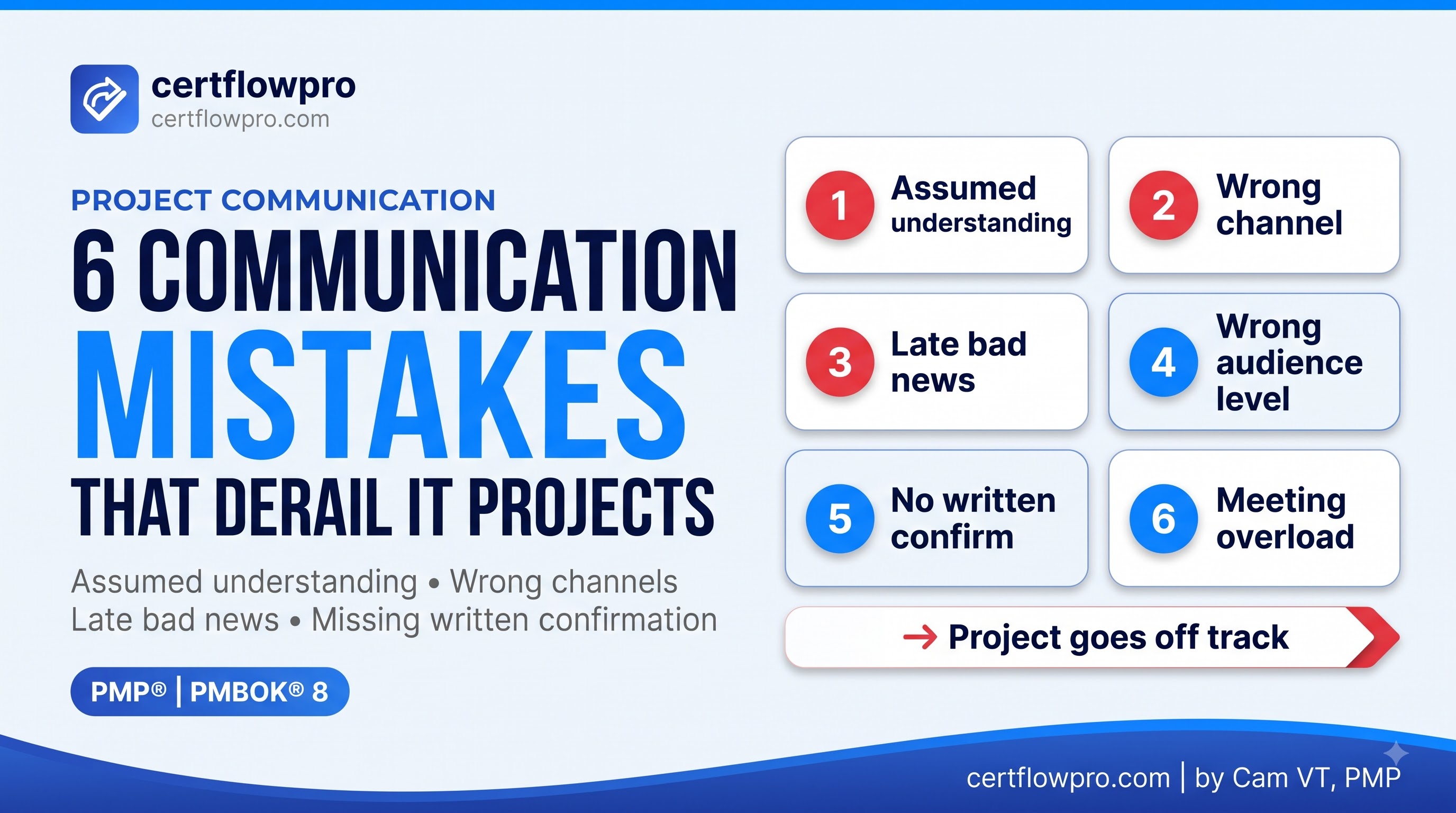
Mistake | How it appears in practice | Corrective approach |
|---|---|---|
Skipping communication requirements analysis | Sending the same report to all stakeholders — developers receive financial summaries; the CFO receives technical logs | Build a communication matrix: stakeholder × information needed × format × frequency |
Confusing Manage and Monitor Communications | PM executes communication but never checks effectiveness; outdated plan maintained despite stakeholder changes | Schedule Communications Management Plan review at each phase gate or monthly |
Information overload | Every update CC's the whole team; inbox floods; important emails get missed | Classify information: who needs to know vs who wants to know; use pull communication (Confluence, wiki) for non-urgent information |
Not recording decisions and action items | After the meeting, everyone understands the outcome differently; two weeks later no one remembers who was responsible for what | Minimum meeting minutes: decisions made, action items (owner + deadline) |
Ignoring cultural and political context | PM emails the CTO directly in a hierarchical organization — creates unnecessary conflict | Communication styles assessment during Plan Communications Management; ask the Sponsor about organizational culture before the project begins |
PMP Exam Tips: PMI's Mindset on Communication
PMP® exam questions on communication typically test several consistent PMI thinking patterns:
1. Proactive over reactive. When a question describes stakeholders complaining about missing information, PMI expects the PM to proactively review and update the Communications Management Plan — not just send an apology email. Monitor Communications → Change Request when the plan needs updating.
2. Formal over informal. Even if you speak with the sponsor daily, in exam scenarios, significant changes to communication must go through Integrated Change Control. Informal communication doesn't replace formal process.
3. Tailored to the stakeholder. There is no one-size-fits-all approach. Senior executives need executive summaries; technical leads need technical detail. Questions asking PMs to "adapt communication style" typically have correct answers containing "tailor" or "adapt."
4. Monitor means act. Monitor Communications is not passive observation. If information needs are not being met, the next step is to consider a Change Request to update the Communications Management Plan — not just add it to lessons learned.
5. Manage vs. Monitor. Manage Communications = execution (creating and distributing information). Monitor Communications = effectiveness check (is information reaching the right people; does the plan still fit?). Questions frequently exploit this distinction.
3 Scenario Questions
Question 1
A project manager is leading a software implementation project using a predictive approach. At the beginning of the project, a detailed communications management plan was created covering all identified stakeholders. Six months into the project, two new regulatory compliance stakeholders have been added, and the project sponsor has requested more frequent status updates. What should the project manager do first?
A. Send the new stakeholders the existing project status report and add the sponsor to the weekly email distribution list.
B. Conduct a communication requirements analysis for the new stakeholders and document required changes to the communications management plan.
C. Hold a meeting with all stakeholders to explain the current communication approach and ask for their feedback.
D. Update the stakeholder register with the new stakeholders and continue with the existing communication plan.
Question 2
During a sprint review, the product owner mentions that the development team's daily updates on Slack are too technical and that they still don't know if the project is on track overall. The scrum master asks the project manager how to handle this situation. What is the best response?
A. Ask the development team to simplify their Slack messages so the product owner can understand them.
B. Add the product owner to the technical Slack channel so they can ask questions directly.
C. Review the communication approach to identify what information the product owner needs and in what format, then adjust accordingly.
D. Create a separate daily email summary for the product owner translated from the technical updates.
Question 3
A project manager working on a hybrid project has been using a formal monthly steering committee report for senior stakeholders and an Agile sprint board for the development team. During a retrospective, the team raises that the steering committee frequently makes decisions without understanding the technical constraints revealed during sprints. What is the most effective corrective action?
A. Invite steering committee members to attend sprint reviews so they can observe technical discussions directly.
B. Add a "technical risks and constraints" section to the monthly steering committee report.
C. Review the communications management plan to identify the gap between technical information and stakeholder needs, and implement changes through the change control process.
D. Ask the development team to document all technical constraints in a wiki that the steering committee can access.
Answers and Explanations
Question 1: Answer B
When there is a significant stakeholder change (two new stakeholders added) and communication needs have shifted (sponsor wants more frequent updates), the first step is to analyze the new communication requirements and formally update the Communications Management Plan — this is Monitor Communications leading to a formal plan update. Answer A skips the requirements analysis step. Answer C (hold a meeting) is useful but not the "first" step — analyze first, then meet. Answer D only updates the stakeholder register without updating the communication plan itself.
Question 2: Answer C
The issue is not that Slack messages are too technical — the issue is that the Product Owner is not receiving the type of information they need (overall project status, not technical details). PMI expects the PM to analyze stakeholder information needs and adjust the communication approach accordingly — this is the core of Plan Communications Management and Monitor Communications. Answers A and D address symptoms rather than root cause. Answer B adds the Product Owner to a channel that provides information in the wrong format for their needs.
Question 3: Answer C
This is a systemic problem: the Communications Management Plan does not ensure technical constraints are communicated to the decision-makers who need them. The PMI-correct solution is: review the plan, identify the gap, implement changes through change control — a formal process. Answers A (invite to sprint reviews) and B (add report section) are specific actions that might be implemented after a plan review, but doing them without formal review is an ad-hoc approach rather than PMI process thinking. Answer D (wiki) is pull communication — appropriate for non-urgent information, but it doesn't ensure the steering committee will read it.
Summary
Project communication management in PMBOK 8 is not a soft skill — it is a structured system of processes: planning (Plan Communications Management), execution (Manage Communications), and monitoring (Monitor Communications). These three processes run in parallel throughout the project lifecycle, not sequentially.
The difference between successful and failed projects often lies in monitoring: recognizing early that the communication plan no longer fits the current project context and proactively updating it — rather than waiting for stakeholders to complain.
To go deeper on building a Communications Management Plan following ECO Task 8, see the communication management planning guide (Task 8 ECO). For the foundational communication channel formula and push/pull/interactive models, see the communication channels and models article. And to test your understanding with real exam-style questions, try 10 free PMP practice questions.
For primary source material: PMP® Examination Content Outline – July 2026 (pmi.org) and the PMBOK® Guide Eighth Edition at pmi.org.
Frequently Asked Questions
When should a project manager update the Communications Management Plan?
The communications management plan needs review when: (1) new stakeholders are added to the project; (2) stakeholders complain about missing information or, conversely, being overwhelmed with irrelevant updates; (3) important decisions are delayed because decision-makers didn't receive information in time; (4) the project moves into a new phase with significantly changed context. Updating the Communications Management Plan is a formal change request through Integrated Change Control — this is what distinguishes Monitor Communications from an ad-hoc adjustment.
What is the difference between Manage Communications and Monitor Communications?
Manage Communications is execution: creating, distributing, storing, and processing project information as planned. Monitor Communications is the effectiveness check: ensuring information is being received by the right people and that the communications management plan still fits the project's current needs. Monitor Communications leads to a Change Request when the plan requires updating.
How does Agile handle communication management differently?
Agile replaces formal written communication with structured face-to-face events: daily standups for daily synchronization, sprint reviews for stakeholder demos and feedback, retrospectives for team process improvement. Burn-down charts and Jira boards provide real-time visibility instead of periodic status reports. PMBOK 8 (§2.5.3) explicitly recognizes these Agile ceremonies as a standard tailoring approach in the software industry.
What is the key benefit of the Monitor Communications process?
PMBOK 8 defines the key benefit of Monitor Communications as: "optimal information flow as defined in the communications management plan and the stakeholder engagement plan." In other words, Monitor Communications is not about sending more information — it is about verifying that the existing information system is working optimally. This process produces Work performance information and Change Requests when the plan needs formal adjustment, rather than waiting for stakeholder complaints or escalated issues.
References
Project Management Institute. (2026). PMP® Examination Content Outline – July 2026. PMI. pmi.org
Project Management Institute. (2025). A Guide to the Project Management Body of Knowledge (PMBOK® Guide) – Eighth Edition. ANSI/PMI 99-001-2025. PMI. pmi.org/pmbok-guide-standards