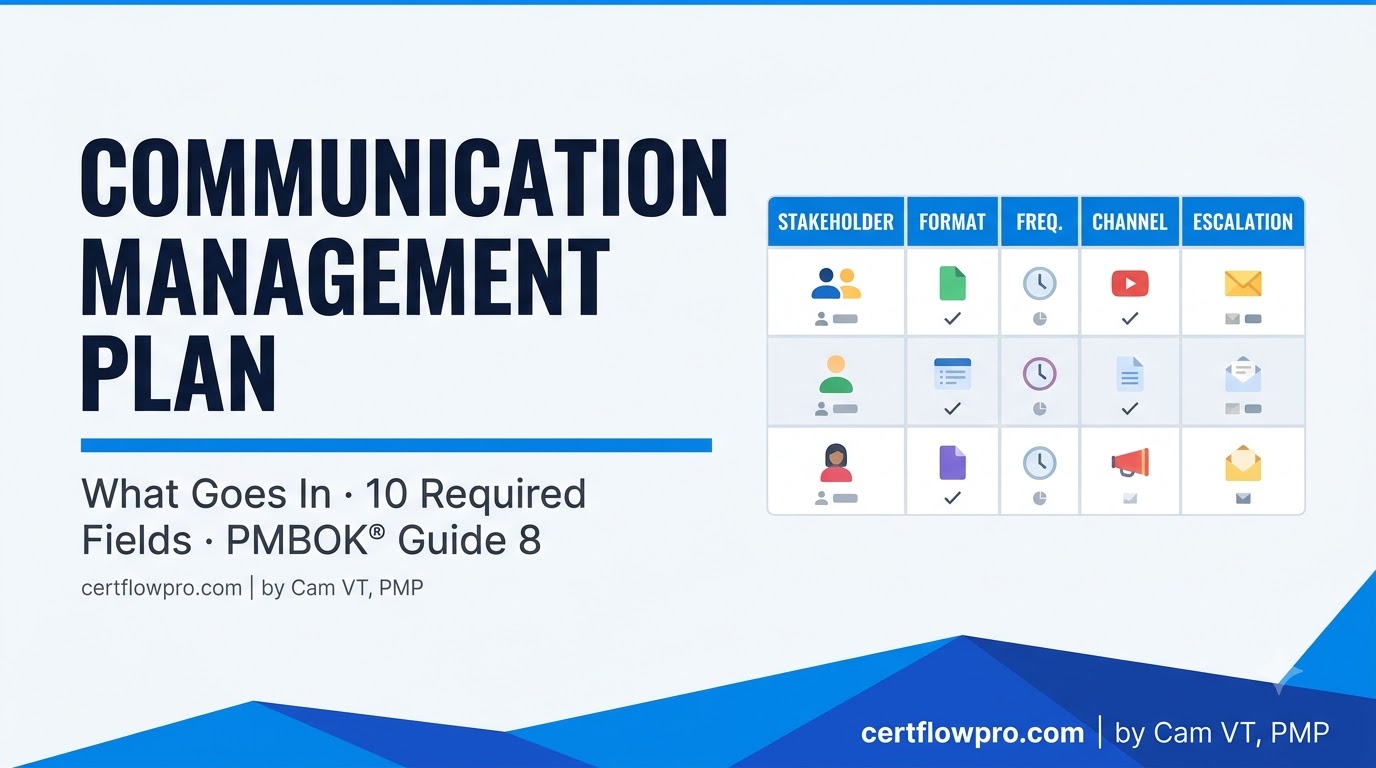
10 required fields in a Communication Management Plan, an IT project example filled in, and 3 common mistakes that keep plans from working in practice.
It's month three of your project. The sponsor just emailed: "Why haven't I been receiving progress updates?" You turn to the team: "Who's responsible for sending status to the sponsor?" Silence. Everyone knows communication matters — but no one knows who sends what, when, or in what format.
A communication management plan template structures exactly those answers: who needs what information, who sends it, through which channel, how often, and how feedback flows. The Communications Management Plan — the PMP® term for this document — is the primary output of the Plan Communications Management process in PMBOK® Guide 8's Stakeholders Performance Domain.
This article breaks down the 10 required fields in a Communications Management Plan, includes a filled example for a software development project, and covers the 3 fields most often left blank — and why that hurts.
Key takeaways
A Communications Management Plan is an artifact (a document) — not a strategy in someone's head.
PMBOK® Guide 8 requires the plan to include: stakeholder communication requirements, information format and frequency, delivery channel, responsible person, escalation procedures, and constraints.
The three fields left blank most often: escalation path, feedback mechanism, and language/time-zone constraints.
Agile projects don't require a formal document, but must still answer the same communication questions — through team charters, working agreements, or the Definition of Done.
On the PMP® exam, questions about the Communications Management Plan typically ask what to do first when a stakeholder isn't receiving the right information.
Why does a Communication Plan need its own document?
Many project managers confuse having a communication approach with having a documented communication plan. When the plan exists only in the PM's head, it disappears when the PM goes on leave, when new team members join, or when disputes arise over what was or wasn't communicated.
PMBOK® Guide 8 places Plan Communications Management within the Stakeholders Performance Domain (Section 2.5) — alongside Manage and Monitor Stakeholder Engagement — to emphasize that communication isn't a standalone activity but part of a system for managing stakeholder expectations. The Communications Management Plan is a component of the Project Management Plan.
On the PMP® exam, the People Domain accounts for 33% of questions and Task 8 — Plan and manage communication — appears frequently. Questions don't test communication theory; they test situational judgment: when a stakeholder is missing critical information, what does the PM do first? The PMI-correct answer is almost always: review and update the Communications Management Plan.
10 required fields in a Communications Management Plan
Below are the 10 fields a complete Communications Management Plan needs, based on PMBOK® Guide 8, Section 2.5.2.3. Each field answers one specific question:
1. Stakeholder / Recipient group
Question answered: Who needs this information?
List each stakeholder or group from the Stakeholder Register. Don't group everyone into a single "all stakeholders" row — a CEO needs an executive summary, a developer needs sprint plan details, QA needs a test report. Each group has different needs and different actions after receiving information.
2. Information to be communicated
Question answered: What do they need to know?
Describe the content specifically: "weekly progress report including % complete, top 3 risks under monitoring, budget variance." Don't write vague entries like "project updates" — a vague description means the sender fills in the gaps and usually omits the part that matters most to the recipient.
3. Format and level of detail
Question answered: How should the information be presented?
Specify the format: email text, PowerPoint slides, dashboard, PDF report, verbal in a meeting. Add the level of detail: "one-page executive summary" for the sponsor, "detailed task-level status" for the team lead. This field prevents the classic mistake of a PM sending a 15-page technical report to the CEO — who never reads past page one.
4. Frequency and timing
Question answered: When and how often?
Be specific: "every Friday before 5 PM," "after each sprint review," "when a change request is approved." Avoid vague entries like "regularly" — ambiguous frequency leads to information gaps or unnecessary reports sent when no one is available to read them.
5. Owner / Responsible person
Question answered: Who is responsible for preparing and sending the information?
List names or roles specifically — don't put "PM" on every row. In practice, the PM may approve but the Scrum Master prepares sprint reports, the BA prepares requirements updates, and the Project Controller prepares EVM data. Clear ownership prevents the "I thought you were handling it" problem.
6. Channel and communication method
Question answered: Where does the information travel?
PMBOK® Guide 8 classifies three communication methods: interactive (two-way real-time — meetings, calls), push (one-way sender-initiated — email, reports, newsletters), pull (recipient-initiated retrieval — SharePoint, project portal, Confluence). List the specific channel: "Slack #project-update," "email via Outlook," "Jira dashboard." Include language if the project spans multiple countries.
7. Official recipients
Question answered: Who gets the full version, and who gets an FYI?
Distinguish To (must read and act) from CC (informed only). In practice, when everyone is CC'd, no one actually reads. Keeping the "To" list tight increases response rates.
8. Feedback mechanism
Question answered: How do recipients respond?
This is the most frequently blank field. Specify: "reply by email within 48 hours," "comment directly on the Confluence page," "raise concerns in the weekly meeting." Without a clear feedback mechanism, communication becomes one-way — the PM sends but never knows whether stakeholders understood, agreed, or even read the message.
9. Escalation path
Question answered: When communication fails or a conflict arises, who decides?
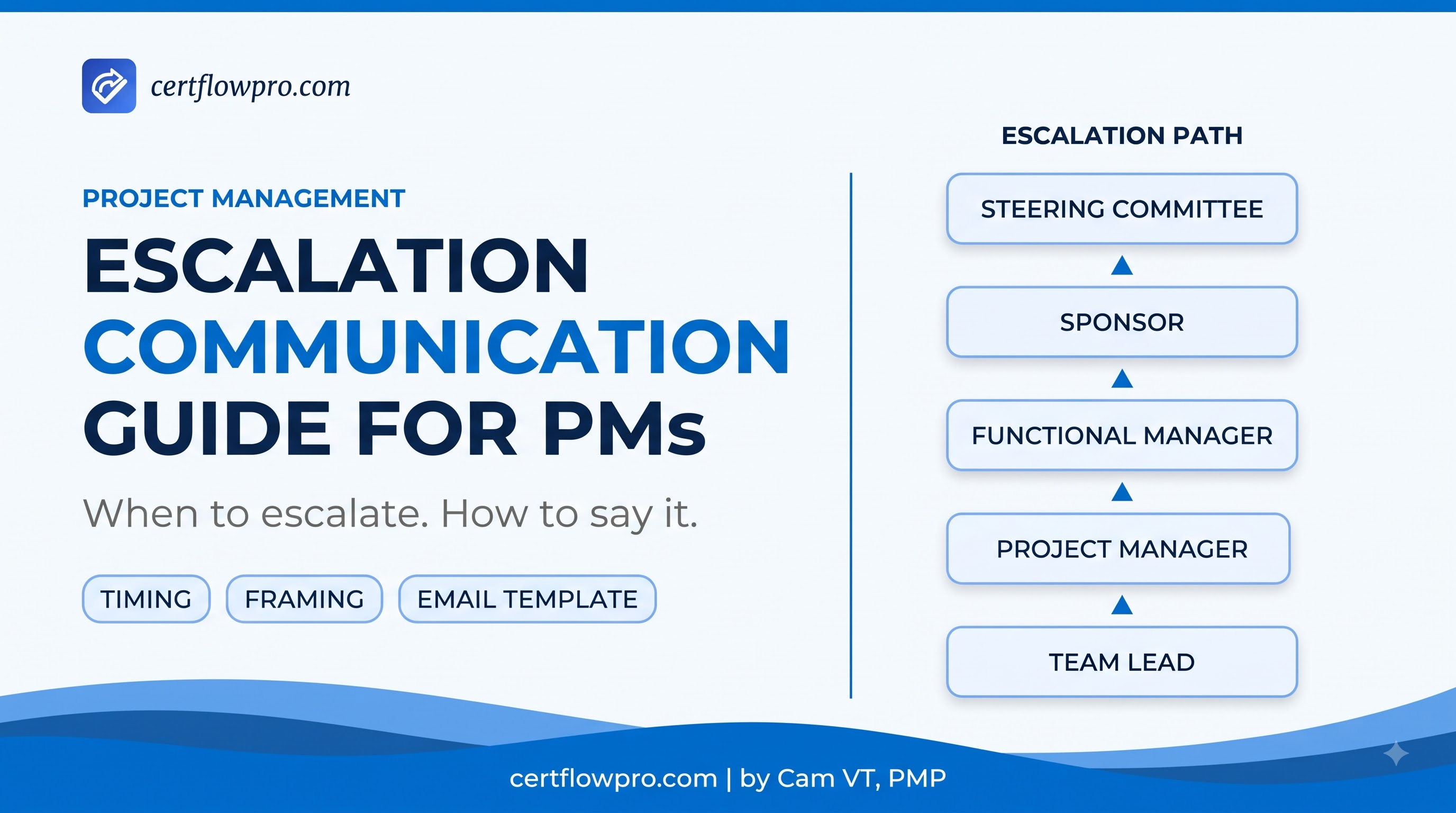
Document the escalation chain: PM → Program Manager → Sponsor → Steering Committee. Include trigger conditions: "if a stakeholder doesn't respond within 3 business days" or "if two groups dispute the accuracy of project information." The escalation path protects the PM when stakeholders later claim they "were never informed."
10. Constraints and assumptions
Question answered: Are there any constraints that affect how communication happens?
Document real constraints: time-zone differences (Vietnam and Japan, +2 hours), language requirements ("all technical documents in English, executive summaries in Vietnamese"), security policies ("no customer data via unencrypted email"), tool restrictions ("client uses Teams only, not Slack"). List assumptions too: "assuming all stakeholders have SharePoint access."
Filled example: IT project Communications Management Plan
Below is a sample Communications Management Plan for a B2B e-commerce order management system, developed by a Vietnamese IT outsourcing firm for a Singapore client. The table shows 5 representative rows:
Stakeholder | Information | Format | Frequency | Owner | Channel | Feedback | Escalation |
|---|---|---|---|---|---|---|---|
Project Sponsor (SG) | Progress, budget, top 3 risks | 1-page executive dashboard, English | Every Friday by 5 PM SGT | PM | Email + PDF attachment | Email reply within 48h | Program Director if sponsor unresponsive for 3 days |
Development Team | Sprint goal, task assignment, blocker updates | Jira board + verbal in daily standup | Daily standup (15 min); sprint planning every 2 weeks | Scrum Master | Google Meet + Jira | Jira updated immediately after standup | PM if blocker persists beyond 2 days |
QA Lead | Release notes, test scope, known defects | Markdown release notes on Confluence, English | Before each sprint release (Wednesday) | BA + Tech Lead | Confluence + Slack #qa-notify | Comment on Confluence within 24h | PM if QA doesn't sign off before release |
Business Analyst (Client SG) | Requirements changes, clarifications, UAT schedule | Email thread + meeting minutes after each session | When change requested; weekly UAT meeting | PM + BA (VN) | Email; Google Meet | Email confirmation within 24h; signed UAT checklist | Sponsor if BA doesn't confirm change within 48h |
Steering Committee | Milestone status, go/no-go decisions, budget approval | 10-slide PowerPoint, English | Monthly (beginning of month) | PM + Project Controller | Zoom meeting + follow-up email | Meeting minutes approved within 3 days | Executive Sponsor if quorum not met |
Real projects typically have 10–15 rows. Additional constraints for this project: a 1-hour time difference between Vietnam and Singapore; all technical documents in English; customer data must not be shared via unencrypted email.
3 fields left blank most often — and their real consequences
Escalation path: When a stakeholder is unresponsive or a conflict arises, no one knows the next step. The PM ends up stuck between parties, deadlines pass, and no one takes ownership. Fix: define escalation paths for each scenario — even if you hope never to use them.
Feedback mechanism: When communication is one-directional (PM sends, no one responds), the PM never knows whether stakeholders understood, agreed, or even read the message. Progress reports sent for two months — but the sponsor never spotted an escalating risk because there was no structured feedback channel. Fix: for every communication type, specify how and when recipients should respond.
Language and time-zone constraints: Offshore projects often skip this. When the sender (Vietnam) sends an email at 5 PM ICT and the recipient (Japan) receives it at 7 PM JST — after business hours — a 24-hour response SLA becomes a 48-hour reality in practice. Document time-zone constraints and adjust response SLAs accordingly.
Predictive, Agile, and Hybrid: how communication plans differ
Aspect | Predictive | Agile | Hybrid |
|---|---|---|---|
Primary artifact | Formal Communications Management Plan — part of the Project Management Plan | No required formal document; replaced by team charter, working agreements | Formal plan for senior stakeholders; informal agreements for the team |
Plan update cadence | Updated via change request or when stakeholders change | Adjusted continuously in each retrospective | Formal plan updated per governance cycle; informal adjusted flexibly |
Preferred channels | Email, formal reports, meetings with agendas and minutes | Face-to-face (or video), Slack, visible kanban board | Combined: formal reports for steering committee, informal daily syncs with team |
Primary recipients | Defined upfront from Stakeholder Register | Whole self-organizing team; product owner is primary external contact | Clear split: external stakeholders (formal) vs. internal team (agile) |
Feedback approach | Formal review, sign-off, change request form | Retrospective, sprint review, continuous feedback in daily standup | Formal sign-off for milestones; agile feedback for team deliverables |
What PMI wants you to understand: whether Predictive or Agile, a PM must answer the same core communication questions — who needs what, when, through which channel, and how feedback returns. Only the formality of the artifact changes.
PMP exam tips: questions about the Communication Plan
PMI mindset on the Communications Management Plan
When a scenario describes a stakeholder not receiving information or receiving incorrect information, the first step per PMI is always: review and update the Communications Management Plan — not apologize immediately, not call an emergency meeting, not blame the team.
Two distinctions commonly confused on the exam:
Plan Communications Management → the process that creates the document (the PROCESS)
Communications Management Plan → the actual document (the ARTIFACT/OUTPUT)
Manage Communications → executing information distribution per the plan
Monitor Communications → checking whether the plan is working as intended
Keywords that signal a question about the Communications Management Plan: "update the plan," "revise communication requirements," "stakeholder information needs have changed," "communication gap identified."
3 Scenario questions
Question 1. You are the project manager of a software development project. During a steering committee meeting, a board member complains that she has not been receiving any updates on the project's financial status, even though another board member receives weekly budget reports. Upon investigation, you discover this stakeholder was not included in the communication distribution list. What should you do first?
A. Send the board member all previous budget reports immediately to make up for the gap.
B. Update the Communications Management Plan to include the board member's communication requirements.
C. Hold an emergency meeting with the steering committee to explain the oversight.
D. Add the board member to the email distribution list and inform her that future reports will be sent.
Question 2. You are managing a hybrid project. The executive sponsor requires formal monthly reports, while the agile development team runs two-week sprints. A new team member asks whether they need to follow the Communications Management Plan for their daily standups and sprint ceremonies. What is the most appropriate response?
A. Yes — all team communications must follow the formal Communications Management Plan exactly.
B. No — agile projects do not use Communications Management Plans at all.
C. The Communications Management Plan covers formal stakeholder communications; agile ceremonies are governed by team working agreements, which should complement the plan.
D. The team should choose whichever approach is faster without documenting it.
Question 3. While reviewing the Communications Management Plan mid-project, you notice that the escalation path field is blank for all communication types. The project involves three vendors across different time zones and multiple client stakeholders. What is the most significant risk of leaving this field blank?
A. The Communications Management Plan will fail its next audit and need to be revised.
B. Stakeholders may not receive information on time due to unclear distribution channels.
C. When communication failures or conflicts occur, there is no agreed process for resolution, which may delay decisions and increase risk.
D. The project management information system will not function correctly without escalation paths defined.
Answers and explanations
Question 1: B. Per PMI mindset, when a stakeholder gap is identified, the first step is to update the Communications Management Plan — formally capturing this stakeholder's communication requirements. Only then should Manage Communications activities proceed. Option A (sending back reports) is execution before updating the plan. Option C (emergency meeting) doesn't address the root cause. Option D (adding to the distribution list) is the right action but incomplete — without formally updating the plan, the same gap may recur for this stakeholder or others.
Question 2: C. A hybrid project maintains two communication layers: (1) formal — the Communications Management Plan governs external stakeholder communication, such as the executive sponsor's monthly reports; (2) informal/agile — working agreements and team norms govern internal ceremonies like standups and sprint reviews. These two layers complement each other. Option A is wrong because applying the formal plan rigidly to internal team ceremonies creates unnecessary overhead. Option B is wrong because even pure Agile projects must answer core communication questions. Option D is an anti-pattern — no agreements at all creates confusion.
Question 3: C. The escalation path answers "when something goes wrong, who decides?" — especially critical in multi-vendor, multi-time-zone projects. Without it, communication failures and conflicts have no defined resolution process, which delays decisions and allows risks to escalate unchecked. Option A (audit) is an internal process risk, not a project risk. Option B relates to distribution channels, not escalation. Option D is incorrect — the PMIS functions independently of escalation path definitions.
Want to practice more communication scenario questions under timed conditions? Try 10 PMP questions free — no account required.
Summary
The Communications Management Plan isn't administrative paperwork — it's the tool that ensures the right people receive the right information at the right time. Its 10 core fields answer every question about who, what, when, where, and what happens if something goes wrong. The three fields most often left blank — escalation path, feedback mechanism, and language/time-zone constraints — are also the most likely sources of real project problems.
If you're studying the Plan Communications Management process under People Domain Task 8, see planning project communications under ECO Task 8. For the full Plan → Manage → Monitor lifecycle in real IT projects, read the 3-process communication management lifecycle.
Frequently Asked Questions (FAQ)
What is included in a Communications Management Plan according to PMBOK 8?
PMBOK® Guide 8 (Section 2.5.2.3) specifies the Communications Management Plan must contain: stakeholder communication requirements; information to be communicated (format, language, detail level, frequency, delivery channel); responsible person; escalation procedures; glossary; and communication constraints and assumptions. It is the output of the Plan Communications Management process.
How often should the Communications Management Plan be updated?
There is no fixed schedule — the plan is updated when stakeholders change, when an information gap is identified, or when Monitor Communications reveals the current plan isn't meeting stakeholder needs. PMBOK® Guide 8 (Table 2-9) states: review the communications management plan periodically and tailor it appropriately based on changing stakeholder needs.
Does an Agile project need a formal Communication Management Plan?
Agile does not require a formal document, but the team must still answer all core communication questions. Instead of a lengthy written plan, Agile uses a team charter, working agreements, and Definition of Done to define how the team communicates. For external stakeholders — sponsors, steering committees — a formal document is typically maintained even on Agile projects.
What is the difference between a communication matrix and a Communication Management Plan?
A communication matrix is a table mapping stakeholders to information types and frequencies — typically one page. A Communications Management Plan is the full document, which includes the matrix but also adds escalation paths, communication methods, constraints, a glossary, and update procedures. In practice, the communication matrix is usually the central component of the Communications Management Plan.