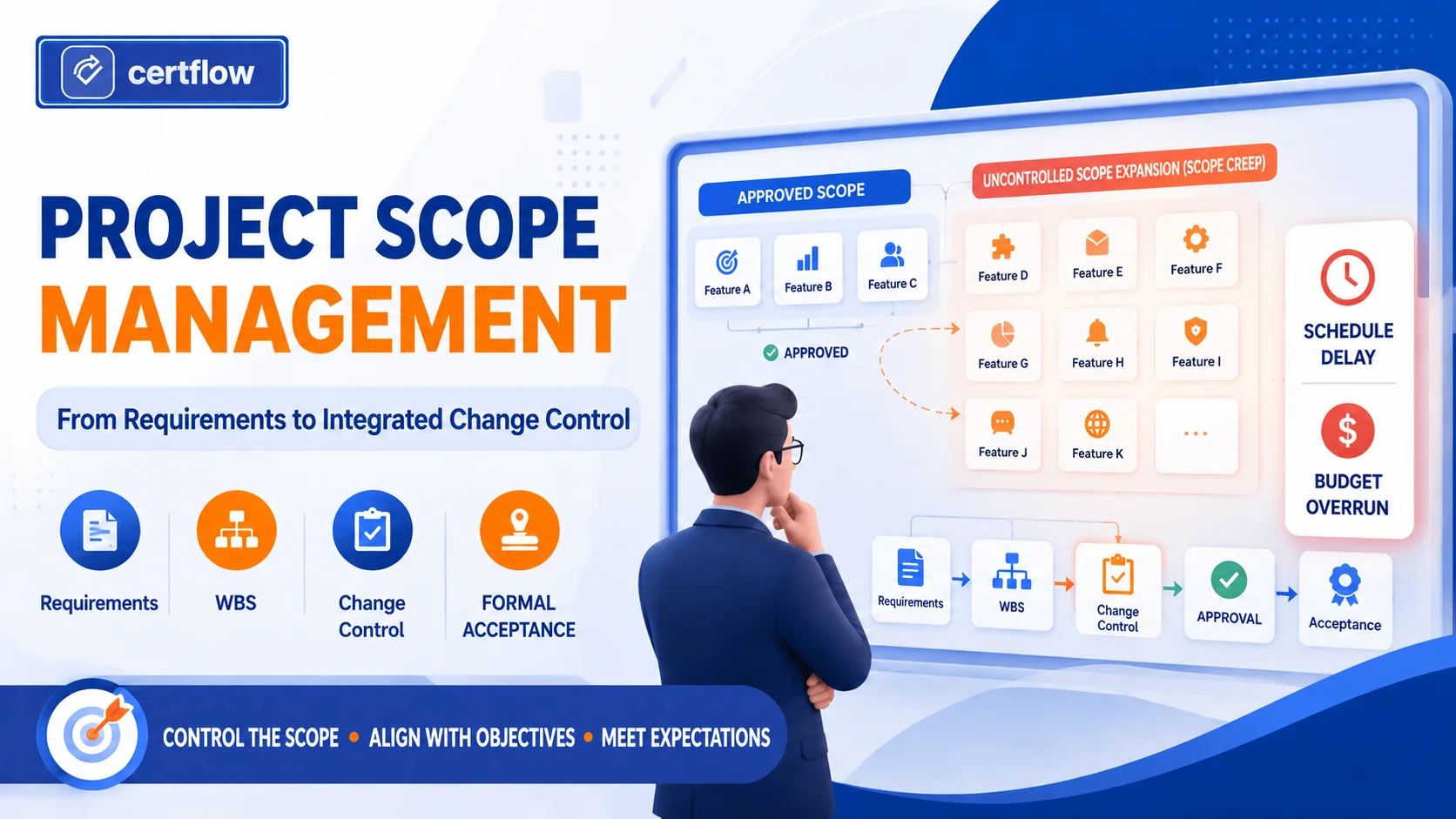
Scope creep can silently derail your project. You will learn how to write a Scope Statement, break down a WBS, and control changes effectively for the PMP exam.
Have you ever faced this situation?
The project initially required three features, but the team ended up delivering eight — two of which nobody asked for, and three others the client had "mentioned" but never formally approved.
The result: missed deadlines, blown budget, and a client who was still unhappy because the three original features got cut to make room for all the "extras."
That is scope management failure. And unfortunately, it happens far more often than you might think.
This article walks through the complete project scope management process — from planning, collecting requirements, defining scope, decomposing the WBS, and controlling changes, all the way to formal acceptance. Understanding this process thoroughly will help you answer the majority of Process domain questions on the PMP exam.
The Core Distinction: Product Scope vs Project Scope
First, these two concepts are different — and the PMP exam tests this frequently.
- Product Scope: The features and functions that characterize a product, service, or result. Measured against product requirements.
- Project Scope: The work that must be performed to deliver a product with the specified features and functions. Measured against the project management plan.
Simply put: Product scope is the "what" — what the customer receives. Project scope is the "how" — what work the team must do to create it. Project scope typically encompasses product scope.
Two Classic Mistakes
Mistake | Description | Consequence |
Scope Creep | Uncontrolled scope changes — requirements keep "creeping" into the project without going through a formal process | Schedule delays, cost overruns, reduced quality |
Gold Plating | The team adds features the client never asked for — "adding extras to look good" | Wasted resources, increased risk, potential introduction of new defects |
Both are wrong answers on the PMP exam. A PM never allows scope creep, and never gold plates.
Step 1: Plan Scope Management
Before doing anything with scope, you need a plan — guidance on how scope will be managed throughout the project.
Scope Management Plan
This document describes how scope will be defined, developed, monitored, controlled, and validated. It is a component of the project management plan and can be formal or informal depending on project needs.
Requirements Management Plan
Describes how project and product requirements will be analyzed, documented, and managed. It is heavily influenced by the relationship between phases — for example, the phase relationship in a waterfall project differs completely from Agile.
Step 2: Collect Requirements — Gather the Right Information, Completely
This is the critical step: incorrect or incomplete requirements at this stage will cause problems throughout the entire project.
What Is a Requirement?
A requirement is a condition or capability that a stakeholder needs to solve a problem or achieve an objective. There are several types:
- Business requirements: Organizational-level needs — why the project exists
- Stakeholder requirements: The needs of specific stakeholders
- Solution requirements: Functional (features) + Non-functional (performance, security, etc.)
- Transition requirements: Requirements for migrating from an old system to a new one
- Project work requirements: Time, cost, and quality requirements for project work
Stated vs Unstated Requirements
One major challenge: clients do not always say everything they need. Stated requirements are what they explicitly communicate. Unstated requirements are what they expect but do not say — for example, "obviously the system must be secure" even though no one wrote that down as a requirement. A skilled PM knows how to surface both.
Requirements Collection Techniques
PMI introduces many techniques — you need to know at least the following:
- Interviews: One-on-one sessions with stakeholders — formal or informal. Best when you need in-depth information from a specific individual.
- Brainstorming: Generates spontaneous ideas from a group. Four rules: go for quantity, withhold criticism, welcome unusual ideas, and combine and improve.
- Delphi Technique: An anonymous method — query a panel of experts, synthesize the results, and repeat until consensus is reached. Advantage: everyone can share opinions without being intimidated by those in authority.
- Prototypes: Create a working model of the product before building the real thing. Requirements gathered from prototypes are typically more complete than those from documents alone.
- Wireframes: Sketches of the user interface — low-fidelity, drawn by hand on paper. Helps stakeholders visualize the product before any code is written.
- Observation (Job shadowing): Watch real users at work — uncovers unstated requirements that interviews cannot surface.
- Questionnaires/Surveys: Best when you need input from a large number of people.
- Benchmarking: Compare against best practices from similar organizations.
- Document Analysis: Analyze business plans, process flows, logical data models, contracts, and similar documents.
📍Exam tip:
When a question asks "which technique avoids bias from people in authority" → Delphi Technique (because it is anonymous).
When it asks "which technique uncovers hidden requirements" → Observation or Prototype.
When it asks "which technique works best for a large number of people" → Questionnaires/Surveys.
Requirements Documentation
Every requirement must be recorded with the following characteristics: unambiguous, measurable and testable, traceable, complete, consistent, and acceptable to key stakeholders.
In Agile, requirements are typically written as User Stories — developed during requirement workshops.
Requirements Traceability Matrix (RTM)
The RTM is a matrix that links requirements to business objectives, project objectives, and deliverables. It allows you to trace every requirement throughout the project life cycle — from collection to validation. If anyone asks "where did requirement X come from, and who approved it?" — the RTM answers that question.
Step 3: Define Scope — Establish Clear Boundaries
From the list of requirements, you need to finalize the specific scope of the project.
The Define Scope Process
- Select the final requirements from the requirements documentation
- Develop a detailed description of the project and product
- Analyze alternatives and identify the best approach
- Analyze risks, assumptions, and constraints
- Reach agreement on deliverables and acceptance criteria
Product Analysis
Translate high-level product descriptions into specific deliverables. Tool: Product Breakdown Structure — decompose the product into smaller, more manageable components.
Project Scope Statement
The most important output of this step. It documents the complete scope — both project scope and product scope. It includes:
- Deliverables: Detailed descriptions of each deliverable
- Acceptance Criteria: The criteria each deliverable must meet for acceptance
- Scope Exclusions: What is explicitly NOT in scope — critical for managing stakeholder expectations
The team and stakeholders must agree on the scope statement before execution begins. Without agreement, scope creep is inevitable.
Step 4: Create WBS — Decompose the Work
The WBS (Work Breakdown Structure) is the most widely used tool in scope management — and also the concept the PMP exam tests most heavily in this area.
What WBS Is — and Is Not
WBS is | WBS is NOT |
A comprehensive classification of project scope | A complete list of every task |
Defines WHAT will be done | A plan, schedule, or activity list |
Can be used to assign responsibilities | An organizational chart |
Decomposition — Rules for Breaking Down Work
Decompose high-level deliverables into smaller, more manageable components. A WBS can be organized by:
- Project phases: Phase 1 → Phase 2 → Phase n
- Major deliverables: Deliverable 1 → Deliverable 2 → Deliverable n
- Combination: A mix of both approaches
Ways to create a WBS:
- Top-down: Use organizational templates or guidelines — faster but may lack detail
- Bottom-up: Build from team member input — takes more time but generates higher team buy-in and greater detail
Work Package — The Lowest Level of the WBS
A work package is the component at the lowest level of the WBS. From a work package, you then decompose further into activities (which belong to schedule management, not the WBS).
Important note: The WBS decomposes deliverables (nouns), not actions (verbs). For example: "Design Report" is a correct WBS component. "Write the Design Report" is an activity — it does not belong in the WBS.
The 100% Rule
The total work at the child level must equal 100% of the work at the parent level. The WBS must not include any work outside the actual project scope. Nothing more, nothing less.
The 8/80 Rule
A rule of thumb for decomposition depth: no work package should be smaller than 8 hours or larger than 80 hours. Work packages should also not exceed a single reporting period. Too much decomposition leads to micromanagement; too little leads to loss of control.
Scope Baseline
Scope baseline = Scope Statement + WBS + WBS Dictionary. This is the approved version, a component of the project management plan, and can only be changed through formal change control procedures.
The WBS Dictionary is the supporting document for the WBS. It contains detailed descriptions for each work package: code of accounts, description of work, assumptions, constraints, responsible organization, schedule milestones, and more.
💡Pro Tip: On the PMP exam, distinguish between: Work package = the lowest level of the WBS, fully decomposed with activities beneath it. Planning package = the lowest level at a given point in time, to be decomposed further as more information becomes available (rolling wave planning). A planning package does NOT yet have activities beneath it.
Step 5: Control Scope — Manage Changes
Scope has been baselined — now protect it. Control Scope is the process of monitoring the status of scope and managing changes.
The Change Handling Process — 9 Steps
When you receive a change request from a stakeholder, follow this process:
1. Understand the change: Clearly understand what the change request is asking for
2. Prevent unnecessary changes: Block changes that are not needed
3. Identify root cause: Find the root cause — why is this change needed?
4. Look at impact: Assess the impact on schedule, cost, quality, risk, and other areas
5. Create a change request: Submit a formal change request
6. Perform Integrated Change Control: Escalate to the CCB for approval or rejection
7. Adjust project management plan: If approved, update the plan and baselines
8. Notify stakeholders: Inform affected stakeholders
9. Manage to new plan: Execute the project against the updated plan
Change Control Board (CCB)
The CCB is the body authorized to approve or reject change requests. CCB members may include stakeholders, managers, team members, and individuals outside the project. The roles and responsibilities of the CCB are documented in the change management plan.
Other names you may encounter: Technical Assessment Board (TAB), Technical Review Board (TRB), Engineering Review Board (ERB).
💡Pro Tip: On the PMP exam, when a change request comes in, the correct answer is almost NEVER "implement it immediately" or "reject it outright." It is always: assess the impact → create a change request → submit it to the change control process. Even when the sponsor is the one asking — it still goes through the process.
Step 6: Validate Scope — Formal Client Acceptance
Validate Scope is the process of presenting completed deliverables to stakeholders and formally obtaining their acceptance.
Validate Scope vs Control Quality — Key Differences
Control Quality | Validate Scope | |
Purpose | Verify that deliverables meet specifications | Stakeholder acceptance of deliverables |
Who performs it | QA team / project team | Customer / sponsor |
Output | Verified deliverables | Accepted deliverables |
Order | Done FIRST | Done AFTER Control Quality |
The sequence is: Control Quality (internal verification) → Validate Scope (external acceptance) → Close Project.
Three Possible Outcomes When Presenting a Deliverable
When you present a deliverable to the client, there are three scenarios:
- Accepted: The deliverable meets requirements → formal acceptance (sign-off)
- Defects found: Requirements are not met → the team must fix the issues
- Change requested: The client wants a change → route it through the change control process; only approved changes are implemented
Summary: The Complete Scope Management Process A to Z
Step | Process | Key Output |
1 | Plan Scope Management | Scope Management Plan, Requirements Management Plan |
2 | Collect Requirements | Requirements Documentation, Requirements Traceability Matrix |
3 | Define Scope | Project Scope Statement |
4 | Create WBS | Scope Baseline (Scope Statement + WBS + WBS Dictionary) |
5 | Control Scope | Change requests, Work performance information |
6 | Validate Scope | Accepted deliverables, Formal acceptance |
And keep these core concepts in mind:
- Scope Creep = uncontrolled change → always wrong
- Gold Plating = adding things nobody asked for → always wrong
- WBS = decomposes deliverables (nouns), not activities (verbs)
- Work Package = lowest WBS level, 8–80 hours
- 100% Rule = sum of children = 100% of parent
- Scope Baseline = Scope Statement + WBS + WBS Dictionary
- Verified deliverables (QA inspects) → Accepted deliverables (client approves)
- Every change must go through the change control process — no exceptions
Scope management is the backbone of a project — everything else (schedule, cost, quality, risk) depends on whether scope is defined and controlled correctly. A solid scope baseline gives you a principled basis for saying "no" when an unreasonable change request comes in, and for saying "yes" the right way when a change genuinely adds value.
Practice scenario-based questions on scope — especially around change control and WBS — on CertflowPro. This topic carries significant weight in the Process domain (41%) of ECO 2026.
Frequently Asked Questions (FAQ)
What is scope creep and how do you control it?
Scope creep is the gradual expansion of project scope without formal approval — typically caused by stakeholders requesting small additions that bypass the change control process. How to control it: maintain a clear Scope Statement, apply Integrated Change Control, and never accept changes verbally.
How are Product Scope and Project Scope different?
Product scope refers to the features and functions of the product or service being created. Project scope is the work required to create that product — including management activities, documentation, and testing. Completion of project scope is measured against the project plan; product scope is measured against product requirements.
How far down should you decompose a WBS?
The WBS should be decomposed down to the work package level — the smallest unit of work that can be estimated, assigned, and controlled. The rule of thumb: no work package should be longer than two weeks (the 8/80 rule). Decomposing too deeply creates management overhead; not decomposing enough makes accurate estimation impossible.
You now have a solid grasp of project scope management — it is time to put that knowledge to work with real exam questions.
Next article: Schedule Management: Critical Path & Schedule Control
Project scope management per PMBOK 8: definition and decomposition
Try Free PMP Practice Questions →
Official References: