Going over budget is every PM's nightmare. You'll master cost estimation methods and the EVM formulas — CPI, EAC, ETC, TCPI — that appear on the PMP exam.
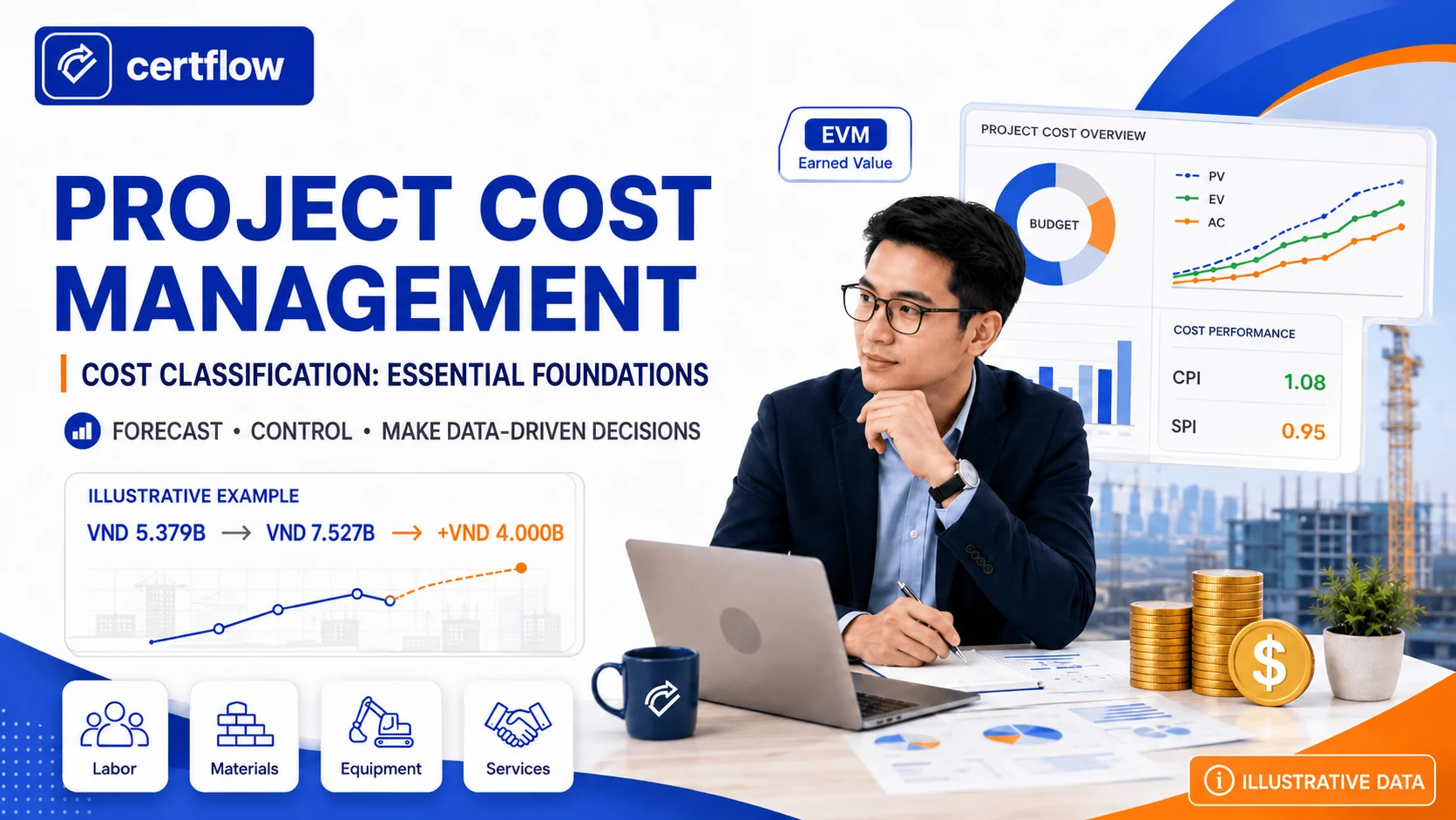
The Thang Long Boulevard project in Hanoi broke ground in 2005 with a total investment of 5,379 billion VND. Two years later, that figure was revised upward to 7,527 billion. Then in 2009, the government added nearly 4,000 billion more to accelerate progress — from 179 billion per kilometer to over 250 billion per kilometer. This story is far from unusual; cost overruns happen everywhere, in every industry. (Data used for illustrative purposes)
Cost management is not just about "counting money" — it is the ability to forecast, control, and make decisions based on financial data. And on the PMP exam, Earned Value Management (EVM) is one of the most reliably scoreable areas — if you master the formulas.
This article walks through the complete process: from cost classification and estimation to budgeting, through to a comprehensive EVM system with every formula you need to know.
Cost Classification: The Foundation You Need
Project costs encompass all resources that will be charged to the project: labor, materials, equipment, services, facilities, and special items such as inflation allowance, financing cost, and contingency.
Definition | Example | |
Direct Cost | Costs directly tied to the project; not shared across other projects | Team salaries, materials, project-specific equipment |
Indirect Cost | Overhead costs that serve multiple projects | Taxes, training, PM software licenses |
Variable Cost | Changes with the volume of work | Materials, supplies, hourly wages |
Fixed Cost | Does not change throughout the project | Office rent, monthly equipment leases |
Plan Cost Management
Defines how costs will be estimated, budgeted, managed, monitored, and controlled. The Cost Management Plan includes:
- Units of measure: VND, USD, man-hours...
- Level of precision: Rounding rules — e.g., $100.49 → $100
- Level of accuracy: Acceptable variance range — e.g., ±10%
- Control thresholds: Variance thresholds that trigger corrective action
- Rules of performance measurement: EVM measurement rules
- Reporting formats: Cost reporting templates
Three Levels of Estimate Accuracy
Cost estimates become more accurate as the project progresses through its phases:
Level | Variance Range | Timing |
ROM (Rough Order of Magnitude) | -25% → +75% | Initiating — at the very start |
Budget Estimate | -10% → +25% | Planning — during the planning phase |
Definitive Estimate | -5% → +10% | Execution — when more information is available |
Exam tip: ROM is the "roughest" estimate with the widest range. When a question says "the project was just approved and the sponsor asks for an estimate" → ROM. When "the project is in detailed planning" → Budget Estimate. When "the project is underway and a precise estimate is needed" → Definitive.
Estimate Costs
Similar to Schedule Management, cost estimation uses comparable techniques:
- Analogous (Top-down): Based on similar past projects — fast and inexpensive, but the least accurate
- Parametric: Uses statistical relationships — cost/m² × total area. More accurate than analogous.
- Bottom-up: Estimates each activity individually and aggregates upward — the most accurate but also the most time-consuming
- Three-point (PERT): Weighted average (O + 4M + P) / 6 — improves accuracy by accounting for uncertainty
Cost of Quality (COQ)
COQ is an important concept — it bridges cost management and quality management. It falls into two major categories:
Cost of Conformance (spending TO achieve quality) | Cost of Non-conformance (spending DUE TO lack of quality) |
Prevention costs — building the product correctly Training, document processes, equipment, time to do it right | Internal failure costs — defects found by the team Rework, scrap |
Appraisal costs — evaluating quality Testing, destructive testing, inspection | External failure costs — defects found by the customer Liabilities, warranty, lost business |
Money spent DURING the project to AVOID failure | Money spent DURING and AFTER the project BECAUSE OF failure |
🗒️ Key lesson: spending on prevention and appraisal is far cheaper than paying for failure. "Do it right the first time" is always the correct PMP approach.
Other Important Concepts
- Value Analysis (Value Engineering): Finding ways to accomplish the same work at lower cost — reducing cost without reducing scope or quality
- Life Cycle Cost: Considering total cost of ownership, not just project costs. Reducing project costs may increase operational costs later → keep the full picture in view.
- Contingency Reserve: Reserve for identified risks — included WITHIN the cost baseline
Determine Budget
A budget is not simply the sum of all estimates — it has a defined structure.
Cost Aggregation
Costs are rolled up from the bottom:
- Activity costs → aggregated into Work Package costs
- Work Package costs → aggregated into Control Account costs
- Control Account costs → aggregated into Project costs
The result is an S-curve — cumulative costs over time, shaped like an "S" because spending is low at the start, accelerates through the middle of the project, and tapers off toward the end.
Budget Structure — Know This Well
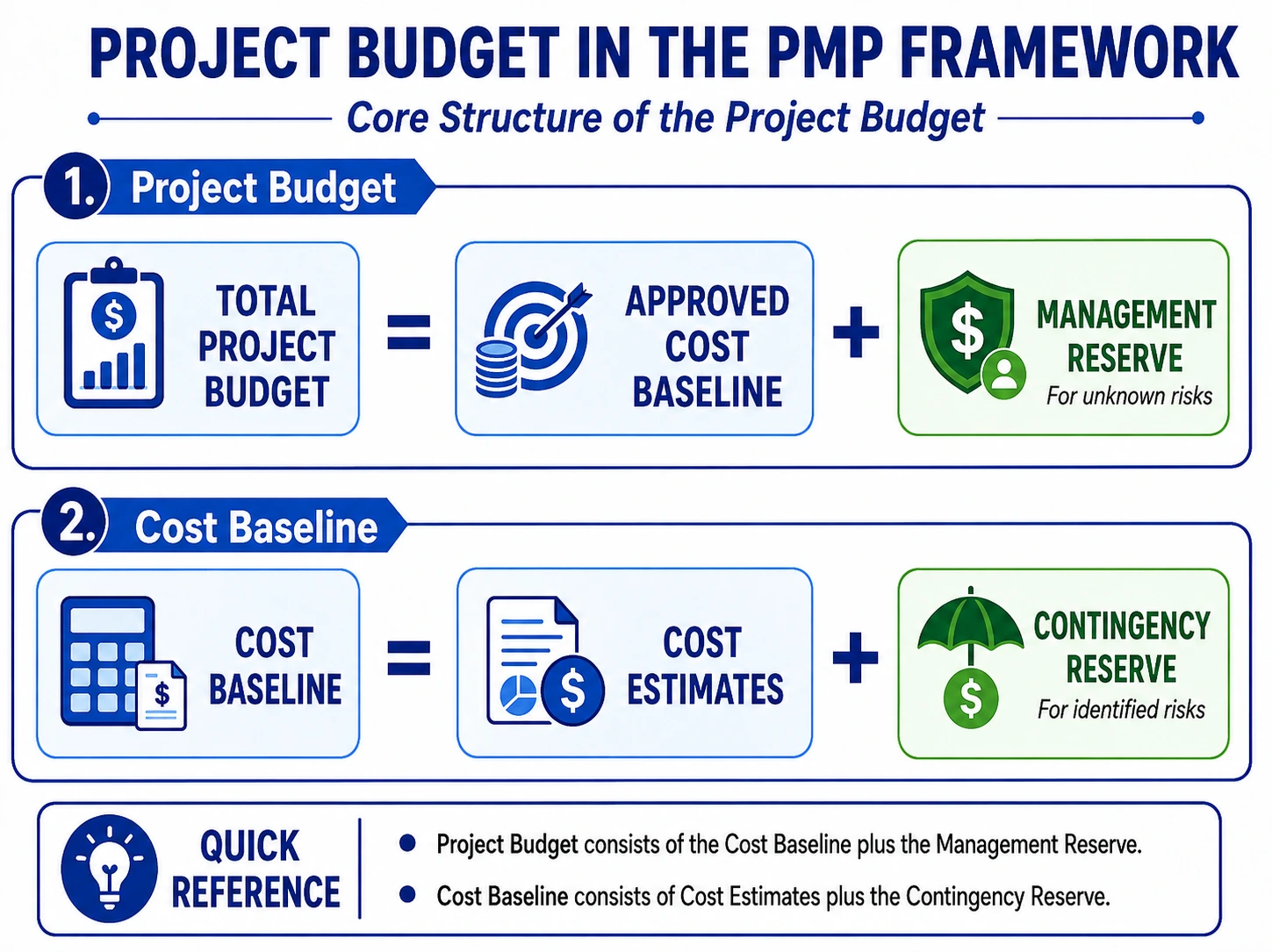
This is highly testable content — understand the layers clearly:
Project Estimates (activity cost estimates)
+ Contingency Reserve (reserve for identified risks)
= Cost Baseline (the PM controls this)
+ Management Reserve (reserve for unknown risks — management controls this)
= Project Budget (total project budget)
Key distinction: Contingency Reserve sits WITHIN the cost baseline — the PM can use it. Management Reserve sits OUTSIDE the cost baseline — using it requires going through the change control process to add it to the baseline. This distinction is frequently tested on the exam.
Funding Limit Reconciliation
Approved funding typically arrives in increments, not all at once. The PM must reconcile expenditure needs against the available funding schedule — if they do not align, schedule or plan adjustments may be required.
Control Costs — Earned Value Management (EVM)
This is the "heaviest" section — but also the easiest to score if you know the formulas. EVM integrates scope, schedule, and cost into a single measurement system.
The Three Core Values: PV, EV, AC
Metric | Meaning | Question It Answers |
PV (Planned Value) | The value of work that should have been completed according to the plan | "Where should you be according to the plan?" |
EV (Earned Value) | The budgeted value of work actually completed | "How much have you actually accomplished?" |
AC (Actual Cost) | The actual cost incurred to complete the work | "How much money have you spent?" |
BAC (Budget at Completion) = Total PV = The total approved budget for the project.
Illustrative Example
A project to build a wall around a garden: 4 sides, one side per day, $200 per side. BAC = $800.
At the end of day 3: 2.5 sides are complete, $560 has been spent.
- PV = 3 sides × $200 = $600 (per the plan, 3 sides should be done by day 3)
- EV = 2.5 sides × $200 = $500 (only 2.5 sides are actually complete)
- AC = $560 (actual money spent)
Variance
Formula | Meaning | How to Interpret |
SV = EV - PV | Schedule Variance — schedule deviation | SV > 0: ahead of schedule. SV < 0: behind schedule. |
CV = EV - AC | Cost Variance — cost deviation | CV > 0: under budget. CV < 0: over budget. |
Using the example above: SV = 500 - 600 = -$100 (behind schedule). CV = 500 - 560 = -$60 (over budget).
Performance Indexes
Formula | Meaning | How to Interpret |
SPI = EV / PV | Schedule Performance Index (SPI) | SPI > 1: ahead. SPI < 1: behind. SPI = 1: on track. |
CPI = EV / AC | Cost Performance Index (CPI) | CPI > 1: under budget. CPI < 1: over budget. CPI = 1: on budget. |
Example: SPI = 500/600 = 0.83 (only 83% of planned work is complete). CPI = 500/560 = 0.89 (every $1 spent yields only $0.89 of value).
The fastest memory trick: Every EVM formula involves EV. EV always comes first. Variance = EV minus the other. Index = EV divided by the other. Schedule relates to PV; Cost relates to AC. Therefore: SV = EV - PV, CV = EV - AC, SPI = EV/PV, CPI = EV/AC.
Forecasting
Now that you know where the project stands, you can forecast the future:
Formula | Meaning | When to Use |
EAC = BAC / CPI | Estimate at Completion (EAC) — projected total cost at project completion | Scenario 1: Current variances are expected to continue (CPI is typical) |
EAC = AC + (BAC - EV) | Remaining work will be completed according to the original plan | Scenario 2: Current variance is atypical and will not continue |
EAC = AC + New Estimate | The remaining work is completely re-estimated | Scenario 3: The original estimate is fundamentally flawed |
EAC = AC + (BAC-EV)/(CPI×SPI) | Accounts for both cost and schedule performance | Scenario 4: Over budget but must still meet the deadline |
Additional metrics:
- ETC (Estimate to Complete) = EAC - AC → How much more money is needed to finish?
- VAC (Variance at Completion) = BAC - EAC → At completion, will the project be over or under budget, and by how much?
TCPI — To Complete Performance Index
TCPI forecasts the cost performance efficiency that must be achieved to complete the project within the remaining budget:
TCPI = (BAC - EV) / (BAC - AC) — when still targeting the original BAC
TCPI = (BAC - EV) / (EAC - AC) — when a new approved EAC is in place
- TCPI > 1: Must do more work per dollar than before → difficult to complete within budget
- TCPI < 1: Less work required per dollar → easier to complete within budget
- TCPI = 1: Maintain current performance → just sufficient
Earning Rules — How to Calculate EV
Four methods for measuring progress to calculate EV:
Method | How It Works | Best For |
0/100 | 0% EV when started, 100% when complete | Short activities (within 1 reporting period) |
50/50 | 50% EV when started, 50% when complete | Activities spanning ≤ 2 reporting periods |
Milestones | EV assigned based on milestone weighting | Activities spanning ≥ 3 reporting periods |
Percent Complete | Subjective completion percentage | Least recommended — most subjective |
Summary: The Cost Management Process
Step | Process | Key Output |
1 | Plan Cost Management | Cost Management Plan |
2 | Estimate Costs | Cost Estimates, Basis of Estimates |
3 | Determine Budget | Cost Baseline, Project Funding Requirements |
4 | Control Costs | EVM data, Forecasts, Change Requests |
EVM Formula Cheat Sheet
- SV = EV - PV (+ = ahead, - = behind)
- CV = EV - AC (+ = under budget, - = over budget)
- SPI = EV / PV (>1 = ahead, <1 = behind)
- CPI = EV / AC (>1 = under budget, <1 = over budget)
- EAC = BAC / CPI (most common scenario)
- ETC = EAC - AC
- VAC = BAC - EAC
- TCPI = (BAC - EV) / (BAC - AC)
- Budget: Estimates + Contingency = Cost Baseline + Management Reserve = Project Budget
Cost management — and EVM in particular — is the area that many candidates fear most, yet it is one of the easiest to score well on if you know the formulas. No complex reasoning required — just remember the formulas, plug in the numbers, and calculate the result. Practice EVM calculations on CertFlow until you can compute CPI, SPI, and EAC within 30 seconds — that is when you turn the "hardest" section into guaranteed points.
Frequently Asked Questions (FAQ)
What does CPI < 1 mean in Earned Value Management?
CPI (Cost Performance Index) = EV / AC. A CPI < 1 means the project is overspending — every dollar spent is generating less than one dollar of value. For example, CPI = 0.85 means that for every $100 spent, the project is only accomplishing $85 worth of work. The PM needs to identify the cause and take corrective action immediately.
What is the difference between EAC, ETC, and TCPI?
EAC (Estimate At Completion): the projected total cost of the project when it is finished. ETC (Estimate To Complete): the additional cost needed from now until completion = EAC - AC. TCPI (To-Complete Performance Index): the cost efficiency that must be achieved to complete the project within the remaining budget = (BAC - EV) / (BAC - AC). TCPI > 1 means the team must perform more efficiently than they currently are.
What is the difference between Contingency Reserve and Management Reserve?
Contingency Reserve: provides for known unknowns — risks that have been identified in the risk register. It sits within the cost baseline, and the PM has authority to use it when those risks occur. Management Reserve: provides for unknown unknowns — risks that were not anticipated. It sits outside the cost baseline and requires sponsor approval to use.
Now that you understand project cost management — it's time to put that knowledge to the test with real exam questions.
Next article: Project Resource Management: RACI & Resource Leveling
Evaluating project status using metrics according to PMBOK 8
Try Free PMP Practice Questions →
Official References: