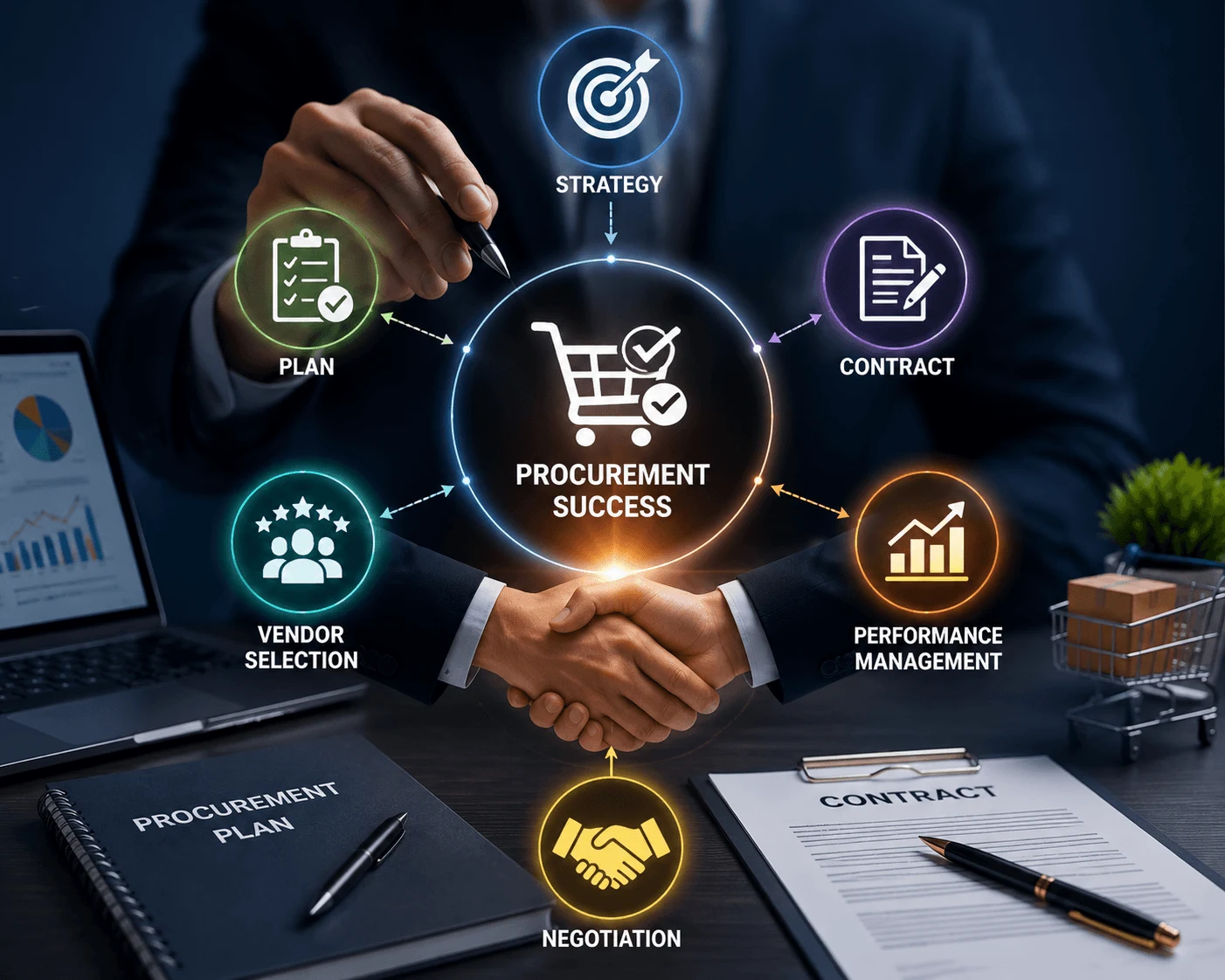
Choosing the wrong vendor or contract type can derail your entire project. This guide covers PMBOK 8's strategic approach from make-or-buy to agile contracting.
1. Why does procurement management matter?
Imagine: a $50M hospital construction project. You select the contractor based on the lowest bid. Six months later, the contractor goes bankrupt because they under-bid. The project halts for 4 months while you find a replacement. Costs increase by 30%. The deadline slips by 8 months. The root cause? A flawed procurement strategy.
PMBOK 8 identifies procurement as a critical part of the Governance Performance Domain — where the PM decides build or buy, which vendor to choose, and what contract type to use:
PMBOK® 8, Section 2.1: "Procurement management is the discipline of selecting, contracting, and supervising vendors to perform outsourced work. Procurement management is a complementary discipline to project management."
This task in the PMP ECO has 10 enablers — the most of any task — reflecting the complexity of procurement: from strategy and contracts to negotiation, vendor oversight, and contract closure.
2. Make-or-Buy — The First Strategic Decision
Before thinking about vendors or contracts, the PM must answer: "Should we build it ourselves or outsource it?"
PMBOK® 8: "Make-or-buy analysis is the decision-making process of gathering and organizing data about product requirements and analyzing them against available alternatives, including the purchase or internal manufacture of the product."
Factor | Advantages of Insourcing (Make) | Advantages of Outsourcing (Buy) |
|---|---|---|
Expertise | Leverage available internal expertise | Access external expertise when internal capability is lacking |
Cost | Often cheaper when significant innovation is required | Often cheaper when volume or specialization is needed |
Control | Tighter integration with organizational strategy | Frees up internal capacity |
Risk | Maintain control over quality, IP, and timeline | Transfer delivery risk to the supplier |
Relationships | Build long-term internal capability | Maintain and grow supplier relationships |
⚠️ PMBOK 8 Note: many organizations outsource when they lack the internal infrastructure or technology. The make-or-buy decision directly affects risk, cost, schedule, and quality — and therefore requires thorough analysis.
3. Procurement Strategy — The Overall Framework
PMBOK 8 Plan Sourcing Strategy (Section 2.1.6.3): "The process of deciding whether to use internal or external resources, considering organizational culture, specialized skills, resource capacity, risk, and the overall value proposition."
The Sourcing Strategy Plan includes
Insourcing/outsourcing decisions — What to make vs. buy
Source selection criteria — Criteria for evaluating vendors
Contract types — Fixed-price, cost-reimbursable, T&M
Bid process — RFP, RFQ, IFB, competitive bidding
Vendor relationship management — How to manage relationships
Risk management — Procurement risks and mitigation strategies
Communication channels — How to communicate with vendors
Procurement metrics — KPIs for measuring vendor performance
PMBOK® 8: "Source selection criteria help guide the evaluation and selection of vendors. Criteria may include cost, technical capability, past performance, financial stability, compliance with requirements, and alignment with organizational values or sustainability goals."
4. The Three Basic Contract Types — and Who Bears the Risk
This is the most important section for the PMP exam — the exam consistently tests your understanding of risk distribution between the buyer and the seller.
Contract Type | Description | Risk to Buyer | Risk to Seller | When to Use |
|---|---|---|---|---|
Fixed-Price (FP) | Fixed price for a well-defined scope | Low — price does not change | High — seller absorbs cost overruns | Clear scope, well-defined requirements |
Cost-Reimbursable (CR) | Buyer pays actual costs plus a fee | High — costs are uncertain | Low — costs are reimbursed | Unclear scope, R&D, innovation |
Time & Materials (T&M) | Payment per hour plus materials used | Medium | Medium | Unclear scope, flexibility needed, short-term work |
- Fixed-Price Variants
Firm Fixed-Price (FFP) — Price is completely fixed. Seller bears 100% of the risk. Fixed-Price
Fixed-Price Incentive Fee (FPIF) — Fixed price plus an incentive if targets are met or exceeded. Risk is shared. Fixed-
Fixed-Price with Economic Price Adjustment (FPEPA) — Fixed price that adjusts for inflation or exchange rate changes. Used for long-duration projects.
- Cost-Reimbursable Variants
Cost Plus Fixed Fee (CPFF) — Costs plus a fixed fee. The fee does not change even if costs increase. Cost Plus
Cost Plus Incentive Fee (CPIF) — Costs plus an incentive fee based on performance metrics. Cost Plus
Cost Plus Award Fee (CPAF) — Costs plus an award fee based on subjective evaluation. Cost Plus
Cost Plus Percentage of Costs (CPPC) — Costs plus a percentage of those costs. Highest risk for the buyer — the seller has no incentive to reduce costs because the fee grows with costs.
🌟 Golden Rule for PMP: Risk spectrum: FFP → FPIF → T&M → CPIF → CPFF → CPAF → CPPC. FFP = lowest risk for buyer, highest for seller. CPPC = highest risk for buyer, lowest for seller. The exam often asks "which contract type places the MOST risk on the buyer?" — the answer is CPPC.
5. The Bid Process and Source Selection
Procurement Documents — PMBOK 8
Document | Purpose | When to Use |
|---|---|---|
RFI (Request for Information) | Gather information about supplier capabilities | Early stage, before understanding market offerings |
RFQ (Request for Quotation) | Request pricing for clearly defined items or services | Well-defined scope, need to compare prices |
RFP (Request for Proposal) | Request a comprehensive proposal: approach + price + qualifications | Complex procurement, need to evaluate approach |
IFB (Invitation for Bid) | Formal competitive bidding, typically lowest price wins | Government and regulated environments |
Source Selection Analysis — PMBOK 8
Evaluation criteria typically include: Cost/price (weighted, not just lowest), Technical capability (skills, tools, approach), Past performance (track record, references), Financial stability (can the vendor survive the project?), Compliance (regulatory, contractual), Sustainability alignment (new in PMBOK 8 — organizational values, green practices), Risk (what risks does each vendor introduce?).
PMBOK 8 emphasizes: "Clearly defining these criteria ensures transparency and consistency in vendor selection."
6. Negotiation — Strategy and Practice
The ECO lists 2 separate enablers for negotiation: "Participate in agreement negotiations" and "Determine a negotiation strategy" — signaling that PMI treats negotiation as a critical skill.
7-Step Negotiation Process
Prepare — Research the vendor, understand your BATNA (Best Alternative to Negotiated Agreement), set objectives, and identify your walk-away point
Set ground rules — Agenda, timeline, decision authority, confidentiality
Clarify positions — Both parties present their requirements and constraints
Explore interests — Behind positions are interests. "Why do they want this?" Uncover the underlying needs
Generate options — Brainstorm creative solutions that benefit both parties
Reach agreement — Confirm the terms and document them clearly
Close and follow through — Formalize the contract, establish communication and monitoring processes
Negotiation Strategies
Strategy | Description | When to Use |
|---|---|---|
Win-Win (Collaborative) | Both parties achieve their most important goals | Long-term relationships, strategic partnerships |
Win-Lose (Competitive) | One party gains at the other's expense | One-time transactions, commodity purchases |
Compromise | Both parties make partial concessions | Time pressure, moderate stakes |
📍 PMP Tip: PMI always favors Win-Win. On the exam, if you see "collaborative negotiation" or "focus on mutual interests" as an option — that is almost always the correct answer, unless the scenario explicitly describes a one-time transaction.
7. Vendor Management — Effective Supplier Oversight
Evaluate Vendor Performance
The PM must continuously monitor vendor performance through: scheduled status reviews, milestone reviews, walkthroughs, inspection of deliverables, performance metrics against SLAs, quality audits, and financial tracking.
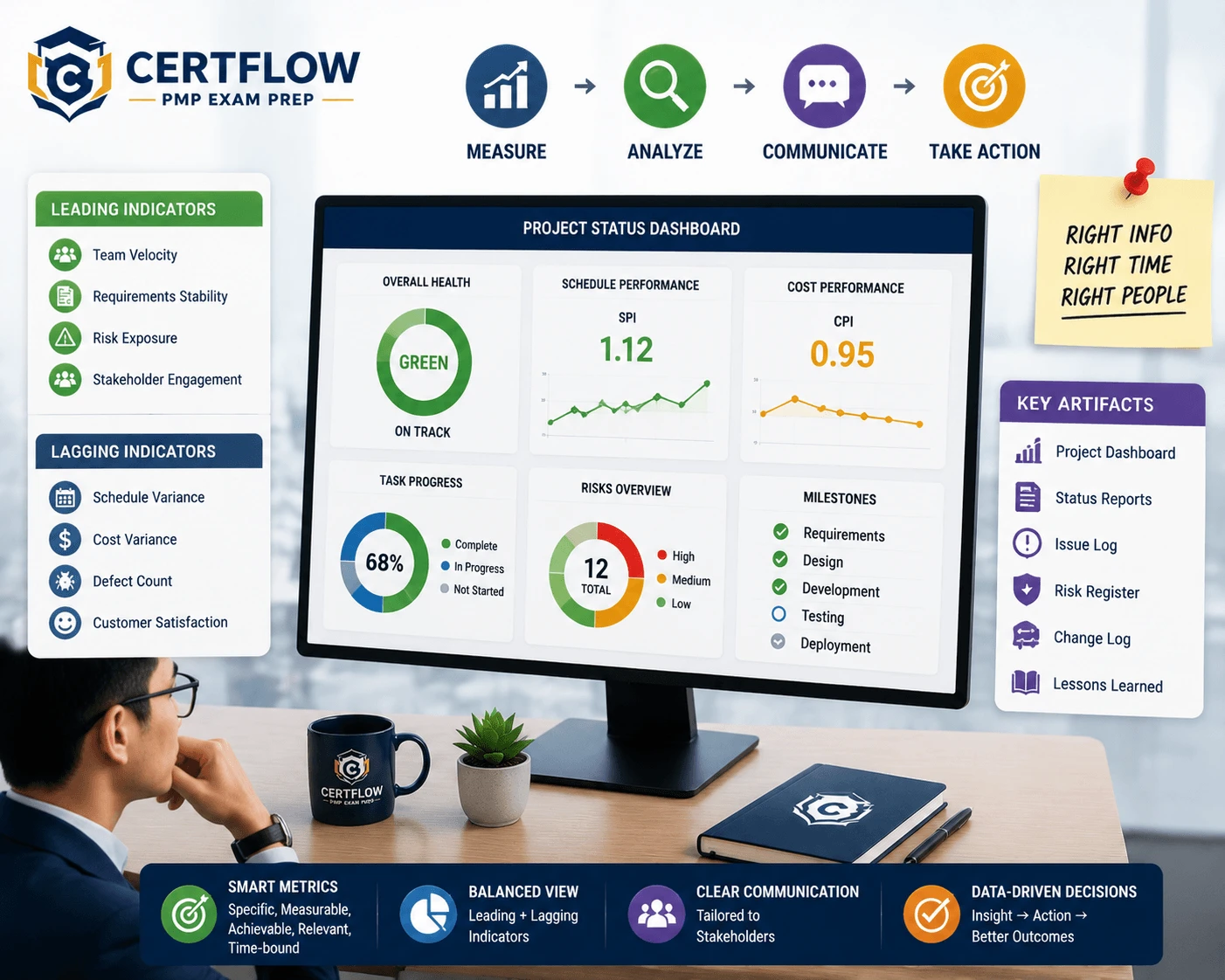
PMBOK® 8, Section 2.6: "Scheduled status reviews and walkthroughs are expected to help ensure that the contractor's reports are accurate and complete." + "Check the variance analysis with metrics such as cost variance (CV) and cost performance index (CPI), as well as the accomplishment of financial targets with the vendors based on the signed contract."
Verify Objectives Are Met
The PM must verify that: deliverables meet acceptance criteria (quality, specifications, performance), timeline adherence is maintained (milestones are met per the contract), costs are within agreed limits, contractual obligations are fulfilled (compliance, reporting, IP rights), and risk management is active (the vendor is mitigating their risks).
Manage Suppliers and Contracts
Ongoing activities include: performance monitoring, issue resolution, change management (contract amendments), relationship management, payment processing, compliance tracking, and risk monitoring.
⚠️ PMBOK 8 Note: "The project plans are integrated with the suppliers' perspectives and work outputs. Align the project management plan with the vendor's way of working."
8. Claims Administration and Contract Closure
Claims Administration
PMBOK 8 (Appendix X4): "A claim is a request, demand, or assertion of rights by a seller against a buyer, or vice versa." Claims typically arise when: scope changes are not documented, parties disagree about deliverable quality, delays occur and blame is disputed, or contract terms are ambiguous.
Best practice: document everything. Every communication, decision, and change must be formally recorded. Claims are difficult to resolve when evidence is lacking.
PMBOK® 8, Appendix X4: "Claims administration involves managing disputes through negotiation if possible, and through alternative dispute resolution (ADR) or legal proceedings as a last resort. Rights and obligations related to audits should be described in the procurement contract."
Contract Closure
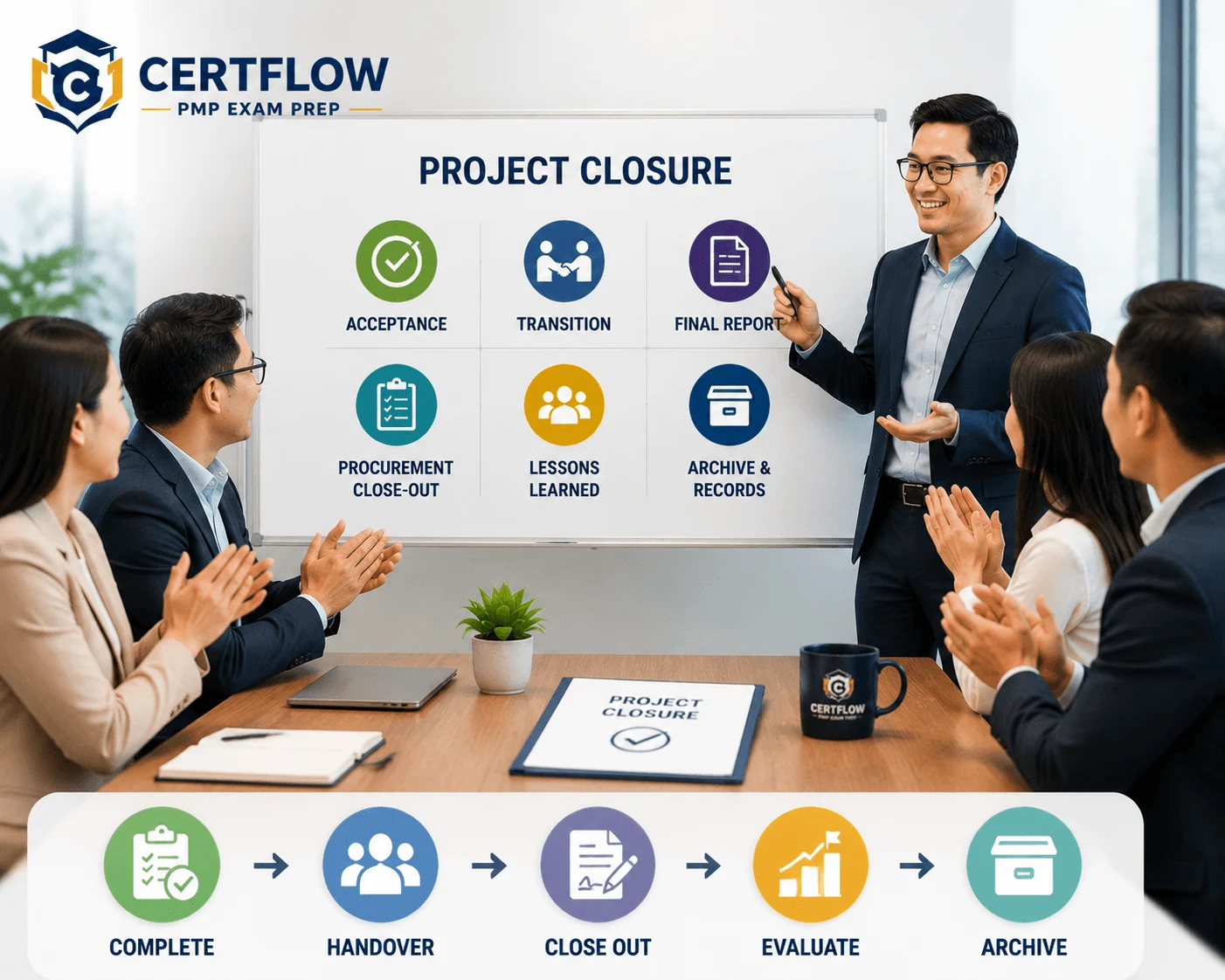
At project close, you must: verify all deliverables have been accepted, process final payments, document performance (for future reference), capture lessons learned, formally close all contracts, and conduct a procurement audit.
⚠️ PMBOK 8: "A procurement audit is a structured review of the procurement process, including the review of contracts and contracting processes for completeness, accuracy, and effectiveness."
9. PMP Exam Tips
📍 Tip 1 — Risk spectrum: FFP = lowest buyer risk, CPPC = highest buyer risk. When the exam asks "which places the most risk on the buyer/seller?" — remember the spectrum: FFP → FPIF → T&M → CPIF → CPFF → CPAF → CPPC.
📍 Tip 2 — Well-defined scope → Fixed-Price: When the scenario describes "requirements are clear and well-documented" — choose Fixed-Price. When "scope is uncertain or it is R&D" — choose Cost-Reimbursable. When "flexibility is needed, short-term work" — choose T&M.
📍 Tip 3 — Win-Win negotiation: PMI favors collaborative negotiation. "Focus on interests, not positions" is almost always correct. "Force the vendor to accept our terms" is almost always wrong.
📍 Tip 4 — Procurement audits: When the exam asks "what should be done at contract closure?" — a procurement audit is a required activity. Lessons learned must also be captured.
10. Ten Scenario-Based Practice Questions
Question 1
Your organization needs a specialized AI system. The internal team lacks AI expertise. The AI vendor market is competitive with many qualified suppliers. The timeline is 12 months with well-defined requirements.
Which combination of make-or-buy decision and contract type is MOST appropriate?
A. Make — develop internally to build long-term capability.
B. Buy — outsource with a Fixed-Price contract since requirements are well-defined.
C. Buy — outsource with a Cost-Reimbursable contract since AI is cutting-edge technology.
D. Make — hire AI specialists and build internally.
Question 2
You are negotiating a construction contract for a hospital wing. The contractor proposes a Firm Fixed-Price (FFP) of $15M. Your engineer estimates the work should cost $12M. The contractor has an excellent reputation and has built similar facilities before.
What does the $3M difference most likely represent?
A. Contractor profit margin — negotiate to reduce it.
B. Risk premium — the contractor is pricing in the risk they bear under FFP. This is expected and reasonable.
C. Overpricing — seek alternative bids immediately.
D. Contingency — request a detailed cost breakdown.
Question 3
Your R&D project is exploring a new material that has never been used commercially. Requirements will evolve as testing progresses. The vendor will need to adjust their approach frequently based on test results.
What contract type is MOST appropriate?
A. Firm Fixed-Price — to control costs.
B. Fixed-Price Incentive Fee — to motivate performance.
C. Cost Plus Incentive Fee — scope is uncertain, but incentives drive efficiency.
D. Time and Materials — for maximum flexibility.
Question 4
During contract execution, your vendor delivers a component that meets all technical specifications in the contract. However, when integrated with your system, it does not perform as expected. The vendor claims they fulfilled their contractual obligations.
What should you do?
A. Accept the deliverable since it meets contractual specifications.
B. Reject and demand rework at the vendor's cost.
C. Review the contract for integration requirements and acceptance criteria. If integration performance was not specified, acknowledge the gap and negotiate a solution. Update future contracts to include integration testing criteria.
D. Escalate to legal for breach of contract.
Question 5
You have three vendor proposals: Vendor A scores highest on technical capability but is 30% more expensive. Vendor B has the lowest price but the lowest technical score. Vendor C is in the middle on both criteria.
Which source selection approach should you use?
A. Select Vendor B — lowest price wins in competitive bidding.
B. Select Vendor A — technical capability is always more important than price.
C. Use multicriteria decision analysis with pre-defined weighted criteria (e.g., technical 40%, price 30%, past performance 20%, risk 10%) to evaluate all vendors objectively.
D. Select Vendor C — the balanced approach is safest.
Question 6
During contract negotiation, the vendor insists on a clause limiting their liability to 50% of the contract value. Your legal team wants unlimited liability. Both sides are at an impasse.
What negotiation approach should you use?
A. Insist on unlimited liability — it protects your organization.
B. Accept the 50% cap to move forward and avoid losing the vendor.
C. Explore the interests behind the positions: understand what specific risks the vendor fears, then propose a tiered liability structure that addresses both parties' core concerns while sharing risk proportionally.
D. Escalate to senior management for a decision.
Question 7
Your vendor's monthly performance report shows green status across all metrics. However, your QA team has rejected 40% of deliverables on first submission over the past 3 months. The vendor's PM insists the rejections are due to "overly strict acceptance criteria."
What should you do?
A. Accept the vendor's explanation and adjust the acceptance criteria.
B. Issue a formal non-compliance notice based on the 40% rejection rate.
C. Organize a joint review: examine the rejected deliverables together to determine whether the acceptance criteria are reasonable, whether the vendor's quality process has gaps, or whether there is a communication breakdown — then address the root cause collaboratively.
D. Replace the vendor.
Question 8
Your project uses an agile approach with a vendor developing a software component. The traditional FFP contract does not align with the iterative nature of agile — scope evolves each sprint.
What contract approach should you consider?
A. Continue with FFP but add strict change control for each sprint change.
B. Switch to a T&M contract with a cap, structured around sprint deliverables — paying per sprint based on team capacity, with regular scope adjustments through backlog refinement.
C. Use Cost-Reimbursable for maximum flexibility.
D. Remove the vendor and bring the work in-house.
Question 9
A key vendor submits a claim for $500K in additional costs, citing "unforeseen site conditions" during construction. Your records show the site survey data was available in the bid documents. The vendor did not attend the pre-bid site visit.
How should you handle this claim?
A. Reject the claim immediately since the vendor should have reviewed the site data.
B. Pay the claim to maintain the vendor relationship.
C. Review the claim against the contract terms, the bid documents, and your records. If the site data was provided and the vendor had the opportunity to assess conditions, present the evidence and negotiate — but remain open to legitimate unforeseen conditions not covered by the survey.
D. Refer to legal immediately.
Question 10
Your project is closing. Three vendor contracts need to be closed. One vendor delivered excellently, one was adequate, and one was consistently problematic. Your procurement team asks what activities should be performed for contract closure.
What should you ensure?
A. Close the excellent and adequate vendor contracts; keep the problematic one open for potential claims.
B. Close all three by verifying deliverable acceptance, processing final payments, conducting procurement audits for each, documenting performance (both good and bad) for future reference, capturing lessons learned, and formally closing each contract.
C. Close the contracts and move on — the project is ending.
D. Have legal close the problematic contract separately.
Answer Key
Question 1: Answer: B
— The internal team lacks expertise (Buy). Requirements are well-defined (Fixed-Price). A competitive vendor market ensures good pricing. While AI is cutting-edge, well-defined requirements reduce uncertainty — making a Fixed-Price contract appropriate. Hiring specialists (D) takes too long for a 12-month timeline.
Question 2: Answer: B
— Under FFP, the seller bears ALL cost overrun risk. The $3M difference is a risk premium — expected behavior for a rational seller. PMBOK 8: under Fixed-Price, the seller has the highest risk. A higher price compensates for that risk. A cost breakdown (D) may be useful, but the $3M is not necessarily "overpricing."
Question 3: Answer: C
— R&D with uncertain scope calls for Cost-Reimbursable. But CPIF adds incentives for the vendor to be efficient — better than CPFF (no incentive) or CPPC (perverse incentive). T&M (D) provides flexibility but no incentive structure. FFP (A) is inappropriate when scope is uncertain.
Question 4: Answer: C
— The gap is in the contract, not in the vendor's performance. If integration testing was not included in the acceptance criteria, the vendor technically fulfilled their obligation. The PM should negotiate a fair resolution AND learn from it — update future procurement documents to include integration requirements. This is a lessons learned opportunity.
Question 5: Answer: C
— PMBOK 8: source selection criteria should be clearly defined before evaluation begins. Multicriteria analysis ensures transparent, consistent, data-driven decisions. Lowest price (A) ignores quality and risk. "Always technical" (B) ignores budget reality. "Middle ground" (D) is a heuristic, not analysis.
Question 6: Answer: C
— PMI favors Win-Win negotiation. "Explore interests behind positions" is a key principle. The vendor's position (50% cap) likely stems from fear of catastrophic loss. Your position (unlimited liability) stems from the need for accountability. A tiered structure (e.g., 100% for gross negligence, capped for minor issues) can address both interests.
Question 7: Answer: C
— Green status reports plus 40% rejections signals a disconnect between reporting and reality. The PM should investigate the root cause jointly — it could be vendor quality issues, unclear specifications, OR overly strict criteria. Adjusting criteria without investigation (A) may result in accepting poor quality. A non-compliance notice (B) may be premature. Replacement (D) is extreme.
Question 8: Answer: B
— PMBOK 8 Tailoring: "A project with an adaptive life cycle may require frequent adjustments to the contract. Contracts should reflect budget expenditures in alignment with iterative progress." T&M with a cap provides agile flexibility while controlling total spend. FFP with change control per sprint (A) creates excessive overhead. CR (C) places too much risk on the buyer.
Question 9: Answer: C
— PMBOK 8: claims should be managed through evidence-based review and negotiation first. Immediate rejection (A) may miss legitimate elements of the claim. Paying without review (B) sets a bad precedent. Legal (D) should be a last resort. The PM should review the facts objectively and negotiate.
Question 10: Answer: B
— PMBOK 8: "A procurement audit is a structured review of the procurement process for completeness, accuracy, and effectiveness." ALL contracts must be formally closed — including performance documentation that becomes OPA for future vendor selection. The problematic vendor's performance must be documented to inform future decisions. Lessons learned are captured from all three.
11. Conclusion
Procurement management connects your project to the outside world — vendors, suppliers, and contractors — and how you manage those relationships determines project success or failure. Three key takeaways:
1. Contract type = Risk distribution — FFP places risk on the seller, CR places risk on the buyer, T&M shares risk between both. Choose the right contract type based on scope clarity and risk tolerance — not on preference or habit. Understanding the risk spectrum is the foundation for every procurement decision.
2. Win-Win negotiation > Win-Lose — Vendors are not adversaries; they are partners. PMI emphasizes collaborative negotiation — understand the interests behind positions, create mutually beneficial options, and build long-term relationships. Vendors who are squeezed too hard will cut corners — and the project pays the price.
3. Document everything, audit at close — Claims are hard to resolve without evidence. Performance is hard to evaluate without metrics. Lessons learned are hard to capture without records. A procurement audit at contract closure is mandatory — not optional. What you document today will save you tomorrow.
PMBOK® 8, Section 2.1.6.3: "The Plan Sourcing Strategy process establishes a clear framework for acquiring project deliverables — defining what to acquire, how to acquire it, and when to acquire it."
Frequently Asked Questions (FAQ)
What factors should a Make-or-Buy analysis in PMBOK 8 consider?
Make (build internally): appropriate when internal capability exists, information security is required, or this is a core competency. Buy (outsource): appropriate when skills are lacking, speed is critical, or the vendor offers economies of scale. PMBOK 8 adds: consider sustainability, supply chain risks, and the vendor's alignment with organizational values.
What should a Statement of Work (SOW) include?
A SOW should include: a clear description of the work to be performed, deliverables and acceptance criteria, timeline and milestones, work location, applicable standards and regulations, and payment terms. The more detailed the SOW, the fewer disputes later — especially with Fixed-Price contracts.
How does agile contracting work in PMBOK 8?
Agile contracting typically uses: Time & Materials (T&M) per sprint, Fixed Price per feature set, or incentive-based contracts tied to business outcomes. The key: contracts must allow scope to change flexibly while still protecting both the buyer and the seller. Collaboration over contract negotiation — Agile Manifesto.
You now have a solid understanding of project procurement management — it is time to practice with real exam questions.
Next article: Project Financial Management: Estimating & Controlling Costs in PMBOK 8
Procurement Management: Contracts and Agile Contracting for PMP
Try Free PMP Practice Questions →
Official References: