Resource planning on paper rarely matches reality. PMBOK 8 gives you flexible, practical tools — RACI charts, leveling, and virtual team strategies.
1. Real-World Scenario: When Resources "on Paper" Don't Match Reality
Imagine: you are assigned to manage a mobile application development project for a bank. The resource management plan shows you have 5 full-time developers. But in reality: 2 are shared with another project, 1 is about to take an extended leave, and the only developer who understands the legacy API is already overloaded. The deadline doesn't move. The budget doesn't increase.
Sound familiar?
According to the PMI Pulse of the Profession, resource-related issues rank in the top 3 causes of project failure. PMBOK 8 makes this clear: "Failure to acquire the necessary resources for the project may affect the schedule, budget, customer satisfaction, and quality while increasing risk. Insufficient resources or capabilities decrease the probability of success and, in a worst-case scenario, could result in project cancellation."
Resource management isn't just about "asking for more people" — it's the art of planning right, allocating intelligently, and optimizing continuously. This article will help you master that approach according to PMBOK 8.
2. What Do Project Resources Include?
Many PMs think only of "people" when it comes to resources. PMBOK 8 defines them much more broadly — project resources fall into two major groups:
Resource Type | Includes | Examples | Who Manages? |
|---|---|---|---|
Human Resources (Team) | Individuals with roles and responsibilities, working collectively to achieve objectives | Developers, testers, BAs, designers, SMEs | PM through Lead the Team |
Physical / Virtual Resources | Equipment, materials, supplies, facilities, infrastructure, software, licenses, services | Servers, testing environments, licenses, lab space, raw materials | PM through Monitor and Control Resourcing |
PMBOK® 8, Section 2.6: "The Resources performance domain refers to how effectively and efficiently a project team plans for and utilizes its available resources. This performance domain encompasses both human resources (the project team itself) and physical or virtual resources."
🌟 Key point: PMBOK 8 clearly separates how these two groups are managed. People are managed through Lead the Team (leadership, motivation, empowerment). Physical/virtual resources are managed through Monitor and Control Resourcing (availability, utilization, maintenance). PMs need two different skill sets for the two groups.
Key Roles in Resource Management
Role | Responsibilities |
|---|---|
Project Manager | Team formation, operation, motivation, empowerment. Proactively develop team skills, enhance satisfaction. |
Resource Manager | Management authority over one or more resources. May be a functional manager in a matrix organization. |
Team Members | Add expertise to planning and decision-making, strengthening commitment to the project. |
3. Overview Framework: 5 Resource Management Processes in PMBOK 8
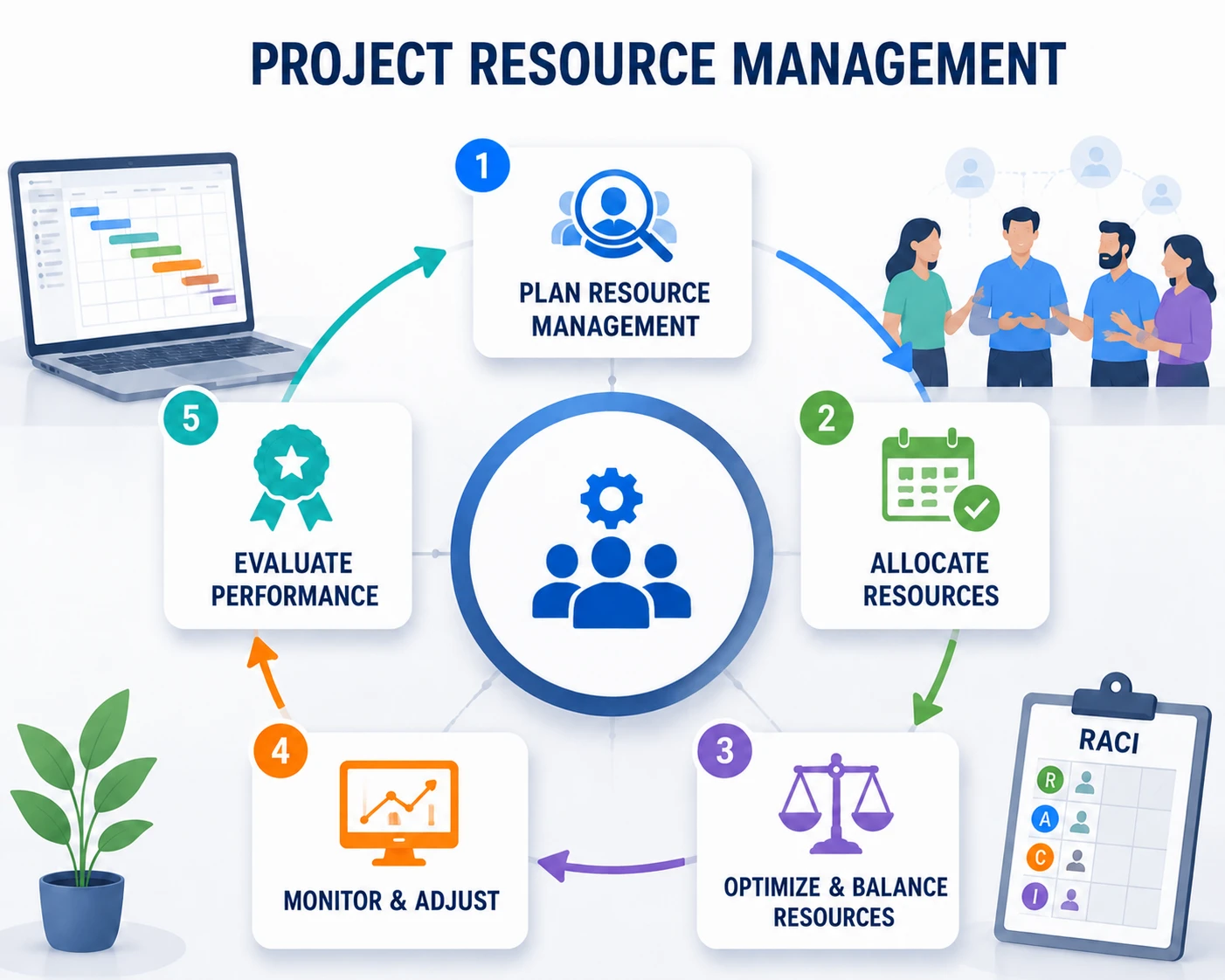
PMBOK 8 (Section 2.6.2) organizes resource management into 5 processes running throughout the project life cycle. Think of these as a connected chain — each process feeds into the next:
Step | Process | Focus Area | Key Benefit |
|---|---|---|---|
1 | Plan Resource Management | Planning | Establishes the approach and management effort level appropriate to project complexity |
2 | Estimate Resources | Planning | Identifies the type, quantity, and characteristics of resources needed |
3 | Acquire Resources | Executing | Obtains and assigns resources to activities |
4 | Lead the Team | Executing | Guides, develops, and manages the team to enhance performance |
5 | Monitor and Control Resourcing | Monitoring | Ensures resources are available as planned and enables corrective actions |
The "Plan and manage resources" task in the PMP ECO covers primarily processes 1, 2, 3, and 5 — focusing on planning and optimization. Process 4 (Lead the Team) is covered under a separate task in the People Domain.
4. Enabler 1: Define and Plan Resources Based on Requirements
This is the foundational step — answering the question: "What do we need, how much, when, and where?"
4.1. Plan Resource Management — Establishing the Strategy
PMBOK 8 (Section 2.6.2.1): "The key benefit of this process is that it establishes the approach and level of management effort needed to manage project resources based on the type and complexity of the project."
The Resource Management Plan — the key output — must clearly define:
- Identification of resources — Methods for identifying required resources
- Acquiring resources — How to obtain them (internal assignment, external procurement, partnerships)
- Roles and responsibilities — RACI matrix, role descriptions, authority levels
- Project organization charts — Hierarchical charts showing reporting relationships
- Resource calendars — Availability windows for each resource
- Training plan — Skill gaps and strategies to address them
- Team development methods — How to build and sustain a high-performing team
- Resource control — Monitoring and releasing resources
- Recognition plan — Rewards and recognition criteria
4.2. Resource Planning Tools — PMBOK 8
PMBOK 8 identifies 5 tools & techniques specific to Plan Resource Management:
Tool | Description | When to Use |
|---|---|---|
RACI Matrix | Responsible, Accountable, Consulted, Informed — a grid mapping work packages to team members | All projects. "Ensures only one person accountable for any one task to avoid confusion." |
Organizational Theory | Understanding human behavior in organizations (Maslow, Herzberg, McGregor, McClelland, Pink) | When designing motivation strategies and reward systems |
SWOT Analysis | Strengths, Weaknesses, Opportunities, Threats for resource planning | Assessing internal capabilities vs. external needs |
Green HRM | People management policies focusing on sustainable use of resources and environmental performance | Projects with sustainability requirements |
Resource-Based View | VRIO framework — Value, Rarity, Imitability, Organization — assessing competitive advantage from resources | Strategic resource decisions, make-or-buy analysis |
🌟 What's new in PMBOK 8 — Green HRM: "A set of people management policies and practices that focuses on the sustainable use of resources, preserving the natural environment, and improving environmental performance. For example, incorporating green practices in recruitment and selection, training and development, performance management, and compensation." — Sustainability is now an official part of resource planning.
4.3. Estimate Resources — Defining Specific Needs
Once you have the strategy, the next step is detailed estimation. PMBOK 8 (Section 2.6.2.2): "The key benefit is that it identifies the type, quantity, and characteristics of resources required to complete the project."
Estimation techniques from PMBOK 8:
- Bottom-up estimating — Estimate each activity individually, then aggregate. Most accurate but most time-consuming.
- Analogous estimating — Based on similar past projects. Fast but less accurate.
- Parametric estimating — Uses a statistical relationship (e.g., 1 developer per 5 user stories per sprint).
- Alternative analysis — Compare multiple allocation options.
- AI and Predictive Analytics — New in PMBOK 8: using machine learning to forecast resource needs.
⚠️ Key outputs: Resource Requirements (detailed needs for each work package), Basis of Estimates (explaining why estimates were made that way), and Resource Breakdown Structure (RBS) — decomposing resources by category and type, analogous to the WBS for scope.
🌟 What's new in PMBOK 8: Estimate Resources now includes Artificial Intelligence, Predictive Analytics, Virtual Reality, Augmented Reality, and Genetic Algorithms as official tools and techniques — reflecting the trend of using technology in resource planning.
4.4. Acquire Resources — Turning Plans into Reality
PMBOK 8 highlights 3 major risks when acquiring resources:
- Failure to acquire → impacts schedule, budget, satisfaction, quality, and increases risk. Worst case: project cancellation.
- Resources unavailable → the PM must assign alternatives "if risks are acknowledged and legal, regulatory, mandatory criteria are not violated."
- Impact documentation → the PM must document the impact of unavailability on schedule, budget, risks, quality, and training plans.
💡 Key tools: Multicriteria Decision Analysis (selecting resources based on multiple criteria: availability, cost, experience, skills), Negotiation (with functional managers, other PMs, external providers), Pre-assignment (resources already designated in the charter/contract), Virtual Teams (PMBOK 8 emphasizes this is now standard, not an exception).
5. Enabler 2: Manage and Optimize Resource Needs and Availability
Once you've planned and acquired resources, the real challenge begins: sustaining and optimizing resources throughout the project life cycle. This is where most PMs struggle — because reality never matches the plan.
5.1. Monitor and Control Resourcing — Continuous Oversight
PMBOK 8 (Section 2.6.2.5): "The key benefit is ensuring that the assigned resources are available to the project at the right time and in the right place and are released when no longer needed."
This process focuses on 6 specific activities:
- Monitoring resource expenditures — Actual costs vs. planned
- Identifying shortages and surpluses — Detecting over- or under-allocation promptly
- Ensuring resources used and released according to plan — Not retaining resources that are no longer needed
- Informing stakeholders — Communicating issues in a timely manner
- Influencing utilization changes — Proactively adjusting before problems occur
- Managing actual changes — Handling resource changes as they arise
PMBOK® 8 warns of 3 risks from inadequate control: (1) Failing to secure critical equipment on time → delays manufacturing. (2) Ordering low-quality materials → high recalls or rework. (3) Too much inventory → high operational costs; too little → inability to satisfy customer demand.
5.2. Resource Optimization — The Two Most Important Techniques
These are the two techniques every PM must master — both for real projects and for the PMP exam:
Technique | Purpose | Affects Critical Path? | When to Use? |
|---|---|---|---|
Resource Leveling | Balances demand vs. supply by adjusting start/finish dates | Yes — may extend the schedule | Resources are overallocated, shared resources have limited availability, or stable usage is required |
Resource Smoothing | Adjusts activities within available float to reduce peak demand | No — uses only free/total float | When you want to optimize without delaying the completion date |
PMBOK® 8, Section 5: "Resource leveling — a resource optimization technique in which adjustments are made to the project schedule to optimize the allocation of resources and which may affect the critical path... Resource smoothing — as opposed to resource leveling, the project's critical path is not changed and the completion date may not be delayed."
Practical example: Developer Tom is assigned to 2 activities on Day 2 (each activity 8 hours = 16 hours/day — impossible). Resource Leveling would move 1 activity to Day 3, resolving the overallocation but potentially extending the project by 1 day. Resource Smoothing would only move the activity if it has float — if it has no float, smoothing cannot resolve the conflict.
5.3. Monitoring and Optimization Tools from PMBOK 8
Monitor and Control Resourcing has its own distinct set of tools:
- Performance reviews — Compare actual vs. planned resource usage
- Trend analysis — Forecast future resource needs based on current data
- Cost-benefit analysis — Evaluate trade-offs when changing resource allocation
- Value stream mapping — New in PMBOK 8: map the entire flow to identify waste in resource usage
- Theory of constraints — New in PMBOK 8: identify the bottleneck resource and optimize around it
- Continuous improvement — New in PMBOK 8: Kaizen mindset for resource optimization
- Control charts — Track whether resource utilization stays within acceptable limits
5.4. Check Results — Metrics for Measuring Effectiveness
PMBOK 8 (Table 2-10) identifies 7 outcomes to verify for the Resources Domain:
Outcome | How to Verify |
|---|---|
Shared ownership | All team members know vision and objectives, own deliverables and outcomes |
High-performing team | Trust, collaboration, adaptability, resilience, empowerment, recognition |
Effective resource utilization | Actual vs. planned resource usage is effectively managed |
Acceptable downtime | Total downtime vs. total planned resource time at acceptable level |
Team productivity | Units produced vs. hours worked, KPIs regularly reviewed |
Efficient physical/virtual resources | Materials used, scrap discarded, rework indicate efficient use |
Procurement management | Procurement processes, order/delivery tracking successfully managed |
6. Comparing Resource Management: Predictive vs. Adaptive
PMBOK 8 (Section 2.6.3) clearly distinguishes how to tailor resource management by development approach:
Aspect | Predictive | Adaptive |
|---|---|---|
Planning | Detailed upfront. Define requirements early, allocate based on full schedule. | Just-enough. Self-organizing teams, flexible agreements, lean methods. |
Team structure | Defined roles, hierarchical reporting, PM assigns tasks | Self-organizing teams, generalizing specialists, team pulls work |
Decision-making | Centralized — PM directs | Distributed — team decides |
Resource allocation | Assigned per schedule baseline | Flexible, capacity-based, pulled when ready |
Optimization | Resource leveling, smoothing, formal reallocation | Velocity-based planning, WIP limits, continuous flow |
Leadership style | More directive when needed | Servant leadership, coaching, facilitation |
Skill approach | Specialists assigned to specific tasks | Generalizing specialists, cross-functional, T-shaped skills |
Change handling | Formal change control for resource changes | Backlog reprioritization, sprint-by-sprint adjustment |
PMBOK® 8, Tailoring: "In an adaptive development approach, projects with high variability benefit from team structures that maximize focus and collaboration, such as self-organizing teams with generalizing specialists. Collaboration is intended to boost productivity and facilitate innovative problem-solving."
Sustainability and Well-being — What's New in PMBOK 8
PMBOK 8 adds two tailoring considerations that have never appeared before:
- Sustainability: "Projects should consider the environmental and social impact of every stage in the value chain, from hiring team members to sourcing materials, transportation, and disposal."
- Employee well-being: "Quiet quitting is when employees continually put in the minimum amount of effort to keep their jobs but do not go the extra mile. Companies are prioritizing mental health initiatives and creating a work culture that fosters work-life balance — flexible work schedules, stress management programs, and generous time-off policies."
⚠️ Note: PMBOK 8 is the first edition to officially mention "quiet quitting" in the context of resource management — reflecting the post-COVID workforce reality that PMs need to keep in mind.
7. PMP Exam Tips for Resource Management
📍 Tip 1 — Resource Leveling vs. Smoothing: If the question says "the project deadline cannot change" — the answer is Resource Smoothing (does not affect the critical path). If "resources are overallocated and must be resolved" — the answer is Resource Leveling (may extend the schedule).
📍 Tip 2 — RACI Matrix: When the exam describes "confusion about who is responsible" or "multiple people think they're in charge" — the answer usually involves establishing or reviewing the RACI matrix. Remember: only ONE person is Accountable for each task.
📍 Tip 3 — Resource unavailable: When resources are not available, the PM should: (1) Assess impact on schedule/cost/risk, (2) Explore alternatives, (3) Document the impact, (4) Communicate to stakeholders — NOT immediately escalate or change the baseline without analysis.
📍 Tip 4 — Predictive vs. Adaptive team: If the question describes "self-organizing team" or "team decides how to do the work" — that is adaptive. If "PM assigns tasks" or "detailed resource allocation plan" — that is predictive. The answer must fit the context.
8. Ten Situational Multiple-Choice Questions
Question 1
You are managing a software project in a matrix organization. Your best developer is also assigned to another project at 50% capacity. Midway through your project, the other PM increases their demand to 80%, leaving only 20% for your critical-path activities.
What should you do FIRST?
A. Escalate to the developer's functional manager immediately.
B. Assess the impact on your project schedule and cost, then negotiate with the other PM and functional manager with data showing the effect on both projects.
C. Find a replacement developer and reassign the work.
D. Adjust your schedule to accommodate the reduced availability.
Question 2
Your project schedule shows that two critical activities require the same testing equipment during Week 5. The equipment cannot be shared simultaneously. The project deadline is fixed and cannot be extended.
Which resource optimization technique should you apply?
A. Resource leveling — adjust the schedule to resolve the conflict.
B. Resource smoothing — use available float to reschedule one activity without affecting the critical path.
C. Fast-tracking — run the two activities in parallel by splitting the equipment usage.
D. Crashing — rent additional equipment to allow both activities to proceed simultaneously.
Question 3
You are planning resources for a construction project. The project charter specifies sustainability requirements. Your team is selecting subcontractors for material sourcing.
Which PMBOK 8 tool should you incorporate into the resource planning process?
A. Organizational theory
B. Green human resource management
C. Resource-based view
D. SWOT analysis
Question 4
Your agile team of 7 has been performing well for 4 sprints. The sponsor wants to "speed things up" by adding 5 more developers to the team immediately.
What is the BEST response?
A. Accept the additional resources since more developers will increase velocity.
B. Explain the impact of team composition changes using concepts from organizational theory — new members disrupt team dynamics (Tuckman regression), require onboarding time, and may actually decrease velocity in the short term. Propose a phased approach if additional resources are needed.
C. Reject the request since the team is already performing well.
D. Add the developers but assign them to a separate work stream.
Question 5
During resource estimation for a data center migration project, your team needs to determine the number of network engineers required. Historical data from three similar migrations is available, and your organization has a standard ratio of 1 network engineer per 50 server migrations.
Which estimation technique is MOST appropriate?
A. Bottom-up estimating
B. Analogous estimating
C. Parametric estimating
D. Expert judgment
Question 6
Your project has multiple teams across 3 countries (US, India, Germany). You notice that the India team consistently works overtime while the US team has idle capacity. Both teams have similar skill sets.
What should you do?
A. Accept the situation since time zone differences make rebalancing impractical.
B. Analyze the workload distribution across teams, identify tasks that can be reassigned based on capacity and skills, and rebalance the allocation — while considering time zone impacts on collaboration and handoffs.
C. Hire additional resources for the India team to reduce their overtime.
D. Ask the US team to extend their working hours to overlap with India.
Question 7
You discover that a critical testing environment (virtual resource) will be unavailable for 2 weeks due to a planned infrastructure upgrade by the IT department. This was not communicated to your project team. The testing phase is on the critical path.
What should you do FIRST?
A. Escalate to the sponsor to pressure IT to postpone their upgrade.
B. Assess the impact on the project schedule, explore alternatives (cloud-based testing environment, rescheduling non-critical testing first), document the impact, and communicate with stakeholders — then negotiate with IT for a resolution that works for both.
C. Submit a change request to extend the project timeline by 2 weeks.
D. Proceed with other project activities and wait for the environment to become available.
Question 8
During a project review, you notice that resource utilization is at 95% across the team for the past 3 months. The team has been meeting deadlines, but you observe increasing sick days, lower participation in retrospectives, and two team members have privately mentioned feeling burned out.
What does this indicate, and what should you do?
A. The team is productive and meeting targets — continue the current approach.
B. High utilization rates with burnout indicators suggest unsustainable workload. Rebalance the workload, address the burnout proactively, and adjust resource plans to maintain sustainable pace — PMBOK 8 emphasizes employee well-being as a tailoring consideration.
C. Hire additional contractors to reduce the workload.
D. Reduce scope to lower the demand on the team.
Question 9
You are creating a Resource Breakdown Structure (RBS) for a hybrid project. The project has both internal development teams (agile) and external construction contractors (predictive).
How should you structure the RBS?
A. Create two separate RBS documents — one for agile, one for predictive.
B. Create one integrated RBS that categorizes all resources by type (human, physical, virtual), then by source (internal, external), and by assignment (agile stream, predictive stream) — providing a holistic view of all project resources.
C. Use the organizational chart instead of an RBS since it already shows resource assignments.
D. Only create an RBS for the predictive stream since agile teams are self-organizing.
Question 10
Your project's resource management plan was created 6 months ago. Since then, 3 team members have left, 2 new technologies were introduced, and the organization restructured one department. The plan has not been updated.
What is the PRIMARY risk?
A. The project budget may be inaccurate due to staffing changes.
B. The resource management plan no longer reflects reality — creating gaps between planned and actual resource availability, skills, and organizational structures. Decisions based on this outdated plan will likely be suboptimal, increasing risk across schedule, cost, and quality.
C. New team members may not understand their roles and responsibilities.
D. The new technologies may require training that wasn't budgeted.
Answer Key
Question 1: Answer: B
— PMBOK 8 states that when resources are unavailable, the PM should document the impact on schedule, budget, risks, and quality, then negotiate. Escalating without analysis (A) is premature. Replacing (C) ignores the negotiation step. Adjusting without assessing (D) may not be necessary if negotiation succeeds.
Question 2: Answer: B
— Since the deadline is fixed, Resource Smoothing is preferred because it does not change the critical path. Leveling (A) could extend the deadline. Fast-tracking (C) is impossible when the resource can't be shared. Crashing (D) may work but adds cost — smoothing should be tried first.
Question 3: Answer: B
— Green HRM is a PMBOK 8 tool specifically for Plan Resource Management that "focuses on the sustainable use of resources, preserving the natural environment, and improving environmental performance." When sustainability is explicitly required, Green HRM is the directly applicable tool.
Question 4: Answer: B
— PMBOK 8's Tuckman Ladder warns that team composition changes can cause regression to earlier stages. Brooks's Law (from organizational theory) states adding people to a late project makes it later. The PM should educate the sponsor with data and propose a measured approach. Flat rejection (C) doesn't address the sponsor's concern.
Question 5: Answer: C
— Parametric estimating uses statistical relationships between historical data and variables. The "1 engineer per 50 servers" ratio is a parametric model. Analogous (B) would use overall project similarity, not a specific ratio. Bottom-up (A) would estimate each activity individually. Parametric is the best fit when you have a reliable parameter.
Question 6: Answer: B
— PMBOK 8's Monitor and Control Resourcing includes "identifying and dealing with resource shortages and surpluses in a timely manner." The PM should analyze data (utilization rates, task dependencies), then optimize allocation. Accepting waste (A) and forcing overtime (D) are poor resource management. Hiring (C) adds cost without addressing the root cause.
Question 7: Answer: B
— PMBOK 8 emphasizes assessing impact and exploring alternatives before escalating or requesting changes. The PM should first understand the full impact, then proactively seek solutions. Immediate escalation (A) may damage relationships. A change request (C) may be needed but not before assessing alternatives. Waiting (D) is passive and wastes time.
Question 8: Answer: B
— PMBOK 8's tailoring considerations explicitly address employee well-being and "quiet quitting." 95% utilization sustained over months is a red flag — it leaves no buffer for unexpected work, learning, or personal needs. The PM should proactively address this before losing team members. Meeting deadlines at the cost of team health is not sustainable.
Question 9: Answer: B
— The RBS is a hierarchical decomposition of ALL resources by category and type. PMBOK 8's holistic view principle applies — one integrated RBS enables the PM to see resource competition, dependencies, and optimization opportunities across both streams. Separate documents (A) lose the cross-stream visibility. Org charts (C) show reporting, not resource categories.
Question 10: Answer: B
— While A, C, and D are all valid concerns, they are symptoms of the root cause: an outdated resource management plan. PMBOK 8 states the plan should be maintained throughout the project. An outdated plan means ALL resource decisions — allocation, estimation, acquisition, optimization — are based on wrong assumptions. The PM should update the plan as a priority.
9. Conclusion
Resource management is one of the greatest challenges and most decisive factors in project success. Three key takeaways from this article:
1. "Right resource, right time, right place" — This is the ultimate goal. Every process from Plan → Estimate → Acquire → Monitor serves this goal. Without the right resources, every other beautiful plan is meaningless.
2. Optimization is a continuous process, not a one-time event — Resource Leveling and Smoothing aren't only applied when building the schedule. PMs must continuously monitor utilization, detect shortages and surpluses, and adjust proactively. PMBOK 8 adds Value Stream Mapping and Theory of Constraints to the toolkit — a clear signal that PMI expects PMs to optimize continuously.
3. People aren't "resources" — they're human beings — PMBOK 8 mentions quiet quitting, employee well-being, and Green HRM for the first time. 95% utilization on paper looks "efficient" but in reality it's a path to burnout. Great PMs balance efficiency with sustainability.
PMBOK® 8, Section 2.6.1: "Project managers should invest suitable effort in acquiring, managing, motivating, and empowering the project team. Additionally, project managers should be aware of different aspects that influence the team such as team environment, geographical locations, communications, organizational change management, internal and external politics, cultural issues, and other factors that may alter project performance."
Remember: resources are the foundation of everything else in the project — scope cannot be delivered without people, the schedule cannot be maintained without equipment, and quality cannot be achieved without the right skills. Investing in resource management is investing in project success.
Frequently Asked Questions (FAQ)
What changed in PMBOK 8's approach to resource management compared to PMBOK 6?
PMBOK 8 adds Green HRM — managing resources with a focus on sustainability and team well-being. It also places greater emphasis on managing distributed/virtual teams, cultural diversity, and psychological safety. The approach is outcome-based rather than process-based: the focus is on the results of resource planning rather than strict adherence to each step.
When should you use Resource Leveling and when should you use Resource Smoothing?
Resource Leveling: when there are hard constraints on resource availability — the timeline may be extended but resource limits must not be exceeded. Use it when resource overallocation is severe. Resource Smoothing: when the timeline is the priority — shift tasks within available float to balance workload without delaying the project.
How does managing virtual teams differ from managing traditional teams?
Virtual teams: members are distributed across different locations, time zones, and cultures. Challenges: building trust, communicating effectively, tracking progress, and maintaining engagement. PMBOK 8 suggests: daily standups via video, asynchronous communication tools (Slack, Confluence), and a clear team charter covering working agreements.
Now that you understand project resource planning, it's time to put it into practice with real exam questions.
Next article: Project Procurement Management: Strategy & Contracts in PMBOK 8
Project resource management: RACI & Resource Leveling for PMP
Leading the project team according to PMBOK 8: 7 leadership competencies PMs need
Try Free PMP Practice Questions →
Official References: