Nguồn lực trên giấy luôn khác ngoài đời — PM biết điều đó. PMBOK 8 tiếp cận resource planning với tư duy linh hoạt hơn. Bài này đi qua RACI, Leveling và virtual team.
1. Tình huống thực tế: Khi nguồn lực "trên giấy" khác nguồn lực "ngoài đời"
Hãy tưởng tượng: bạn được giao quản lý một dự án phát triển ứng dụng mobile cho ngân hàng. Resource management plan cho thấy bạn có 5 developers full-time. Nhưng thực tế: 2 người đang bị chia sẻ với dự án khác, 1 người sắp nghỉ phép dài hạn, và developer duy nhất hiểu legacy API đang overloaded. Deadline không đổi. Budget không tăng.
Nghe quen không?
Theo PMI Pulse of the Profession, resource-related issues nằm trong top 3 nguyên nhân thất bại dự án. PMBOK 8 nhấn mạnh rõ: "Failure to acquire the necessary resources for the project may affect the schedule, budget, customer satisfaction, and quality while increasing risk. Insufficient resources or capabilities decrease the probability of success and, in a worst-case scenario, could result in project cancellation."
Quản lý nguồn lực không chỉ là "xin thêm người" — mà là nghệ thuật lập kế hoạch đúng, phân bổ thông minh, và tối ưu liên tục. Bài viết này sẽ giúp bạn nắm vững cách làm điều đó theo PMBOK 8.
2. Nguồn lực trong dự án bao gồm những gì?
Nhiều PM chỉ nghĩ đến "con người" khi nói về nguồn lực. PMBOK 8 định nghĩa rộng hơn nhiều — nguồn lực dự án bao gồm hai nhóm lớn:
Loại nguồn lực | Bao gồm | Ví dụ | Ai quản lý? |
|---|---|---|---|
Human Resources (Team) | Individuals với roles và responsibilities, làm việc tập thể để đạt mục tiêu | Developers, testers, BA, designers, SMEs | PM qua Lead the Team |
Physical / Virtual Resources | Equipment, materials, supplies, facilities, infrastructure, software, licenses, services | Servers, testing environments, licenses, lab space, raw materials | PM qua Monitor and Control Resourcing |
PMBOK® 8, Section 2.6: "The Resources performance domain refers to how effectively and efficiently a project team plans for and utilizes its available resources. This performance domain encompasses both human resources (the project team itself) and physical or virtual resources."
🌟 Điều quan trọng: PMBOK 8 tách biệt rõ ràng cách quản lý hai nhóm này. Con người được quản lý qua Lead the Team (leadership, motivation, empowerment). Tài nguyên vật lý/ảo được quản lý qua Monitor and Control Resourcing (availability, utilization, maintenance). PM cần hai bộ kỹ năng khác nhau cho hai nhóm.
Các vai trò chính trong quản lý nguồn lực
Vai trò | Trách nhiệm |
|---|---|
Project Manager | Team formation, operation, motivation, empowerment. Proactively develop team skills, enhance satisfaction. |
Resource Manager | Management authority over one or more resources. Có thể là functional manager trong matrix organization. |
Team Members | Add expertise to planning and decision-making, strengthening commitment to the project. |
3. Framework tổng quan: 5 quy trình quản lý nguồn lực theo PMBOK 8
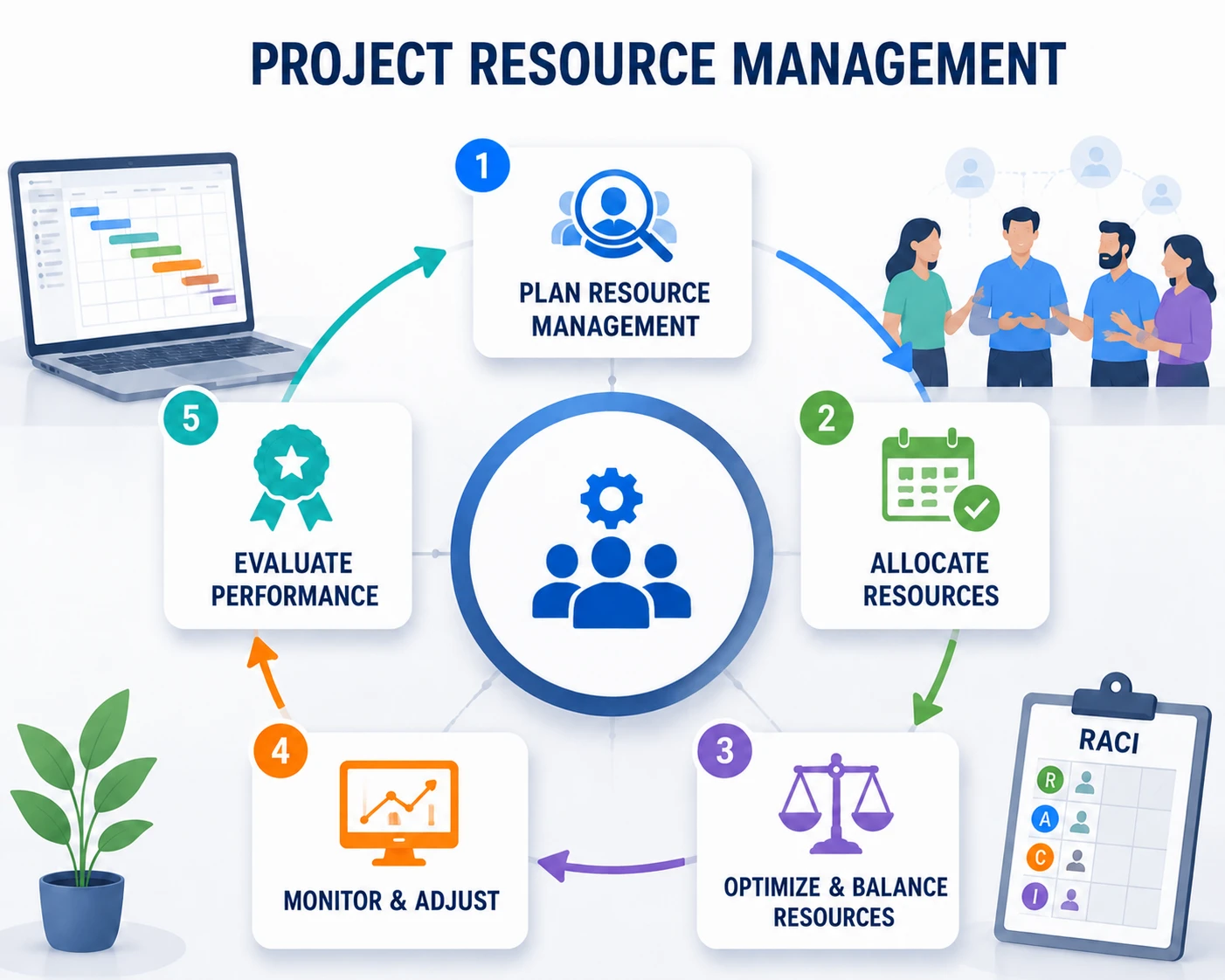
PMBOK 8 (Section 2.6.2) tổ chức quản lý nguồn lực thành 5 quy trình xuyên suốt vòng đời dự án. Hãy hình dung đây là một chuỗi liên kết — mỗi quy trình feeds vào quy trình tiếp theo:
Bước | Quy trình | Focus Area | Key benefit |
|---|---|---|---|
1 | Plan Resource Management | Planning | Thiết lập approach và mức quản lý phù hợp với complexity dự án |
2 | Estimate Resources | Planning | Xác định type, quantity, và characteristics nguồn lực cần thiết |
3 | Acquire Resources | Executing | Obtain và assign nguồn lực cho activities |
4 | Lead the Team | Executing | Guide, develop, manage team để enhance performance |
5 | Monitor and Control Resourcing | Monitoring | Đảm bảo resources available as planned, corrective actions |
Task "Plan and manage resources" trong PMP ECO bao phủ chủ yếu quy trình 1, 2, 3, và 5 — tập trung vào planning và optimization. Quy trình 4 (Lead the Team) được cover ở một Task riêng trong People Domain.
4. Enabler 1: Define and plan resources based on requirements
Đây là bước nền tảng — trả lời câu hỏi: "Chúng ta cần gì, bao nhiêu, khi nào, và ở đâu?"
4.1. Plan Resource Management — Thiết lập chiến lược
PMBOK 8 (Section 2.6.2.1): "The key benefit of this process is that it establishes the approach and level of management effort needed to manage project resources based on the type and complexity of the project."
Resource Management Plan — output chính — cần xác định rõ:
- Identification of resources — Phương pháp xác định nguồn lực cần thiết
- Acquiring resources — Cách thức obtain (internal assignment, external procurement, partnerships)
- Roles and responsibilities — RACI matrix, role descriptions, authority levels
- Project organization charts — Hierarchical charts showing reporting relationships
- Resource calendars — Availability windows cho từng resource
- Training plan — Skill gaps và strategies to address them
- Team development methods — Cách build và sustain high-performing team
- Resource control — Monitoring và releasing resources
- Recognition plan — Rewards và recognition criteria
4.2. Công cụ lập kế hoạch nguồn lực — PMBOK 8
PMBOK 8 liệt kê 5 tools & techniques đặc thù cho Plan Resource Management:
Tool | Mô tả | Khi nào dùng |
|---|---|---|
RACI Matrix | Responsible, Accountable, Consulted, Informed — grid mapping work packages với team members | Mọi dự án. "Ensures only one person accountable for any one task to avoid confusion." |
Organizational Theory | Hiểu hành vi con người trong tổ chức (Maslow, Herzberg, McGregor, McClelland, Pink) | Khi cần thiết kế motivation strategies, reward systems |
SWOT Analysis | Strengths, Weaknesses, Opportunities, Threats cho resource planning | Đánh giá internal capabilities vs. external needs |
Green HRM | People management policies focusing on sustainable use of resources và environmental performance | Dự án có yêu cầu sustainability |
Resource-Based View | VRIO framework — Value, Rarity, Imitability, Organization — đánh giá competitive advantage từ resources | Strategic resource decisions, make-or-buy analysis |
🌟 Điểm mới PMBOK 8 — Green HRM: "A set of people management policies and practices that focuses on the sustainable use of resources, preserving the natural environment, and improving environmental performance. For example, incorporating green practices in recruitment and selection, training and development, performance management, and compensation." — Sustainability giờ là một phần chính thức của resource planning.
4.3. Estimate Resources — Xác định nhu cầu cụ thể
Sau khi có chiến lược, bước tiếp theo là ước tính chi tiết. PMBOK 8 (Section 2.6.2.2): "The key benefit is that it identifies the type, quantity, and characteristics of resources required to complete the project."
Các kỹ thuật estimation từ PMBOK 8:
- Bottom-up estimating — Ước tính từng activity rồi cộng lại. Chính xác nhất nhưng tốn thời gian nhất.
- Analogous estimating — Dựa trên dự án tương tự. Nhanh nhưng kém chính xác.
- Parametric estimating — Dùng statistical relationship (VD: 1 developer / 5 user stories / sprint).
- Alternative analysis — So sánh nhiều phương án phân bổ khác nhau.
- AI và Predictive Analytics — PMBOK 8 mới: dùng machine learning để dự báo resource needs.
⚠️ Outputs quan trọng: Resource Requirements (chi tiết nhu cầu cho từng work package), Basis of Estimates (giải thích tại sao estimate như vậy), và Resource Breakdown Structure (RBS) — phân rã nguồn lực theo category và type, giống WBS cho scope.
🌟Điểm mới PMBOK 8: Estimate Resources giờ bao gồm Artificial Intelligence, Predictive Analytics, Virtual Reality, Augmented Reality, và Genetic Algorithms như tools & techniques chính thức — phản ánh xu hướng dùng công nghệ trong resource planning.
4.4. Acquire Resources — Biến kế hoạch thành thực tế
PMBOK 8 nhấn mạnh 3 rủi ro lớn khi acquire resources:
- Failure to acquire → ảnh hưởng schedule, budget, satisfaction, quality, và tăng risk. Worst case: project cancellation.
- Resources unavailable → PM phải assign alternatives "if risks are acknowledged and legal, regulatory, mandatory criteria are not violated."
- Impact documentation → PM phải document impact của unavailability lên schedule, budget, risks, quality, training plans.
💡 Tools chính: Multicriteria Decision Analysis (chọn resource dựa trên nhiều tiêu chí: availability, cost, experience, skills), Negotiation (với functional managers, other PMs, external providers), Pre-assignment (resources đã được chỉ định từ charter/contract), Virtual Teams (PMBOK 8 nhấn mạnh đây là standard, không phải exception).
5. Enabler 2: Manage and optimize resource needs and availability
Sau khi đã plan và acquire, thách thức thực sự bắt đầu: duy trì và tối ưu nguồn lực suốt vòng đời dự án. Đây là nơi phần lớn PM gặp khó khăn — vì thực tế luôn khác kế hoạch.
5.1. Monitor and Control Resourcing — Giám sát liên tục
PMBOK 8 (Section 2.6.2.5): "The key benefit is ensuring that the assigned resources are available to the project at the right time and in the right place and are released when no longer needed."
Quy trình này quan tâm đến 6 hoạt động cụ thể:
- Monitoring resource expenditures — Chi phí thực tế vs. kế hoạch
- Identifying shortages and surpluses — Phát hiện thiếu/thừa kịp thời
- Ensuring resources used and released according to plan — Không giữ resource không cần
- Informing stakeholders — Communicate issues kịp thời
- Influencing utilization changes — Chủ động điều chỉnh trước khi xảy ra vấn đề
- Managing actual changes — Xử lý thay đổi resource khi chúng xảy ra
PMBOK® 8 cảnh báo 3 rủi ro khi thiếu kiểm soát: (1) Failing to secure critical equipment on time → delays manufacturing. (2) Ordering low-quality materials → high recalls or rework. (3) Too much inventory → high operational costs; too little → inability to satisfy customer demand.
5.2. Resource Optimization — Hai kỹ thuật quan trọng nhất
Đây là hai kỹ thuật mà PM phải nắm vững — cả cho thực tế lẫn đề thi PMP:
Kỹ thuật | Mục đích | Ảnh hưởng Critical Path? | Khi nào dùng? |
|---|---|---|---|
Resource Leveling | Cân bằng demand vs. supply bằng cách điều chỉnh start/finish dates | Có — có thể kéo dài schedule | Resources bị overallocated, shared resources có limited availability, cần giữ usage ổn định |
Resource Smoothing | Điều chỉnh activities trong phạm vi float để giảm peak demand | Không — chỉ dùng free/total float | Muốn tối ưu nhưng không được delay completion date |
PMBOK® 8, Section 5: "Resource leveling — a resource optimization technique in which adjustments are made to the project schedule to optimize the allocation of resources and which may affect the critical path... Resource smoothing — as opposed to resource leveling, the project's critical path is not changed and the completion date may not be delayed."
Ví dụ minh họa: Developer Tom được assign 2 activities cùng Day 2 (mỗi activity 8 giờ = 16 giờ/ngày — bất khả thi). Resource Leveling sẽ dời 1 activity sang Day 3, giải quyết overallocation nhưng có thể kéo dài project 1 ngày. Resource Smoothing sẽ chỉ dời nếu activity đó có float — nếu không có float, smoothing không giải quyết được.
5.3. Tools giám sát và tối ưu từ PMBOK 8
Monitor and Control Resourcing có bộ tools riêng biệt:
- Performance reviews — So sánh actual vs. planned resource usage
- Trend analysis — Dự báo nhu cầu resource tương lai dựa trên data hiện tại
- Cost-benefit analysis — Đánh giá trade-offs khi thay đổi resource allocation
- Value stream mapping — PMBOK 8 mới: map toàn bộ flow để tìm waste trong resource usage
- Theory of constraints — PMBOK 8 mới: identify bottleneck resource và optimize xung quanh nó
- Continuous improvement — PMBOK 8 mới: Kaizen mindset cho resource optimization
- Control charts — Theo dõi resource utilization có nằm trong acceptable limits không
5.4. Check Results — Metrics đo hiệu quả
PMBOK 8 (Table 2-10) xác định 7 outcomes cần kiểm tra cho Resources Domain:
Outcome | Cách kiểm tra |
|---|---|
Shared ownership | All team members know vision and objectives, own deliverables and outcomes |
High-performing team | Trust, collaboration, adaptability, resilience, empowerment, recognition |
Effective resource utilization | Actual vs. planned resource usage is effectively managed |
Acceptable downtime | Total downtime vs. total planned resource time at acceptable level |
Team productivity | Units produced vs. hours worked, KPIs regularly reviewed |
Efficient physical/virtual resources | Materials used, scrap discarded, rework indicate efficient use |
Procurement management | Procurement processes, order/delivery tracking successfully managed |
6. So sánh quản lý nguồn lực: Predictive vs. Adaptive
PMBOK 8 (Section 2.6.3) phân biệt rõ cách tailoring resource management theo development approach:
Aspect | Predictive | Adaptive |
|---|---|---|
Planning | Detailed upfront. Define requirements early, allocate based on full schedule. | Just-enough. Self-organizing teams, flexible agreements, lean methods. |
Team structure | Defined roles, hierarchical reporting, PM assigns tasks | Self-organizing teams, generalizing specialists, team pulls work |
Decision-making | Centralized — PM directs | Distributed — team decides |
Resource allocation | Assigned per schedule baseline | Flexible, capacity-based, pulled when ready |
Optimization | Resource leveling, smoothing, formal reallocation | Velocity-based planning, WIP limits, continuous flow |
Leadership style | More directive when needed | Servant leadership, coaching, facilitation |
Skill approach | Specialists assigned to specific tasks | Generalizing specialists, cross-functional, T-shaped skills |
Change handling | Formal change control for resource changes | Backlog reprioritization, sprint-by-sprint adjustment |
PMBOK® 8, Tailoring: "In an adaptive development approach, projects with high variability benefit from team structures that maximize focus and collaboration, such as self-organizing teams with generalizing specialists. Collaboration is intended to boost productivity and facilitate innovative problem-solving."
Sustainability và Well-being — Điểm mới PMBOK 8
PMBOK 8 thêm hai tailoring considerations chưa từng có:
- Sustainability: "Projects should consider the environmental and social impact of every stage in the value chain, from hiring team members to sourcing materials, transportation, and disposal."
- Employee well-being: "Quiet quitting is when employees continually put in the minimum amount of effort to keep their jobs but do not go the extra mile. Companies are prioritizing mental health initiatives and creating a work culture that fosters work-life balance — flexible work schedules, stress management programs, and generous time-off policies."
⚠️ Chú ý: PMBOK 8 lần đầu tiên đề cập chính thức khái niệm "quiet quitting" trong resource management — phản ánh thực tế nhân sự hậu COVID mà PM cần lưu tâm.
7. Mẹo thi PMP về Resource Management
📍 Mẹo 1 — Resource Leveling vs. Smoothing: Nếu câu hỏi nói "the project deadline cannot change" — đáp án là Resource Smoothing (không ảnh hưởng critical path). Nếu "resources are overallocated and must be resolved" — đáp án là Resource Leveling (có thể kéo dài schedule).
📍 Mẹo 2 — RACI Matrix: Khi đề thi mô tả "confusion about who is responsible" hoặc "multiple people think they're in charge" — đáp án thường liên quan đến establishing hoặc reviewing RACI matrix. Nhớ: chỉ MỘT người Accountable cho mỗi task.
📍 Mẹo 3 — Resource unavailable: Khi resources không available, PM nên: (1) Assess impact trên schedule/cost/risk, (2) Explore alternatives, (3) Document impact, (4) Communicate to stakeholders — KHÔNG phải immediately escalate hoặc change the baseline without analysis.
📍 Mẹo 4 — Predictive vs. Adaptive team: Nếu câu hỏi mô tả "self-organizing team" hoặc "team decides how to do the work" — đó là adaptive. Nếu "PM assigns tasks" hoặc "detailed resource allocation plan" — đó là predictive. Đáp án phải phù hợp với context.
8. Mười câu hỏi trắc nghiệm tình huống
Question 1
You are managing a software project in a matrix organization. Your best developer is also assigned to another project at 50% capacity. Midway through your project, the other PM increases their demand to 80%, leaving only 20% for your critical-path activities.
What should you do FIRST?
A. Escalate to the developer's functional manager immediately.
B. Assess the impact on your project schedule and cost, then negotiate with the other PM and functional manager with data showing the effect on both projects.
C. Find a replacement developer and reassign the work.
D. Adjust your schedule to accommodate the reduced availability.
Question 2
Your project schedule shows that two critical activities require the same testing equipment during Week 5. The equipment cannot be shared simultaneously. The project deadline is fixed and cannot be extended.
Which resource optimization technique should you apply?
A. Resource leveling — adjust the schedule to resolve the conflict.
B. Resource smoothing — use available float to reschedule one activity without affecting the critical path.
C. Fast-tracking — run the two activities in parallel by splitting the equipment usage.
D. Crashing — rent additional equipment to allow both activities to proceed simultaneously.
Question 3
You are planning resources for a construction project. The project charter specifies sustainability requirements. Your team is selecting subcontractors for material sourcing.
Which PMBOK 8 tool should you incorporate into the resource planning process?
A. Organizational theory
B. Green human resource management
C. Resource-based view
D. SWOT analysis
Question 4
Your agile team of 7 has been performing well for 4 sprints. The sponsor wants to "speed things up" by adding 5 more developers to the team immediately.
What is the BEST response?
A. Accept the additional resources since more developers will increase velocity.
B. Explain the impact of team composition changes using concepts from organizational theory — new members disrupt team dynamics (Tuckman regression), require onboarding time, and may actually decrease velocity in the short term. Propose a phased approach if additional resources are needed.
C. Reject the request since the team is already performing well.
D. Add the developers but assign them to a separate work stream.
Question 5
During resource estimation for a data center migration project, your team needs to determine the number of network engineers required. Historical data from three similar migrations is available, and your organization has a standard ratio of 1 network engineer per 50 server migrations.
Which estimation technique is MOST appropriate?
A. Bottom-up estimating
B. Analogous estimating
C. Parametric estimating
D. Expert judgment
Question 6
Your project has multiple teams across 3 countries (US, India, Germany). You notice that the India team consistently works overtime while the US team has idle capacity. Both teams have similar skill sets.
What should you do?
A. Accept the situation since time zone differences make rebalancing impractical.
B. Analyze the workload distribution across teams, identify tasks that can be reassigned based on capacity and skills, and rebalance the allocation — while considering time zone impacts on collaboration and handoffs.
C. Hire additional resources for the India team to reduce their overtime.
D. Ask the US team to extend their working hours to overlap with India.
Question 7
You discover that a critical testing environment (virtual resource) will be unavailable for 2 weeks due to a planned infrastructure upgrade by the IT department. This was not communicated to your project team. The testing phase is on the critical path.
What should you do FIRST?
A. Escalate to the sponsor to pressure IT to postpone their upgrade.
B. Assess the impact on the project schedule, explore alternatives (cloud-based testing environment, rescheduling non-critical testing first), document the impact, and communicate with stakeholders — then negotiate with IT for a resolution that works for both.
C. Submit a change request to extend the project timeline by 2 weeks.
D. Proceed with other project activities and wait for the environment to become available.
Question 8
During a project review, you notice that resource utilization is at 95% across the team for the past 3 months. The team has been meeting deadlines, but you observe increasing sick days, lower participation in retrospectives, and two team members have privately mentioned feeling burned out.
What does this indicate, and what should you do?
A. The team is productive and meeting targets — continue the current approach.
B. High utilization rates with burnout indicators suggest unsustainable workload. Rebalance the workload, address the burnout proactively, and adjust resource plans to maintain sustainable pace — PMBOK 8 emphasizes employee well-being as a tailoring consideration.
C. Hire additional contractors to reduce the workload.
D. Reduce scope to lower the demand on the team.
Question 9
You are creating a Resource Breakdown Structure (RBS) for a hybrid project. The project has both internal development teams (agile) and external construction contractors (predictive).
How should you structure the RBS?
A. Create two separate RBS documents — one for agile, one for predictive.
B. Create one integrated RBS that categorizes all resources by type (human, physical, virtual), then by source (internal, external), and by assignment (agile stream, predictive stream) — providing a holistic view of all project resources.
C. Use the organizational chart instead of an RBS since it already shows resource assignments.
D. Only create an RBS for the predictive stream since agile teams are self-organizing.
Question 10
Your project's resource management plan was created 6 months ago. Since then, 3 team members have left, 2 new technologies were introduced, and the organization restructured one department. The plan has not been updated.
What is the PRIMARY risk?
A. The project budget may be inaccurate due to staffing changes.
B. The resource management plan no longer reflects reality — creating gaps between planned and actual resource availability, skills, and organizational structures. Decisions based on this outdated plan will likely be suboptimal, increasing risk across schedule, cost, and quality.
C. New team members may not understand their roles and responsibilities.
D. The new technologies may require training that wasn't budgeted.
Đáp án
Question 1: Answer: B
— PMBOK 8 states that when resources are unavailable, the PM should document the impact on schedule, budget, risks, and quality, then negotiate. Escalating without analysis (A) is premature. Replacing (C) ignores the negotiation step. Adjusting without assessing (D) may not be necessary if negotiation succeeds.
Question 2: Answer: B
— Since the deadline is fixed, Resource Smoothing is preferred because it does not change the critical path. Leveling (A) could extend the deadline. Fast-tracking (C) is impossible when the resource can't be shared. Crashing (D) may work but adds cost — smoothing should be tried first.
Question 3: Answer: B
— Green HRM is a PMBOK 8 tool specifically for Plan Resource Management that "focuses on the sustainable use of resources, preserving the natural environment, and improving environmental performance." When sustainability is explicitly required, Green HRM is the directly applicable tool.
Question 4: Answer: B
— PMBOK 8's Tuckman Ladder warns that team composition changes can cause regression to earlier stages. Brooks's Law (from organizational theory) states adding people to a late project makes it later. The PM should educate the sponsor with data and propose a measured approach. Flat rejection (C) doesn't address the sponsor's concern.
Question 5: Answer: C
— Parametric estimating uses statistical relationships between historical data and variables. The "1 engineer per 50 servers" ratio is a parametric model. Analogous (B) would use overall project similarity, not a specific ratio. Bottom-up (A) would estimate each activity individually. Parametric is the best fit when you have a reliable parameter.
Question 6: Answer: B
— PMBOK 8's Monitor and Control Resourcing includes "identifying and dealing with resource shortages and surpluses in a timely manner." The PM should analyze data (utilization rates, task dependencies), then optimize allocation. Accepting waste (A) and forcing overtime (D) are poor resource management. Hiring (C) adds cost without addressing the root cause.
Question 7: Answer: B
— PMBOK 8 emphasizes assessing impact and exploring alternatives before escalating or requesting changes. The PM should first understand the full impact, then proactively seek solutions. Immediate escalation (A) may damage relationships. A change request (C) may be needed but not before assessing alternatives. Waiting (D) is passive and wastes time.
Question 8: Answer: B
— PMBOK 8's tailoring considerations explicitly address employee well-being and "quiet quitting." 95% utilization sustained over months is a red flag — it leaves no buffer for unexpected work, learning, or personal needs. The PM should proactively address this before losing team members. Meeting deadlines at the cost of team health is not sustainable.
Question 9: Answer: B
— The RBS is a hierarchical decomposition of ALL resources by category and type. PMBOK 8's holistic view principle applies — one integrated RBS enables the PM to see resource competition, dependencies, and optimization opportunities across both streams. Separate documents (A) lose the cross-stream visibility. Org charts (C) show reporting, not resource categories.
Question 10: Answer: B
— While A, C, and D are all valid concerns, they are symptoms of the root cause: an outdated resource management plan. PMBOK 8 states the plan should be maintained throughout the project. An outdated plan means ALL resource decisions — allocation, estimation, acquisition, optimization — are based on wrong assumptions. The PM should update the plan as a priority.
9. Tổng kết
Quản lý nguồn lực là một trong những thách thức lớn nhất và cũng là yếu tố quyết định nhất cho thành công dự án. Ba takeaways chính từ bài viết:
1. "Right resource, right time, right place" — Đây là mục tiêu tối thượng. Mọi quy trình từ Plan → Estimate → Acquire → Monitor đều phục vụ mục tiêu này. Không có nguồn lực phù hợp, mọi kế hoạch đẹp đẽ khác đều vô nghĩa.
2. Optimization là quá trình liên tục, không phải sự kiện một lần — Resource Leveling và Smoothing không chỉ áp dụng lúc lập schedule. PM phải liên tục monitor utilization, phát hiện shortages/surpluses, và điều chỉnh proactively. PMBOK 8 thêm Value Stream Mapping và Theory of Constraints vào toolkit — đây là tín hiệu rõ ràng rằng PMI kỳ vọng PM tối ưu liên tục.
3. Con người không phải "resources" — họ là con người — PMBOK 8 lần đầu đề cập quiet quitting, employee well-being, và Green HRM. 95% utilization trên giấy là "hiệu quả" nhưng trong thực tế là đường đến burnout. PM giỏi balance efficiency với sustainability.
PMBOK® 8, Section 2.6.1: "Project managers should invest suitable effort in acquiring, managing, motivating, and empowering the project team. Additionally, project managers should be aware of different aspects that influence the team such as team environment, geographical locations, communications, organizational change management, internal and external politics, cultural issues, and other factors that may alter project performance."
🗒️ Hãy nhớ: nguồn lực là nền tảng của mọi thứ khác trong dự án — scope không thể deliver nếu thiếu người, schedule không thể giữ nếu thiếu thiết bị, và quality không thể đạt nếu skills không phù hợp. Đầu tư vào resource management chính là đầu tư vào thành công dự án.
Câu Hỏi Thường Gặp (FAQ)
PMBOK 8 thay đổi gì trong cách tiếp cận resource management so với PMBOK 6?
PMBOK 8 bổ sung Green HRM — quản lý nguồn lực gắn với sustainability và wellbeing của team. Cũng nhấn mạnh hơn về managing distributed/virtual teams, cultural diversity và psychological safety. Approach outcome-based thay vì process-based: focus vào kết quả resource planning hơn là tuân thủ từng bước.
Khi nào nên dùng Resource Leveling và khi nào dùng Resource Smoothing?
Resource Leveling: khi có hard constraints về resource availability — timeline có thể bị kéo dài nhưng không được vượt resource limits. Dùng khi resource overallocation nghiêm trọng. Resource Smoothing: khi timeline là priority — chỉ dịch chuyển tasks trong available float để cân bằng workload mà không delay project.
Managing virtual teams khác gì quản lý team truyền thống?
Virtual teams: thành viên ở nhiều địa điểm, múi giờ và văn hóa khác nhau. Thách thức: xây dựng trust, giao tiếp hiệu quả, track progress và maintain engagement. PMBOK 8 gợi ý: daily standups qua video, asynchronous communication tools (Slack, Confluence), và team charter rõ ràng về working agreements.
Bạn đã nắm vững lập kế hoạch nguồn lực dự án — giờ là lúc luyện tập với câu hỏi thi thật.
Bài tiếp theo: Quản Lý Mua Sắm Dự Án: Chiến Lược & Hợp Đồng PMBOK 8
Nguồn tham khảo chính thức:
Bạn đã sẵn sàng luyện tập chưa?
Thử CertFlow miễn phí — 10 câu hỏi, không cần đăng ký.
Bắt Đầu Miễn Phí