You can deliver on time and within budget — but if your stakeholders aren't aligned, your project will still fail. Here's the full PMBOK stakeholder process.
Think back to a project that ran into trouble. What percentage of those problems involved people — a dissatisfied stakeholder, an uncooperative department, a sponsor who suddenly shifted priorities? I'd bet that number is pretty high.
PMI is clear: stakeholder satisfaction is one of the key criteria for measuring project success. You can deliver on scope, schedule, and budget — but if stakeholders aren't satisfied, the project is still considered a failure.
This article walks you through the complete stakeholder management process — from identification, analysis, and classification, to planning engagement, and ongoing management and monitoring. This knowledge falls under the People domain in the ECO 2026, accounting for 33% of the PMP exam.
Who Are Stakeholders? — A Broader Definition Than You Think
According to PMI, a stakeholder is any individual, group, or organization that:
Can influence the project, or
Is affected by the project, or
Perceives itself to be affected by the decisions, activities, or outcomes of the project.
Notice the third point — "perceives itself to be affected." Even when someone is not actually impacted, if they believe they are, they are still a stakeholder and must be managed. This is a small detail that frequently appears in exam questions.
Why manage stakeholders?
In a single sentence: proactive and proper stakeholder management = reduced project risk. A key stakeholder you fail to identify or engage early can become a serious risk when they unexpectedly intervene at a late stage — when the cost of change is already very high.
Step 1: Identify Stakeholders — Find All of Them
This is the first and arguably most important step. Missing a key stakeholder at this stage can have serious consequences later.
What, Why, When?
What: The PM and project team identify all individuals or organizations affected by the project.
Why: An unidentified key stakeholder can become a high risk for the project. Early identification helps determine the right engagement focus for each person or group.
When: As early as possible — ideally during the initiation phase, and definitely before planning begins. Then repeat periodically throughout the project, as stakeholders may change.
Stakeholder Analysis: 4 Steps
The stakeholder analysis process consists of 4 clear steps:
Step 1: Identify all potential stakeholders
Don't just list "a few important people" — identify everyone. Use Directions of Influence for comprehensive identification:
Upward: Senior management, sponsor, steering committee
Downward: Team members, supporting staff
Outward: Customers, suppliers, regulators, partners
Sideward: Peer project managers, other departments
Another useful tool is the Stakeholder Wheel — a circle listing the stakeholder groups surrounding the project: Customer, Suppliers, Management, Project Team, Regulators, Competitors, Employees, Partners, Owners.
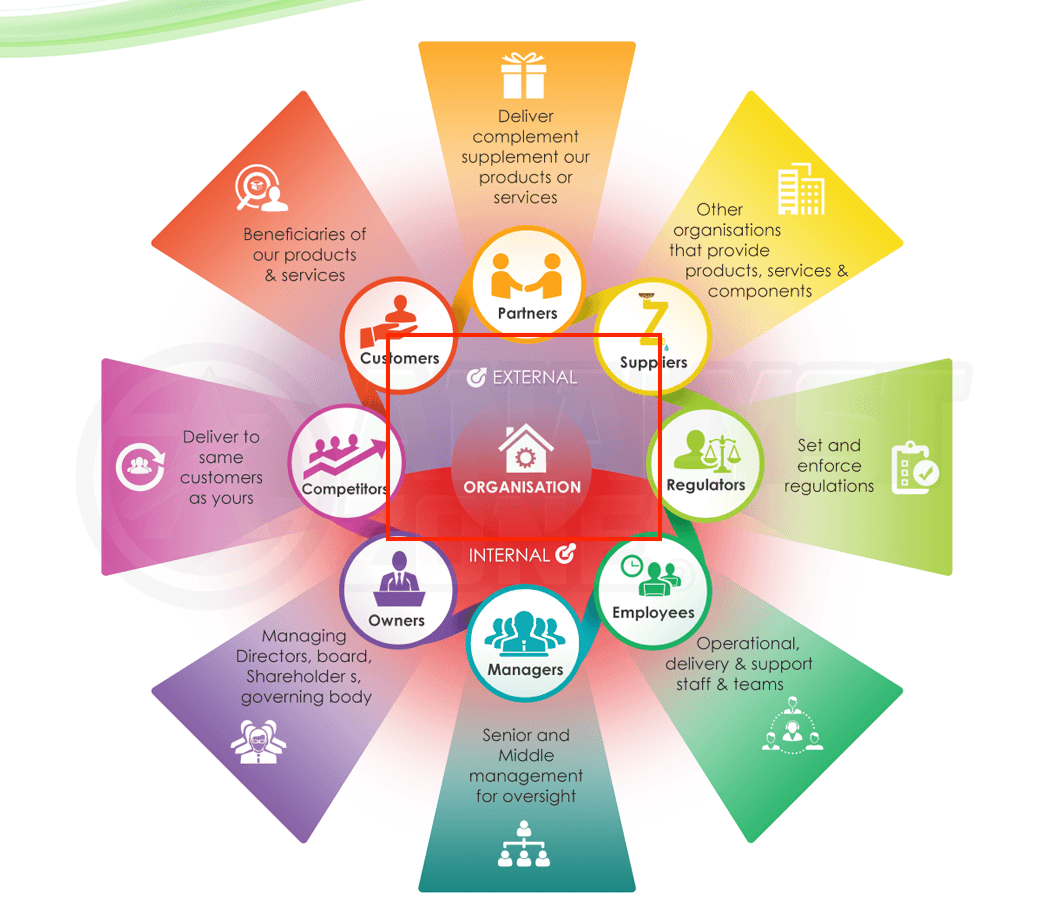
Step 2: Analyze stakeholders
For each stakeholder, identify:
Requirements, expectations, and key concerns
Degree of influence on the project
Relevant knowledge and expertise
Role in the project
Pay special attention to identifying key stakeholders — those with decision-making authority. They are the ones you must prioritize managing.
Step 3: Classify stakeholders
After analysis, you need to prioritize — because you cannot spend equal time on everyone. PMI introduces several classification models:
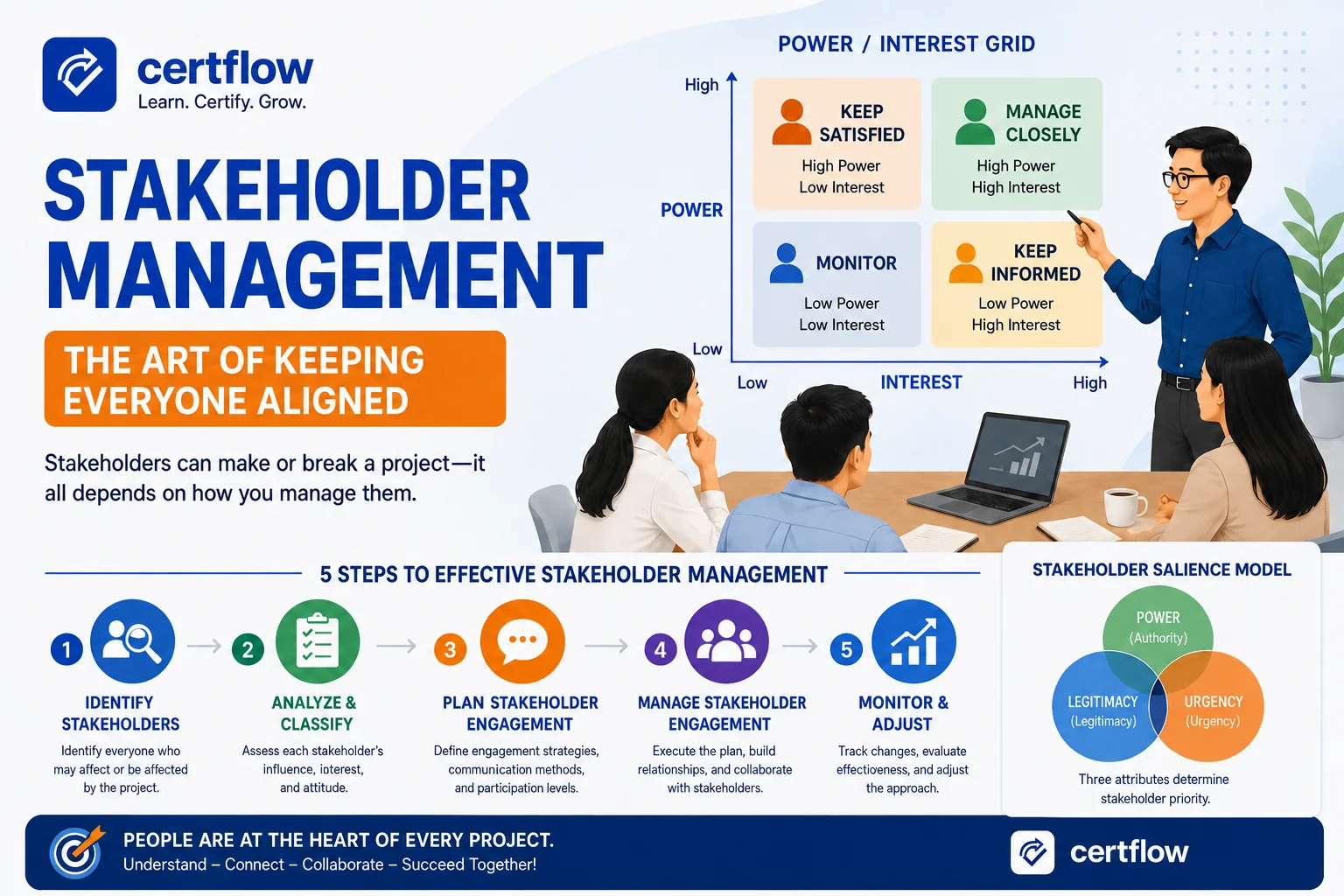
Power/Interest Grid — The most widely used model:
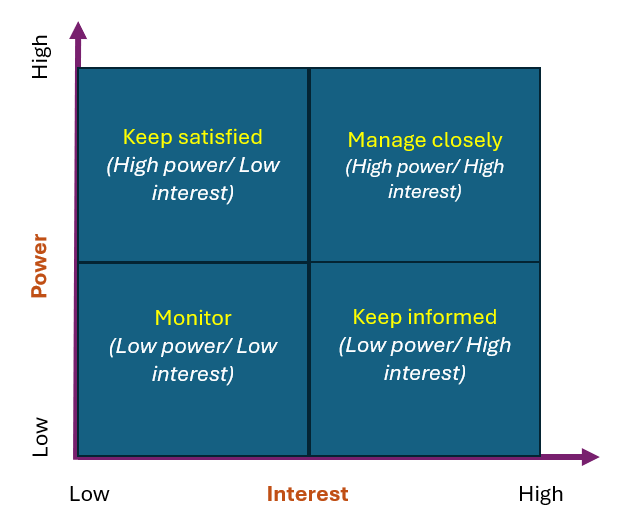
Beyond the Power/Interest Grid, you should also know:
Salience Model: Classifies stakeholders on 3 factors — Power, Urgency, and Legitimacy. A stakeholder with all 3 factors is called a "definitive stakeholder" — the highest priority.
Stakeholder Cube: Adds an additional analysis dimension — power, interest, and attitude.
Step 4: Define management strategy
Based on classification, determine the communication and management approach for each group. The "Manage Closely" group requires high communication frequency, detailed content, and two-way interaction. The "Monitor" group needs only periodic updates.
Stakeholder Register: A Living Document
All of this information is recorded in the Stakeholder Register — a living document updated throughout the project. The register includes:
Identification information: Name, organizational position, location, project role, contact information
Assessment information: Key requirements, expectations, degree of influence, phase of greatest interest
Classification: Internal/external, supporter/neutral/resistor
Pro Tip: In the PMP exam, when a question states "a new stakeholder has been identified," the first step is almost always to "update the stakeholder register" and "meet with the stakeholder to understand their concerns." Not to add them to the communication plan first, not to notify the sponsor — but to meet and understand them first.
Organizational Structure: How It Affects PM Authority
Before discussing the engagement plan, you need to understand something that directly affects how you manage stakeholders: organizational structure. Structure determines how much authority the PM has, whom the team reports to, and how resources are allocated.
Three main structures
Characteristic | Functional | Matrix | Projectized |
PM Authority | Very little or none | Low → High (depending on type) | Highest |
Team reports to | Functional Manager | Both FM and PM | Project Manager |
Budget management | Functional Manager | Shared | Project Manager |
Main advantages | Deep expertise, clear career path | Balance between specialization and project focus | 100% dedicated to the project |
Disadvantages | PM lacks authority, slow response | Two bosses, potential for conflict | Lack of specialization, no "home" when project ends |
Matrix: Three Variants
Matrix is the most common structure in practice — but also the most complex:
Weak Matrix: PM has little authority — the role resembles a Project Coordinator or Project Expediter more than a true PM. The Expediter only facilitates communication and has no decision-making authority. The Coordinator has some authority but still reports to senior management.
Balanced Matrix: Authority is shared equally between PM and Functional Manager. Sounds ideal, but can easily lead to conflict if the two sides aren't aligned.
Strong Matrix: PM has more authority than the Functional Manager. Closest to Projectized but still maintains departmental structure.
Most large organizations use a Composite structure — combining multiple structures at different levels. For example: R&D operates as Projectized, accounting operates as Functional, and IT operates as Matrix.
PMI Talent Triangle: Three Skills Every PM Needs
Regardless of organizational structure, PMI expects PMs to balance three sets of skills:
Technical Project Management: Hard project management knowledge and skills — planning, scope management, schedule, cost.
Leadership: The ability to guide, inspire, manage conflict, and build teams.
Strategic and Business Management: Understanding of business, organizational strategy, and how projects create value.
In the PMP exam, especially with the ECO 2026, the latter two skills (Leadership + Business) are emphasized more than ever before.
Other important roles
Sponsor: Provides financial resources, champions the project at the executive level, and plays a key role in developing the initial scope and project charter. If the project is for an external customer, the customer may serve as both sponsor and customer.
Functional Manager: Owns resources within the department, approves the final schedule, and helps resolve team member performance issues. The PM and Functional Manager must work closely together to avoid resource conflicts.
PMO (Project Management Office): The department that standardizes governance and shares resources, methodologies, and tools. There are 3 types of PMO based on level of control:
PMO Type | Control Level | Role |
Supportive | Low | Provides templates, best practices, training, and lessons learned |
Controlling | Medium | Requires compliance with templates, forms, and governance frameworks |
Directive | High | Directly manages projects. The PM is assigned by and reports to the PMO. |
Step 2: Plan Stakeholder Engagement — Designing the Engagement Approach
Now that you've identified stakeholders — what do you do with that list? The next step is to plan how you will engage each person or group.
5 Levels of Engagement
PMI defines 5 levels of engagement — you need to know these precisely as they are frequently tested:
Unaware: Does not know the project exists or its impact.
Resistant: Aware of the project and its impact — but opposed to the change.
Neutral: Aware of the project — but neither supportive nor opposed.
Supportive: Aware of the project and in favor of the change.
Leading: Aware of the project and actively engaged to ensure its success.
Stakeholder Engagement Assessment Matrix
This is the core tool of Plan Stakeholder Engagement. It compares the current engagement level (C - Current) with the desired engagement level (D - Desired) for each stakeholder.
Example: Stakeholder A is currently at the Resistant level (C), but you need them at the Supportive level (D). The gap between C and D is precisely the problem you need to address.
Process:
Assess the current engagement level of each stakeholder
Determine the desired level needed for project success
Investigate the root cause of the gap between C and D
Develop appropriate communication strategies to close the gap
Pro Tip: In practice, not every stakeholder needs to be at the "Leading" or "Supportive" level. Sometimes, moving a stakeholder from Resistant to Neutral is already a major success. Don't waste energy trying to turn an opponent into a champion — sometimes you just need them to stay out of the way.
What does the Stakeholder Engagement Plan include?
Current and desired engagement level of each stakeholder
Scope and impact of change on stakeholders
Communication requirements for the current phase: format, content, level of detail, language, frequency, and timing of information delivery
Step 3: Manage Stakeholder Engagement — Day-to-Day Execution
The plan is set — now it's time to execute. Manage Stakeholder Engagement is the process of communicating and working with stakeholders daily to win support, maintain support, and minimize resistance.
Why does this need its own process?
Because stakeholders are not static — their attitudes and commitment change continuously as new events affect them. A supportive stakeholder can become resistant when they learn the project will affect their department.
Three types of events to manage
When working with stakeholders, you will encounter three types of events — distinguishing them is critical:
Event | Definition | Recorded in |
Risk | An uncertain event, not yet occurred, potentially positive or negative | Risk Register |
Issue | A negative event that has already occurred | Issue Log |
Change | A request to modify scope, schedule, cost, or process | Change Log |
Ground Rules: Establishing Clear Expectations
Ground rules are a set of behaviors that the team and stakeholders agree to follow. They help reduce conflict and set clear expectations. Examples:
We will:
Be clear about roles and responsibilities
Consider the interests and concerns of affected stakeholders
Say "no" when necessary and remain consistent
We will NOT:
Seek stakeholder input on decisions that have already been made
Engage on issues outside the project scope
Say "yes" when we know "no" will follow later
Managing stakeholder expectations
This is the most difficult part — and also the most important skill. PMs manage expectations through:
Communication: Clear, timely, and appropriately formatted communication
Negotiation: Negotiating when expectations exceed project capacity
Conflict resolution: Resolving disputes when stakeholder expectations conflict with one another
And don't forget feedback — two-way communication. Feedback ensures that the information you send to stakeholders is received and understood correctly, and helps you gauge their reactions to project decisions and activities.
Step 4: Monitor Stakeholder Engagement — Continuous Monitoring
The final process — but not a "set it and forget it" one. Monitoring occurs throughout the project.
Why monitor?
The effectiveness of engagement activities may not match expectations
The stakeholder community changes as the project progresses — new people join, others leave, roles change
How to monitor?
The process is fairly simple but requires discipline:
Compare current engagement outcomes against the Stakeholder Engagement Plan
Identify and quantify any variance
Propose options to address variances: maintain, increase, or reduce engagement activities
Prioritize and select the best option
The main tool remains the Stakeholder Engagement Assessment Matrix — but this time used to compare current engagement levels against the desired levels previously set, to see whether the gap has narrowed or widened.
Summary: The Stakeholder Management Process from A to Z
For easy reference, here is the complete process at a glance:
Step | Process | Key Output | When |
1 | Identify Stakeholders | Stakeholder Register | Initiation + periodically |
2 | Plan Stakeholder Engagement | Stakeholder Engagement Plan | Planning + periodically |
3 | Manage Stakeholder Engagement | Issue Log, Change Log updates | Throughout the project |
4 | Monitor Stakeholder Engagement | Work performance info, Change requests | Throughout the project |
One important point: this is not a linear process you complete in sequence. In practice (and on the PMP exam), you continually return to Identify when new stakeholders emerge, update the Plan when circumstances change, and Monitor in parallel with Manage.
Pro Tip for the exam: When you encounter a stakeholder question and are unsure which answer to choose, ask yourself: "Do I understand this stakeholder yet?" If not → choose an action to understand them (meet, analyze, assess). If yes → choose an action to engage or manage them. The "understand before act" principle applies strongly to every stakeholder question.
From Theory to the Exam Room
Stakeholder management is not just a knowledge area — it is a skill that runs through every aspect of project management. You will encounter stakeholders in questions about scope (who approves requirements?), risk (which stakeholder is affected?), communication (who to communicate with and how?), and change management (who is requesting the change?).
Mastering the 4 steps — Identify → Plan → Manage → Monitor — along with the Power/Interest Grid, Engagement Assessment Matrix, and 5 levels of engagement will give you the confidence to answer most stakeholder questions on the PMP exam.
Practice now with stakeholder scenario questions on CertFlow — each question includes a detailed explanation to help you understand how to apply the PMP mindset to specific situations.
Frequently Asked Questions (FAQ)
Who is a stakeholder according to PMI's definition?
A stakeholder is any individual, group, or organization that can influence the project, is affected by it, or perceives itself to be affected by the project's decisions and outcomes — even if not actually impacted. This last detail often appears in exam questions.
What is the difference between Manage Stakeholder Engagement and Monitor Stakeholder Engagement?
Manage is about actively communicating, resolving issues, and building consensus with stakeholders. Monitor is about tracking actual engagement levels against the plan and identifying gaps that require adjustments to the engagement strategy. Monitor provides the data; Manage is the action.
When should you use the Power/Interest Grid vs. the Salience Model?
The Power/Interest Grid classifies stakeholders on 2 dimensions (power & interest) — simple and suitable for smaller projects. The Salience Model evaluates 3 dimensions (power, legitimacy, urgency) and identifies "definitive" stakeholders requiring the highest priority — better suited for complex projects with many stakeholders.
Now that you understand stakeholder management — it's time to practice with real exam questions.
Try Free PMP Practice Questions →
Official References: