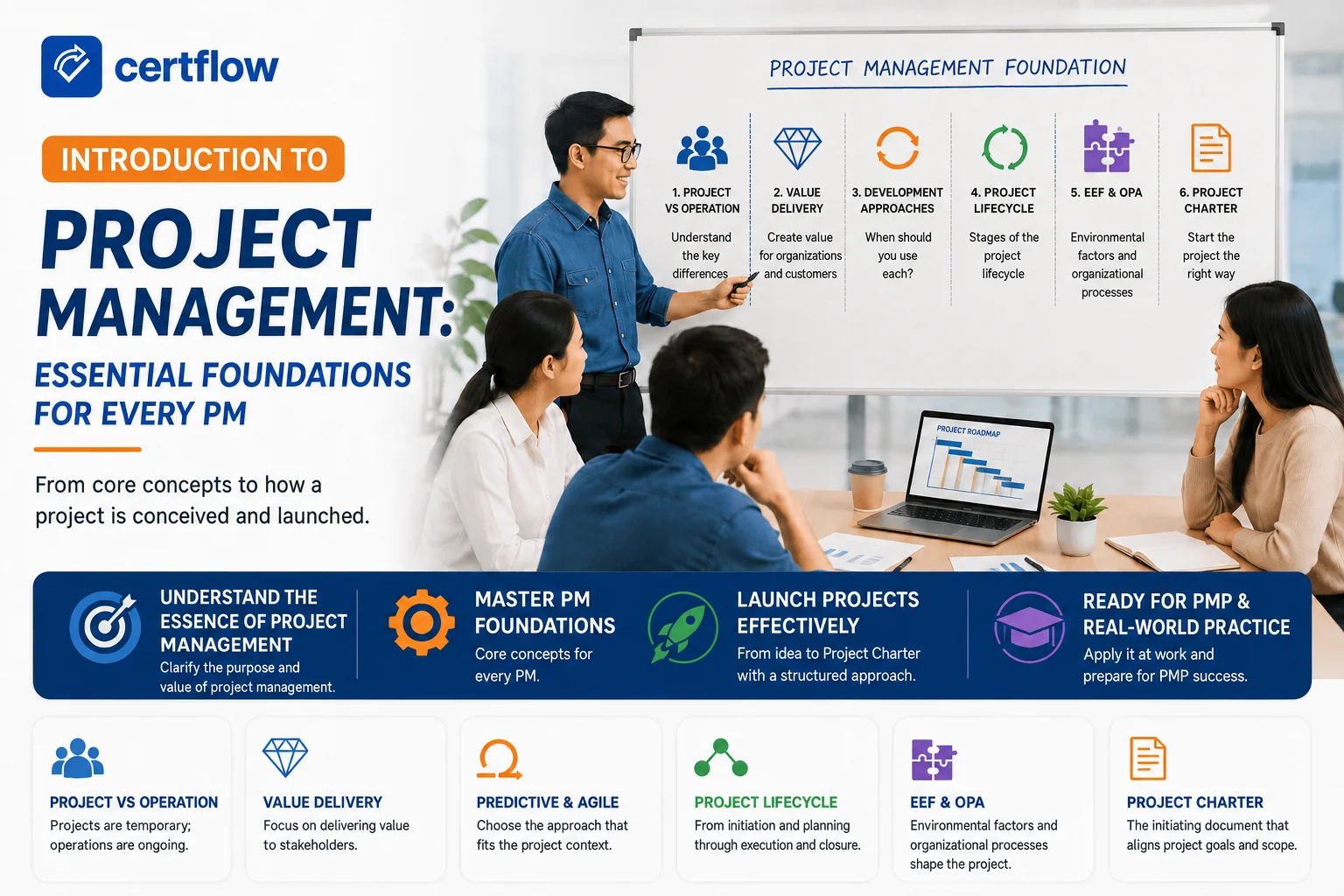
Before diving into scope or risk, you need the full picture. Learn what a project really is, when to pick Agile vs Predictive, and how a Project Charter kicks everything off.
What is project management, and why is it the first thing to learn when you start preparing for the PMP? Before you study scope, schedule, cost or risk, you need the full picture: what a project is, how it differs from operations, which phases it goes through, and when to choose a predictive, agile or hybrid approach.
This is guide 1 of the 14-part project management fundamentals series for the PMP. Every concept here comes back in almost every scenario question on the exam.
What is project management?
Project management is the application of knowledge, skills, tools and techniques to project activities to meet project objectives and deliver value. A project is a temporary endeavor, with a defined start and end, that creates a unique product, service or result.
In practice, project management means balancing several factors at once: scope, schedule, cost, quality, resources, risk and stakeholder satisfaction. The person responsible is the project manager (PM), assigned by the organization to lead the team to the project's objectives.
📍 PMP exam note: PMI defines a project as "a temporary endeavor undertaken to create a unique product, service, or result." Three keywords: temporary, unique, and product/service/result (a concrete output).
What is a project? Characteristics and examples
Work counts as a project when it has both characteristics:
Temporary: it has a clear start and end date. "Temporary" describes the project's duration, not its result. A building stands for decades, but the project to build it ends at handover.
Unique: it creates something that did not exist in that form before, even if parts are repetitive. Every new bank branch differs in location, team and context.
Common project examples: implementing an ERP system in a factory, building a mobile banking app, opening a new chain of stores, upgrading a core system to meet a new regulation, running a product launch event.
Where do projects come from?
Projects are always started for a specific reason:
External drivers: customer demand, market changes, legal or social requirements. Example: a new data privacy law forces a company to upgrade its systems.
Internal drivers: business strategy, new technology, or the need to improve products, processes or services. Example: leadership launches a digital transformation to reduce operating costs.
Projects vs operations: what is the difference?
The PMP exam tests this distinction often, and even experienced PMs mix them up because the line can be blurry in real life.
Criterion | Project | Operations |
Duration | Temporary, with a start and end | Ongoing, with no fixed end |
Output | A unique result | Repetitive, stable results |
Goal | Meet the objectives, then close | Sustain the business |
Example | Building a factory, developing a new CRM | Running the factory, supporting CRM users every day |
The two meet at transition: when the project ends, its result is handed over to operations. Exam questions often ask what the PM should do to make that handover smooth: train users, transfer documentation, and agree acceptance criteria with the operations team early. See the full project closure checklist.
Why is project management important?
"Why not just do the work?" Because without management, one of scope, schedule, cost, quality, risk or stakeholders will almost certainly slip out of control. Good project management helps an organization:
Meet business objectives and deliver the expected value.
Spot and handle risks before they become problems.
Use resources efficiently and avoid rework.
Keep stakeholders aligned and reduce conflict.
Recognize early when a project no longer delivers value and should stop.
Value is at the center of project management
Since the 7th edition, and continuing in PMBOK 8, the PMBOK Guide puts value at the center: organizations run projects to create value, not just to "finish according to plan".
What is value?
Value is the worth, importance or usefulness of something. Each stakeholder sees it differently:
Customers: features that solve their actual problem.
The organization: business value, meaning the benefits minus the cost of achieving them.
Society: contributions to the community or the environment.
When you must choose between feature A and feature B, or between cutting scope and raising the budget, the final question is always: "Which option delivers more value to stakeholders?" The same thinking helps you eliminate wrong answers in many scenario questions. How to measure and deliver value continuously is covered in value-based delivery.
Project vs program vs portfolio
Projects rarely stand alone. In most organizations they sit inside a three-level value delivery system:
Project | Program | Portfolio | |
What it is | A temporary endeavor creating a unique result | Related projects managed together for shared benefits | Projects, programs and operations grouped to meet strategic goals |
Focus | Meeting the project's objectives | Managing dependencies between projects | Investing in the right work |
Success measure | Quality, schedule, budget, satisfaction | Benefits delivered to the organization | Overall return on investment |
An easy way to remember it: a portfolio is like an investment fund, a program is like a "digital transformation" initiative made up of 5 to 10 projects, and a project is where the work actually gets done.
Predictive vs agile vs hybrid: what is the difference?
This is a core topic on today's PMP exam. Since July 9, 2026, the exam has 180 questions in 240 minutes, with about 40% predictive and 60% agile or hybrid questions. Many of them are really testing whether you can recognize which approach the project is using.
Criterion | Predictive (traditional, waterfall) | Agile (adaptive) | Hybrid |
Requirements | Clear and stable from the start | Unclear, change often | Partly clear, partly unclear |
Planning | Detailed upfront, with baselines | Continuous, per iteration | High-level plan plus sprint planning |
Delivery | Once, at the end | Small increments, frequently | Depends on the part of the project |
Change | Through change requests and formal approval | Added to the backlog and reprioritized | Both mechanisms |
Best for | Construction, manufacturing, tightly regulated work | Software, new products not yet proven in the market | Digital transformation, large projects with mixed work |
Predictive works when you know exactly what to build from the start, such as a building from approved drawings: plan in detail, then execute the plan. Agile fits when requirements are unclear: deliver small pieces, get feedback, adjust. Hybrid is the reality for most projects, for example infrastructure and contracts run predictively while feature development runs in sprints.
The Stacey Complexity Matrix: which approach fits?
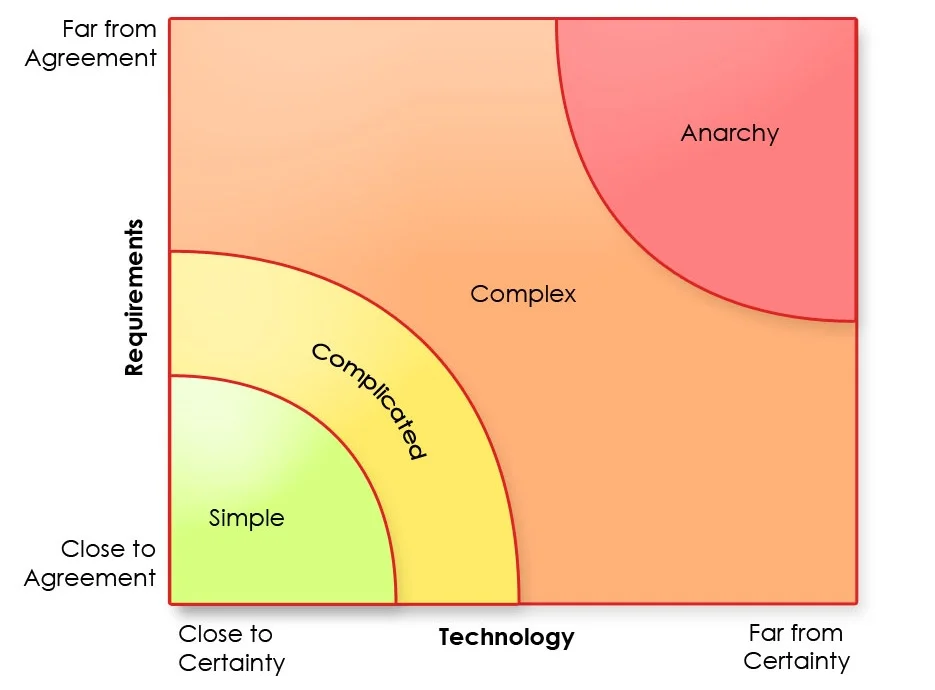
The Stacey matrix uses two axes: how much agreement there is on requirements, and how certain the technology or method is.
Simple: cause and effect are clear → predictive.
Complicated: needs expert analysis, several right answers → predictive or hybrid.
Complex: cause and effect only visible in hindsight, so you must experiment and learn → agile.
Chaotic: no visible cause and effect → act to stabilize first, then choose an approach.
How to recognize the approach in an exam question
When the question does not say, read the keywords:
"Sprint", "backlog", "velocity", "product owner", "retrospective" → agile.
"Baseline", "change request", "WBS", "change control board" → predictive.
Both sets of keywords, or an organization "moving to agile" → hybrid. Here the right answer usually respects the organization's existing processes while keeping the agile mindset.
PMI does not treat any approach as "better". The goal is the best value in the given context, which PMI calls tailoring: adapting the way of working to the project. The exam rewards tailoring, not loyalty to one method.
What are the phases of the project life cycle?
The project life cycle is the series of phases a project passes through from start to finish. A generic life cycle has four stages:
Starting the project: define objectives, build the business case and project charter.
Organizing and preparing: build the project management plan, form the team.
Carrying out the work: create deliverables, monitor and control.
Ending the project: acceptance, handover, lessons learned.
Depending on the approach, the life cycle can be predictive (sequential phases), iterative, incremental, adaptive (agile) or hybrid.
Phases and phase gates
A phase is a set of related activities that ends with one or more deliverables, for example in construction: feasibility, design, build, handover. Between phases sits a phase gate (also called a stage gate, kill point or phase review): a review that decides Go, Hold, Kill or Recycle. Who makes that decision is set by the organization's project governance framework.
3 rules that apply to every project life cycle
Cost and staffing start low, peak while the work is carried out, and drop toward the end.
The cost of change rises over time: changing a drawing is far cheaper than changing floor 20 during construction.
Stakeholder influence and risk are highest at the start and decrease as the project progresses.
Project life cycle vs product life cycle
A product life cycle runs from concept through launch, growth and maturity to retirement, and can last many years. A project life cycle is only one segment of it. A product goes through many projects: each major release of a banking app, for example, is a separate project.
EEF vs OPA: what is the difference?
These two terms appear constantly in PMP study. Get them wrong and you will pick wrong answers in many scenario questions.
Enterprise Environmental Factors (EEF)
EEFs are conditions inside or outside the organization that the PM cannot control, but that affect how the project is planned and run.
Internal EEFs | External EEFs |
Organizational culture, structure, governance | Market conditions |
Technology infrastructure, PMIS | Laws and regulations, such as data privacy rules |
Existing staff capabilities | Industry and government standards |
Geographic distribution of offices and plants | Cultural, social and political factors |
To assess external EEFs systematically, PMs often use a PESTLE analysis.
Organizational Process Assets (OPA)
OPAs are internal organizational assets the project can use, and some of them the project also updates:
Processes, policies and templates: templates, approval rules, internal standards. The project uses them but usually does not change them.
Organizational knowledge repositories: lessons learned, historical data, issue and defect databases. The project both uses and updates them.
Quick way to tell them apart: EEFs are the "rules of the field" you must play by. OPAs are the "toolbox" you take from and add to as you learn. On the exam, when asked "what should the PM consult first?", the answer is often lessons learned (an OPA). When the question describes a constraint the PM cannot change, it is an EEF.
How are projects selected and started?
Project selection methods
Organizations always have more ideas than resources, so they must choose. Methods that often appear on the exam:
Feasibility checks: feasibility study, murder board (a panel of experts who try to "shoot down" the idea with hard questions), scoring models.
Financial measures: payback period (shorter is better), NPV (positive, and higher is better), IRR (higher is better), ROI, BCR (above 1 means benefits exceed costs).
Common traps: opportunity cost (the value of the option you give up) and sunk cost (money already spent that cannot be recovered). Sunk cost must not influence future decisions.
📍 Exam tip: if a question gives the NPV of several projects with different durations, just pick the highest NPV. NPV already accounts for time, so do not divide by the number of years.
Business case
The business case answers "why is this project worth doing?": it states the business need, the proposed option, the expected benefits and the success criteria. It is the basis for approving the project, and for checking throughout the project whether it is still worth continuing.
Once the project is approved, the sponsor issues the project charter, the document that formally authorizes the project and gives the PM authority to use organizational resources. Without a charter, the project has not formally started. For a full walkthrough with a template, see the project charter guide.
Key stakeholders in a project
A stakeholder is any individual, group or organization that may affect, be affected by, or perceive itself to be affected by the project. The roles you will meet in most questions:
Role | Main responsibility |
Sponsor | Provides resources, issues the charter, resolves issues beyond the PM's authority |
Project manager | Leads the team to the project's objectives |
Project team | Does the project work |
Customer / end user | Uses or benefits from the project's result |
PMO | Standardizes processes, supports and oversees projects |
Product owner (agile) | Manages and prioritizes the product backlog to maximize value |
The PM is a stakeholder too. How to classify stakeholders with the power interest grid and engage them with a stakeholder engagement strategy is covered in two separate guides.
Practice questions (with answers)
Question 1. A software company asks you to provide technical support for a CRM system that has been running for 3 years, and to deliver a new reporting module within 4 months. Which is a project?
A. CRM technical support B. The new reporting module C. Both D. Neither
Question 2. Right after being assigned, a PM wants to estimate the duration of a project similar to one the company completed last year. What should the PM use first?
A. Market conditions B. Lessons learned and historical data from the previous project C. Government regulations D. Each team member's opinion
Question 3. A bank is building a new app. Feature requirements are unclear and will change with user feedback, but the integration with the core banking system must follow a strict validation process. Which approach fits best?
A. Predictive for the whole project B. Agile for the whole project C. Hybrid D. Wait until requirements are clear
Answers:
Question 1: Answer: B. The new module is temporary (4 months) and creates a unique result. Technical support is ongoing work, which makes it operations.
Question 2:Answer: B. Lessons learned and historical data are OPAs, the first source to check when a similar project exists. A and C are EEFs.
Question 3:Answer: C. The unclear features suit agile, and the tightly controlled integration suits predictive. Combining them is tailoring to the context.
Want more scenario questions like these? Try a free PMP practice exam on CertFlow.
Frequently asked questions (FAQ)
What is project management in simple terms?
Project management is applying knowledge, skills, tools and techniques so a project meets its objectives and delivers value, while balancing scope, schedule, cost, quality, risk and stakeholder expectations.
What is the difference between a project and operations?
A project is temporary and creates a unique result. Operations are ongoing, repetitive work that sustains the business. When a project ends, its result is handed over to operations.
Should I choose predictive, agile or hybrid?
Choose predictive when requirements are clear and stable, agile when requirements are unclear and early feedback matters, and hybrid when the project has both kinds of work. PMI values tailoring the approach to the context and does not treat any method as the best.
How many PMP exam questions are predictive vs agile?
Since July 9, 2026, the PMP exam has 180 questions in 240 minutes. About 40% are predictive and 60% are agile or hybrid. Content is split across the three 2026 ECO domains: People 33%, Process 41% and Business Environment 26%.
Are the 5 process groups still used on the 2026 PMP exam?
The 5 process groups (Initiating, Planning, Executing, Monitoring and Controlling, Closing) are no longer the exam's structure, because the exam now follows the three 2026 ECO domains. They still help you understand how a predictive project runs, and about 40% of questions are still predictive scenarios.
What should a beginner study first for the PMP?
Start with the fundamentals in this guide: projects vs operations, value, predictive/agile/hybrid, the project life cycle, EEFs/OPAs and the project charter. Then plan your preparation with a PMP self-study plan. If you are not sure you meet the requirements, read what is PMP certification first.
What to study next
After this fundamentals guide, continue the series in this order:
Stakeholder analysis: the power interest grid
Communication: the communication channels formula
Team development: the Tuckman model
Scope: how to create a WBS
Agile: the agile manifesto and Scrum
See all 14 guides in the project management fundamentals series. Once the fundamentals are solid, move on to the 2026 ECO series: People, Process and Business Environment.
Official sources: