5 PMI-aligned techniques to motivate your project team under deadline pressure without burning them out.
Three weeks before go-live, the team lead sends a private message: "No one is asking questions in Slack anymore. Not because they know the answers—because they've stopped caring." The deadline hasn't moved, but the team already has. Downward.
Learning how to motivate project team under deadline pressure is one of the most directly tested skills in the PMP® exam and one of the hardest to execute well in real projects. PMBOK® Guide 8 and the ECO July 2026 are clear: effective team leadership during a crunch is not about demanding more effort—it is about maintaining psychological safety, providing transparent information, and removing obstacles so the team can do their best work under difficult conditions.
This article explains why deadline pressure often backfires when handled the wrong way, walks through five PMI-aligned techniques for sustaining team motivation across Predictive, Agile, and Hybrid environments, and includes three scenario questions to sharpen your exam readiness.
Key takeaways
Deadline pressure cannot be resolved by adding hours—identify the root cause before taking action.
PMI mindset: leading a team means removing obstacles, not increasing top-down pressure.
Psychological safety—teams feeling safe to report problems early—is the most effective schedule-slip prevention tool.
In Agile, the correct response to deadline pressure is de-scoping, not crunch.
Recognizing effort (not only outcomes) sustains momentum during the most demanding phases of a project.
Why deadline pressure often reduces performance instead of increasing it
When a project falls behind, many project managers instinctively increase meeting frequency, tighten reporting requirements, or remind the team of the consequences of missing the date. These actions are well-intentioned but frequently produce the opposite result: the team starts managing the PM's emotions instead of solving the actual problem.
Research from BI Norwegian Business School shows that intermediate deadlines can help teams focus—but when checkpoints are too frequent or paired with heavy surveillance, teams become defensive, share fewer problems, and shift to short-term decision-making rather than root-cause thinking.
PMI frames this through the lens of psychological safety: the environment in which team members feel safe surfacing bad news without fear of blame. When a PM responds to schedule slippage by tightening control, psychological safety drops, and the real problems stay hidden until they are no longer recoverable. This is the most common project management failure pattern under schedule pressure.
Team motivation in PMBOK 8 and ECO July 2026
The People Domain accounts for 33% of the PMP exam under the ECO July 2026 framework. Task 3 of this domain—"Lead the project team"—includes the ability to motivate and sustain team performance as a core enabler. This is not a soft skill tagged on at the end of a project; it is a competency PMI evaluates directly in scenario-based questions.
PMBOK® Guide 8 establishes "Build an Empowered Culture" as one of its six foundational principles. [AUTHOR: insert exact quote and section number from PMBOK 8 PDF] The principle holds that teams perform best when they have autonomy, complete information, and a sense of ownership over outcomes. The PM's role is not command-and-control—it is to create the conditions for the team to operate effectively.
In deadline-pressure situations, this translates to a specific shift in language and posture: instead of announcing "you must complete X by Y," an effective PM asks "what do we need to complete X by Y, and what can I clear out of your way?" The difference in tone is small. The difference in outcome is significant.
For the full framework of team leadership competencies under ECO 2026, see Leading a Project Team: 7 PM Competencies in PMBOK 8.
Diagnosing the source of pressure before acting
Before selecting any motivation technique, the PM needs to understand where the pressure is coming from. The three most common sources point to very different solutions.
Unrealistic baseline schedule
When the original estimate was too optimistic—often due to top-down schedule pressure or insufficient information at planning time—the team does not have a performance problem; they have a planning problem. No amount of motivation will fix an unachievable baseline. The PM needs to re-plan with realistic estimates, present trade-offs to the sponsor, and protect the team from being labeled underperforming against a number that was never achievable.
Mid-project scope expansion
If requirements grew after baseline approval without a corresponding adjustment to timeline or resources, the team is being asked to do more in the same time—not because they are insufficiently motivated but because the plan no longer matches reality. The correct intervention here is change control, not a motivation conversation. The PM must clearly communicate to stakeholders that scope and schedule cannot both increase without additional resources.
Resource loss or team disruption
When a key team member goes on extended leave or is pulled to another project, motivating the remaining team must be paired with a real solution: redistribution, scope reduction, or a resource request. No motivation technique compensates for a sustained structural resource gap.
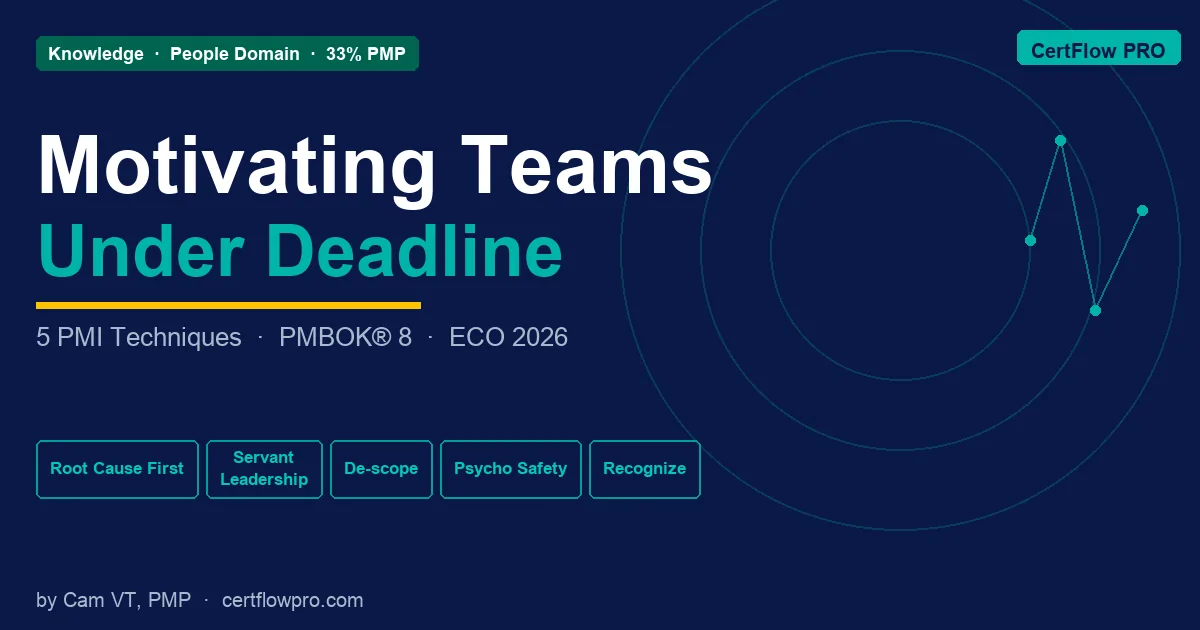
5 techniques to motivate a project team: the PMI approach
After diagnosing the root cause, the following five techniques align with PMI mindset and apply across both Predictive and Agile environments.
1. Involve the team in re-planning
When a deadline is at risk, the wrong response is for the PM to create a revised plan and announce it. The right response is to bring the team into the recovery planning process. Team members understand the technical details better than the PM; they can identify realistic shortcuts and hidden risks that are invisible from a project management perspective. More importantly, when people co-create the plan, their commitment to executing it is substantially higher.
In Agile, this looks like an emergency backlog refinement session with the Product Owner to re-prioritize what must ship before the release date. In Predictive, it is a schedule compression workshop with the team leads and key contributors.
2. Make project status transparent
Teams lose motivation fastest when they feel information is being withheld or when they do not understand why the deadline matters so much. The PM should share the real context: what the penalty clause is, how the release date connects to the client's business plan, and which constraints are fixed versus negotiable.
Transparency does not mean transferring all anxiety onto the team. The PM still acts as a filter. But the team needs enough context to make good prioritization decisions. When people understand why, they are far more willing to accept the constraints of how.
3. Recognize effort, not only outcomes
Under deadline pressure, final outcomes may not arrive quickly—but progress is happening every day. The PM should acknowledge incremental wins: a module completed, a difficult bug resolved, an integration test passing on the first try. Public recognition in a daily standup or team channel, even a single sentence, creates a continuous chain of small victories that keeps the team feeling forward momentum.
PMI highlights recognition as a high-impact, zero-cost leadership tool. Financial bonuses are often unavailable when a project is under budget pressure—but acknowledgment never is.
4. Remove obstacles rather than adding pressure
This is the essence of servant leadership—the leadership style PMI treats as the standard for project managers in both Predictive and Agile contexts. Rather than asking "why isn't this done yet?", the effective PM asks "what is blocking you, and how can I help remove it?"
Blockers might be: a dependency waiting on another team, an environment access not yet provisioned, a technical question needing an architecture review, or a requirement ambiguity requiring Product Owner clarification. Clearing these blockers efficiently does more for team productivity than any motivational speech. For more on this leadership style, see Servant Leadership in Project Management.
5. Shield the team from external noise
When a project is under pressure, stakeholders and sponsors often increase direct contact with individual team members—creating expensive context switching and introducing anxiety that is hard to contain. The PM's role is to act as a buffer: collecting all external questions, responding through official communication channels (status reports, sprint reviews, executive dashboards), and protecting the team's deep work time.
In Scrum, this is a defined responsibility of the Scrum Master—protecting the Development Team from ad-hoc requests during a sprint. In Predictive environments, the PM must proactively fulfill this shielding role even without the formal designation.
Predictive, Agile, and Hybrid: different approaches to the same deadline
Approximately 60% of PMP exam questions involve adaptive, agile, or hybrid contexts—understanding how each approach handles deadline pressure is therefore a high-priority exam topic.
Aspect | Predictive | Agile | Hybrid |
|---|---|---|---|
Variable adjusted under pressure | Resources (crashing) or activity sequencing (fast-tracking); scope and deadline are fixed | Scope (de-scope backlog); deadline and team size are fixed | Combination: de-scope the Agile track; fast-track the Predictive track |
Motivating the team | Re-plan together; clear milestones; reduce unnecessary meetings | Retrospective to improve process; Product Owner decides priority | Clearly separate fixed vs. flexible constraints; Scrum of Scrums if needed |
Risk to avoid | Crashing tasks that cannot be parallelized (Brooks's Law) | Forcing "extra sprints" outside the timebox — violates Agile principles | Mixing rules between tracks; stakeholders not understanding that Agile scope is negotiable |
PMI mindset | Analyze trade-offs and present options to sponsor before deciding | Empowered team self-organizes to achieve sprint goal | PM mediates between two approaches; prioritize value delivery above process purity |
Common mistakes PMs make under schedule pressure
Requiring overtime without addressing root cause: sustained overtime leads to burnout, more errors, and a lower actual delivery rate—making the deadline harder to meet, not easier.
Adding people to a late project: Brooks's Law states that adding people to a late software project makes it later. New team members require onboarding and pull attention away from senior contributors who need to guide them. Exceptions apply only when there are independent tasks that require no project-specific context.
Cutting contingency reserve as the first response: reserves exist to manage identified risks, not to compensate for planning shortfalls. Eliminating reserve without re-planning leaves the project exposed for the remainder of the timeline.
Hiding schedule problems from the sponsor until it is too late: PM has a professional obligation to report project status accurately. Early disclosure preserves options; late disclosure eliminates most of them.
Ignoring burnout signals: sudden quiet in team meetings, declining work quality, and a spike in defect rates are warning signs. The right response is a 1-on-1 conversation, not an additional deadline.
When tension escalates into interpersonal conflict under pressure, see Conflict Management in Projects: 5 Techniques per PMBOK 8. The skill of reading team emotional states under stress is also covered in Emotional Intelligence for Project Managers.
PMP exam tips: recognizing correct answers on team motivation questions
PMI mindset to remember: In scenario questions about teams under pressure, the correct answer consistently: (1) diagnoses before acting, (2) involves and empowers the team rather than imposing a solution, and (3) protects team well-being before managing upward. Wrong answers typically involve: adding people, mandating overtime, or escalating to management before attempting to resolve within the team.
Common answer traps:
"Escalate to management" is almost always wrong when the PM has not yet attempted an internal resolution.
"Hire additional resources" is attractive but usually wrong—onboarding is slow, cost is high, and not every task can be parallelized.
"Extend the deadline" is sometimes correct, but only when paired with "negotiate with the sponsor or client"—a PM never unilaterally moves a deadline.
The correct answer usually begins with an action that deepens understanding of the situation (1-on-1s, root cause analysis, re-estimating) before moving to a solution.
3 scenario questions
Question 1. You are managing a software deployment project with a contractual go-live deadline in 3 weeks. Your team lead reports that two senior developers are overwhelmed and starting to make integration errors. The client is tracking progress closely. What should you do FIRST?
A. Immediately engage two contract developers to supplement the team
B. Meet with the team lead to identify specific impediments and develop a joint action plan
C. Redistribute tasks so that less-stressed team members take over the problematic modules
D. Proactively inform the client about the risk of a schedule slip
Question 2. You are the Product Owner on an agile project. At sprint review, the team confirms they can complete only 70% of the planned stories before the public release date two sprints away. Stakeholders are worried about missing features. What is the BEST response?
A. Ask the team to work on weekends to close the remaining stories before the release
B. Facilitate a backlog prioritization session to ensure the most valuable 70% reaches production, and defer lower-priority stories to a post-release sprint
C. Add two new team members mid-sprint to help complete the remaining backlog
D. Extend the next sprint by one week to accommodate all planned stories
Question 3. A project manager notices that team members have stopped raising concerns in status meetings, even though the project is visibly behind schedule. In private conversations, team members admit they fear being blamed for the delays. What should the PM do to address this situation?
A. Set up an anonymous issue-reporting channel so team members can flag problems without fear
B. Facilitate a team retrospective to discuss how the team communicates challenges and establish agreed ground rules for safe reporting
C. Reassure team members individually in one-on-one meetings that they will not be held responsible for the delay
D. Escalate to the project sponsor, as the team culture is negatively affecting project delivery
Answers and explanations
Question 1: B. PMI mindset prioritizes understanding before acting. Meeting with the team lead to surface specific impediments is the correct first step of servant leadership—and produces the information needed to choose an appropriate response. A is wrong because adding people to a late project (Brooks's Law) slows onboarding and distracts senior contributors. C may be part of the solution but is premature without first understanding root cause. D is important but requires accurate information that the PM does not yet have.
Question 2: B. In Agile, when deadline and team size are fixed, scope is the variable. Prioritizing the highest-value 70% and deferring the rest is the standard Agile response. A violates the Agile Manifesto's sustainable pace principle and risks burnout. C violates the principle of stable team composition during a sprint and triggers Brooks's Law. D violates Scrum's time-boxing rule—sprints are fixed-length; extending them is an anti-pattern.
Question 3: B. Psychological safety is built most durably through team process and shared norms, not through workarounds or individual reassurance. A retrospective where the team co-creates ground rules for safe reporting creates sustainable group commitment. A is a workaround that addresses symptoms, not root cause. C provides temporary individual comfort but does not scale to team culture. D is premature escalation before the PM has attempted resolution within the team.
Want to test your understanding of People Domain scenarios under exam conditions? Try 10 free PMP scenario questions—no registration required.
Summary
Motivating a project team under deadline pressure starts not with encouragement but with diagnosis. Once the PM understands where the pressure is coming from, the approach is consistent: involve the team in recovery planning, provide honest context, recognize incremental progress, clear blockers actively, and shield the team from external interference. In Agile, de-scope rather than crunch; in Predictive, compress the schedule only after careful trade-off analysis with the sponsor.
These competencies intersect with the broader People Domain skill set. If you have not yet read Leading a Project Team: 7 PM Competencies in PMBOK 8, that is the natural next article—it places deadline-pressure motivation within the complete leadership competency framework that ECO 2026 Task 3 requires.
Frequently asked questions (FAQ)
What is the PMI-recommended approach when a project team misses a milestone?
PMI recommends root cause analysis before any corrective action—not blame, not mandatory overtime. Once the root cause is identified, the PM works with the team to update the plan, communicates transparently with stakeholders about schedule implications, and records lessons learned to prevent recurrence.
How does servant leadership apply when a project is behind schedule?
Under schedule pressure, servant leadership means actively asking what the team needs to move faster—then going and resolving those blockers, whether that is slow approvals, unresolved dependencies, or technical questions needing an architecture decision. The PM does not solve technical problems for the team; the PM clears the path so the team can solve them efficiently.
What is psychological safety and why does it matter for deadline management?
Psychological safety is the team's shared belief that they can raise problems, admit mistakes, and ask questions without fear of blame or punishment. Under deadline pressure, it is the primary mechanism by which a PM receives accurate, timely information about emerging risks—rather than discovering critical issues too late to act on them effectively.
When is crashing—adding resources to recover a late project—actually the right answer?
Crashing works only when three conditions hold: tasks on the critical path can be parallelized, new resources can contribute without a long onboarding period, and the sponsor approves the additional cost. Without all three, crashing typically adds overhead and delays more than it helps. Always analyze trade-offs and present options to the sponsor before making this decision.
References
Project Management Institute. (2026). PMP® Examination Content Outline – July 2026. PMI. pmi.org (accessed: 08/10/2026)
Project Management Institute. (2025). A Guide to the Project Management Body of Knowledge (PMBOK® Guide) – Eighth Edition. PMI.
Van Oorschot, K. et al. (2019). Deadlines help project teams face pressure. BI Business Review. bi.no (accessed: 08/10/2026)