Why can one PM defuse a tense room with a few calm sentences while another only makes it worse? A practical look at emotional intelligence for project managers and PMP prep
Some project managers walk into a tense meeting, say a few calm sentences, and defuse a problem before it turns into an internal crisis. Others walk in already running hot and only make things worse. That gap has nothing to do with Gantt charts or formulas. It comes down to emotional intelligence.
This article explains what emotional intelligence means for a project manager, why it matters across predictive, agile, and hybrid delivery models, how it affects conflict and stakeholder trust, and how to build it in a way that helps both your PMP prep and your day-to-day work.
What Is Emotional Intelligence for a Project Manager?
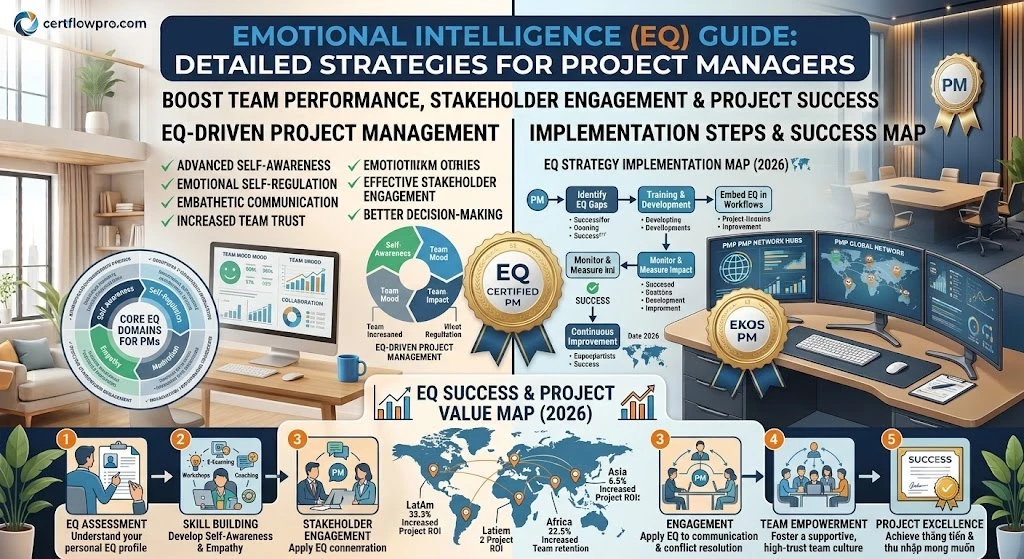
Emotional intelligence for a project manager is the ability to recognize, regulate, and effectively use emotions — both your own and other people's — to make better decisions, resolve conflict, build trust, and keep the project moving. In PMP terms, it turns leadership, communication, and stakeholder engagement from theory into concrete behavior.
The definition sounds simple, but the impact is significant. A PM with strong emotional intelligence recognizes when a sponsor isn't simply "asking questions" but is actually signaling a loss of confidence. They can tell when a missed deadline comes from being overloaded rather than from laziness. They know when to push, when to pause, and when silence in a meeting reflects disagreement rather than alignment.
PMI's guidance consistently treats emotional intelligence as part of effective leadership, especially when leading teams, managing conflict, and engaging stakeholders. PMBOK-based thinking also ties it to accountability, empowerment, value delivery, and collaboration. In other words, emotional intelligence isn't an "extra" skill — it's required operating equipment for modern project leadership.
If you've ever read a PMP question and thought, "Why is the correct answer so people-focused when the schedule is slipping?" — this is exactly why. PMI expects you to protect outcomes through relationships, not act like a spreadsheet.
Why Emotional Intelligence Matters More Than Technical Control
Technical skill gets you into the room. Emotional intelligence is what helps you survive it. Most projects in crisis don't fail because nobody understood the critical path. They fail because priorities were unclear, trust eroded, warnings were softened, stakeholders disengaged, or conflict simmered under the surface until it erupted.
On one ERP rollout I worked on, the status reports looked stable for weeks — green milestones, a clean risk log, no major escalations. But the warehouse lead had stopped speaking up in steering meetings, and the implementation partner kept answering on her behalf. That was the real warning sign. Once we pulled her into a smaller session, it came out: the new workflow was going to slow down receiving by nearly 20 percent during peak season. The schedule issue only became visible after the emotional signal was taken seriously.
That's why emotional intelligence matters so much in project management — it helps you catch weak signals early, and it keeps you from making the classic mistake of solving the visible problem while ignoring the human system underneath it.
Better decisions under pressure — When you can regulate your own emotions, you're less likely to react defensively, overpromise, or escalate too soon.
Stronger team performance — Teams work harder for leaders who are clear, fair, and calm, especially when a painful trade-off is on the table.
Healthier stakeholder relationships — People support a project when they feel heard and respected, not merely "kept informed."
Smoother conflict resolution — PMs with high EI address tension early, before it turns into missed deadlines, blame, or quiet resistance.
This is also why so many PMP questions favor an answer that starts with "understand," "clarify," "listen," or "engage" before taking action. PMI isn't telling you to avoid action — it's telling you to choose the action that actually works on people, not just on paper.
Pro Tip: When two PMP answer choices both look "correct," the better one is usually the one that protects the relationship, clarifies the root cause, and keeps the stakeholder engaged before moving to command-and-control.
The 5 Emotional Intelligence Skills
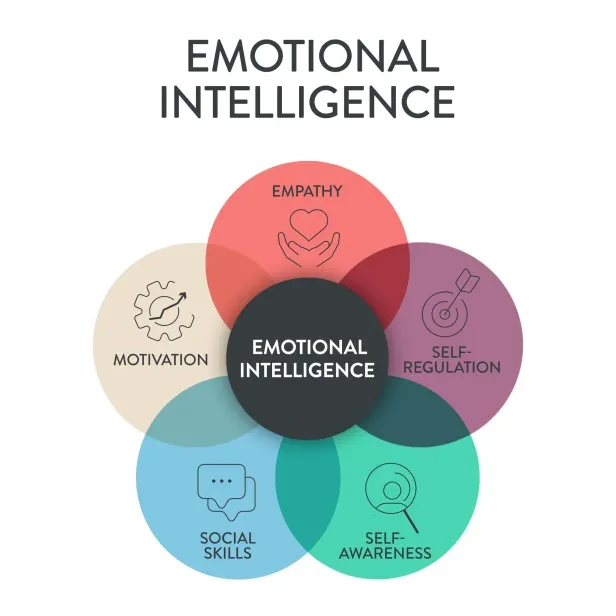
You don't need a psychology degree to build emotional intelligence. In practice, PMs rely on a handful of repeatable habits. Most frameworks group EI into five areas, and they map surprisingly well onto common PMP scenarios.
Self-awareness: The ability to notice your own stress, bias, defensiveness, and reaction patterns. If you know that schedule slippage makes you curt, you can catch that reaction before your tone damages trust. This is the starting point, because unmanaged emotion leaks into every meeting whether you intend it to or not.
Self-regulation: Once you've noticed your emotional state, you need to manage it. Self-regulation is what stops a PM from escalating publicly, blaming a vendor in front of a client, or making a promise on the spot just to end a difficult call.
Motivation: High-EI leaders can reconnect people with the purpose of the work when it feels repetitive or politically messy. In PMI language, this ties closely to focus on value — people do better work when they understand why it matters, not just what's on the task list.
Empathy: Empathy isn't agreement. It's accurate understanding. A sponsor worried about ROI, a developer worried about rework, and an operations lead worried about adoption may all resist the same change — for different reasons. Treat them as one generic "resistant stakeholder group" and your response will miss the mark.
Social skill: This is where emotional intelligence becomes visible. It shows up in facilitation, active listening, conflict management, influence, negotiation, feedback, and timing. It's the difference between "You need to meet this deadline" and "Let's look at the dependency causing the date risk and agree on the least damaging trade-off." Same issue, very different outcome.
📌 If stakeholder behavior is where you struggle most, stakeholder engagement strategy pairs well with practicing emotional intelligence.
Emotional Intelligence in Predictive, Agile, and Hybrid Projects
Many candidates assume emotional intelligence belongs more to agile than to predictive delivery. That isn't entirely true. The expression changes, but the need doesn't.
Context | Where EI shows up most | What good looks like |
|---|---|---|
Predictive | Change resistance, formal reporting, sponsor alignment | Clear communication, calm escalation, tact around baselines and approvals |
Agile | Servant leadership, team dynamics, feedback loops | Good listening, coaching instead of controlling, protecting transparency and trust |
Hybrid | Conflicting expectations between governance and delivery teams | Translating concerns, reducing friction, aligning language across groups |
In predictive environments, emotional intelligence typically matters most during governance-heavy moments: scope changes, status reviews, escalations, and messaging up to the steering committee. A PM needs to present facts without triggering unnecessary defensiveness, and needs to understand when a stakeholder's request is about compliance, optics, or genuine business value.
In agile environments, the link is even clearer. Agile Practice Guide themes like servant leadership, trust, collaboration, transparency, and team empowerment all depend on emotional maturity. A Scrum event can be mechanically correct and still be emotionally unsafe. When that happens, the team goes quiet, risks stay hidden, and velocity becomes theater.
Hybrid environments are where emotional intelligence really shows its strength. You may have a steering committee demanding certainty while the delivery team needs room to run experiments. One side wants a fixed date. The other wants to keep exploring. A high-EI project manager doesn't pick a side and burn out as the translator between them — they present the uncertainty honestly, protect relationships on both sides, and help both groups discuss trade-offs using an approach both can accept.
This is also why servant leadership on agile teams is worth understanding even if your project isn't fully agile — many of its behaviors improve predictive teams too.
Emotional Intelligence in Conflict, Feedback, and Stakeholder Management
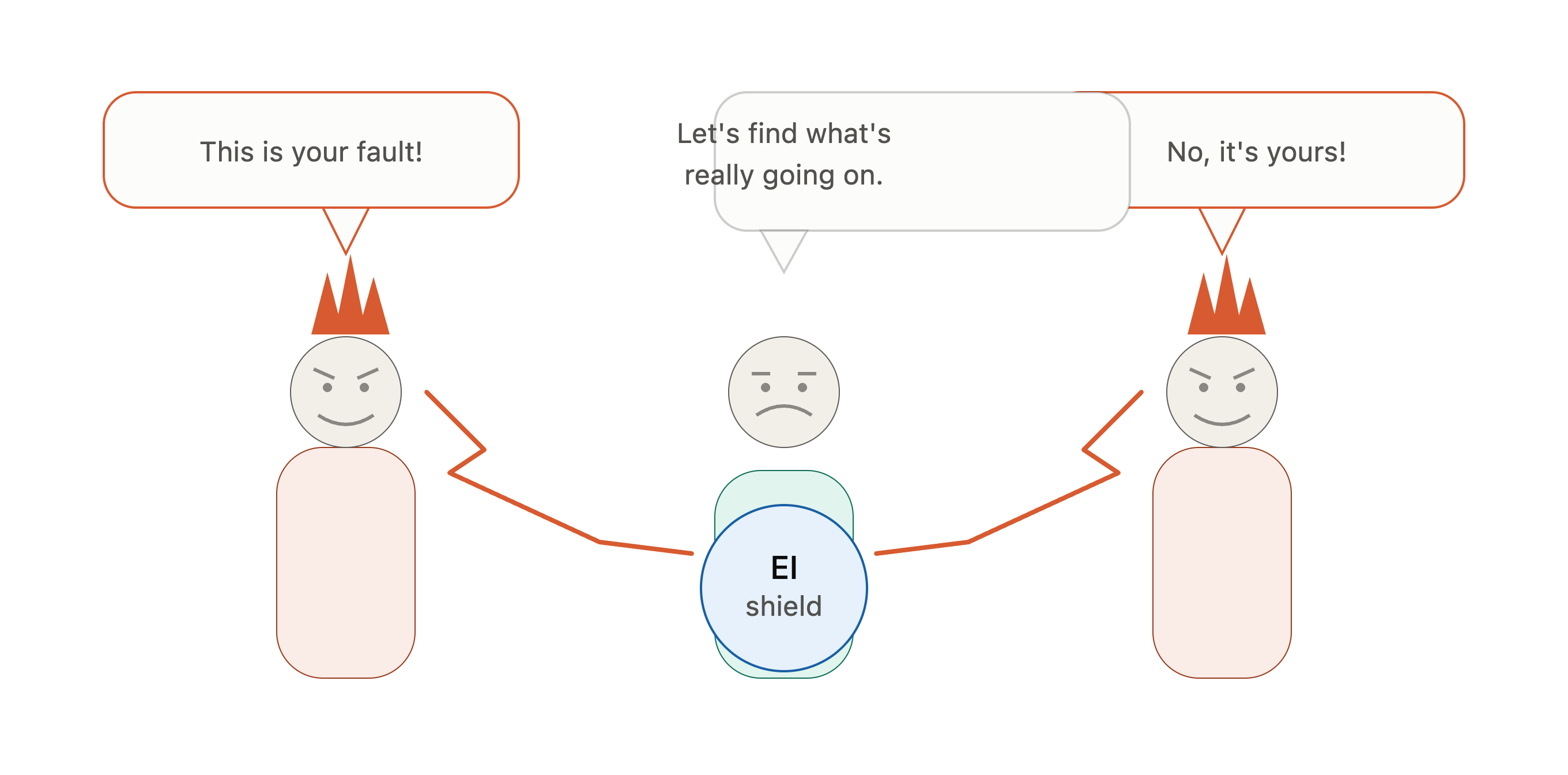
Conflict is where emotional intelligence stops being theoretical. PMI generally favors direct, collaborative problem-solving, because unresolved conflict damages performance. Emotional intelligence helps you recognize what kind of conflict you're dealing with before you choose how to respond.
Consider three common situations. First, two team leads argue over resource priority. Second, a sponsor challenges the plan in front of everyone. Third, a business stakeholder says they support the project but ignores every review request. All three create delay, but they don't come from the same place — one may be structural, one political, one emotional. Apply the same script to all three and you'll waste time.
With team conflict — EI helps you separate the issue from the ego, ask better questions, and reduce defensiveness before addressing the actual work problem.
With stakeholder resistance — EI helps you hear the real concern behind the objection, which is usually risk, status, or fear of loss rather than dislike of the project itself.
With feedback — EI lets you deliver a hard truth without making someone feel attacked, and receive criticism without treating it as an attack.
One habit worth adopting is the "name, ask, align" sequence. Name what you're observing, without assigning blame. Ask a question that surfaces the real concern. Then align on the next step. For example: "I've noticed the operations review has slipped twice. Is there a usability issue we haven't addressed yet? Let's identify it now so we protect the go-live date." That works far better than, "You're blocking us again."
For exam prep, this matters because many PMP questions are really tests of emotional discipline disguised as process questions. The best answer usually protects dignity, gathers facts, and engages the right person before escalating.
📌 For more practice with this pattern, see conflict management for project managers.
Pro Tip: When a stakeholder becomes emotional, don't rush to defend the plan. Slow the conversation down. People rarely absorb logic while they feel ignored, threatened, or embarrassed.
Common Emotional Intelligence Mistakes Project Managers Make
Most PMs don't fail because they lack empathy — they fail because they apply it incorrectly. Emotional intelligence has a few traps, especially for people who take pride in being calm and collaborative.
Mistake | Why it causes harm |
|---|---|
Confusing empathy with agreement | You can understand someone's frustration without changing the baseline, budget, or scope for them. |
Avoiding conflict in the name of harmony | Delayed conflict usually returns as missed deadlines, shadow decisions, or passive resistance. |
Over-accommodating strong personalities | If one loud stakeholder dominates every meeting, other quiet risks become invisible. |
Taking others' behavior personally | A stressed executive may be reacting to external pressure, not attacking you. |
Using tone instead of clarity | Kindness matters, but vague kindness creates confusion. Clear is kinder than fuzzy. |
I've seen otherwise excellent project managers burn out because they became an emotional shock absorber for everyone around them. They listened well, supported the team, protected the sponsor relationship — but never set a boundary. That isn't high emotional intelligence.
The better pattern is firm empathy: understand people, respect people, but still hold your ground on roles, decisions, and commitments. PMI's view of accountable leadership fits this well — good leaders aren't cold, but they aren't endlessly accommodating either. They're fair, self-aware, and clear.
Conclusion: Use Emotional Intelligence to Become a PM People Trust
Emotional intelligence is one of those skills that looks almost invisible when done well. Meetings become cleaner. Risks surface earlier. Feedback lands better. Stakeholders stop posturing and start contributing. Teams trust you enough to bring bad news right away instead of hiding it until the end of the day — which, as every project manager knows, is never a good sign.
Remember this: emotional intelligence helps project managers read situations accurately, regulate their own reactions, resolve conflict sooner, and build stronger stakeholder buy-in. It matters in predictive, agile, and hybrid work alike. And for PMP candidates, it explains why so many correct answers begin with listening, assessing, engaging, and leading — rather than commanding right away.
The best way to improve isn't to memorize a definition and move on. Practice it in your next status meeting, your next risk review, and your next difficult conversation.
Frequently Asked Questions (FAQ)
What is emotional intelligence for a project manager? It's the ability to recognize, regulate, and effectively use emotions — your own and other people's — to make better decisions, resolve conflict, build trust, and keep a project moving in the right direction.
Does emotional intelligence show up on the PMP exam? Yes. PMI weaves it into topics like leadership, stakeholder engagement, conflict management, servant leadership, and decision-making under pressure, rather than testing it as a standalone chapter.
What are the 5 core emotional intelligence skills? Self-awareness, self-regulation, motivation, empathy, and social skill.
Does emotional intelligence matter more in agile than in predictive projects? Not really. It shows up differently — tied to servant leadership and team dynamics in agile, and to change management and sponsor communication in predictive — but the underlying need is the same in both.
What's the most common mistake when applying emotional intelligence? Confusing empathy with agreement, and avoiding conflict in the name of harmony — both tend to make the underlying problem come back later, and worse.
Project Scope Management: WBS & Scope Control for PMP
7 leadership competencies PMs need according to PMBOK 8
Conflict management according to PMBOK 8: 5 techniques and 6 steps
Project management fundamentals series for PMP
Try Free PMP Practice Questions →
Official References: