The more orders you give, the worse your team performs. What servant leadership is, Larry Spears' 10 traits, and how to spot the right answer on the PMP.
Last updated: October 1, 2026 — checked against the PMI Lexicon of Project Management Terms, the 2026 PMP Examination Content Outline and the 2020 Scrum Guide.
There's a paradox that anyone who has managed a team of strong engineers eventually runs into: the more orders you give, the worse their work gets. The best developers I've worked with didn't need someone standing behind them pushing deadlines — they needed someone clearing the road so they could focus on what they do best.
That is the essence of servant leadership. This article explains what servant leadership is, Larry Spears' 10 characteristics, why it fits IT projects so well, how to apply it in practice, and how to spot the right answer when the topic shows up on the PMP exam.
What Is Servant Leadership?
Servant leadership is a leadership style in which the manager puts the team's growth and success first, using credibility rather than positional power to remove impediments, delegate and help the team become self-directed. The concept was introduced by Robert K. Greenleaf in 1970.
PMI defines it in the PMI Lexicon as "the practice of leading the team by focusing on understanding and addressing the needs and development of team members in order to enable the highest possible team performance."
The central question of a servant leader isn't "How can the team serve my goals?" but "What do I need to do so the team can succeed?" It sounds simple, but it inverts the management model many of us grew up with.
Where the concept came from
The term was introduced by Robert K. Greenleaf in his 1970 essay "The Servant as Leader." His core idea: a true leader begins with a natural desire to serve others, and only from that foundation chooses to lead.
Later, Larry Spears, who led the Greenleaf Center for Servant Leadership, distilled Greenleaf's thinking into ten characteristics that remain the most widely cited framework today. They're covered in detail below.
How servant leadership differs from traditional leadership
Dimension | Traditional leadership | Servant leadership |
|---|---|---|
Central question | "What can the team do for my goals?" | "What can I do for the team's success?" |
Source of authority | Position, title | Credibility, trust |
Primary role | Direct and supervise | Remove impediments, enable |
Decision-making | Concentrated at the top | Delegated to the team (empowerment) |
Measure of success | Team compliance | Team growth and autonomy |
Important: servant leadership is not passivity or giving the team whatever it wants. A servant leader still sets high standards and stays accountable for outcomes — they simply reach those outcomes by lifting the team up rather than pressing it down.
Why Servant Leadership Fits IT Projects So Well
It's no accident that servant leadership is tightly associated with agile culture and software teams. There are three practical reasons.
1. IT is knowledge work. You can't supervise an engineer into writing a better algorithm by hovering over their shoulder. The value lives in their head, and it only flows when they have space, autonomy and intrinsic motivation.
2. The strongest technical person is rarely the manager. On a dev team, the PM or Scrum Master is seldom the best coder in the room. Dictating technical decisions is a recipe for bad outcomes. The more sensible role is to serve: remove impediments, shield the team from noise, and let the experts decide within their domain.
3. Agile is built on self-organization. The 2020 Scrum Guide describes Scrum Masters as "true leaders who serve the Scrum Team and the larger organization" — not people who assign work. That maps directly onto servant leadership. (See the 2020 Scrum Guide.)
Larry Spears' 10 Characteristics of Servant Leadership
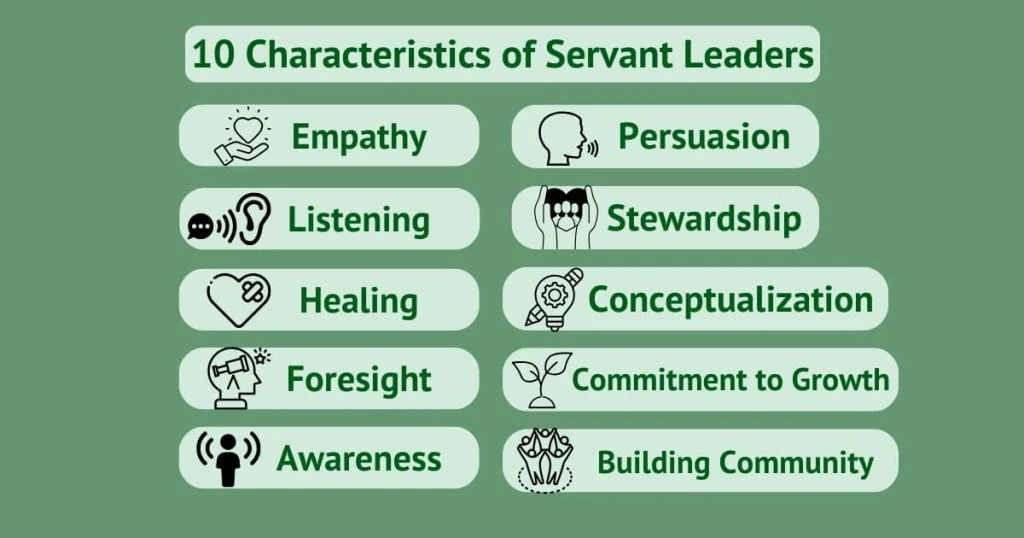
The ten characteristics at a glance:
- Listening
- Empathy
- Healing
- Awareness
- Persuasion
- Conceptualization
- Foresight
- Stewardship
- Commitment to the growth of people
- Building community
Applying each characteristic to IT projects
- Listening: listen to understand before reacting. When an engineer says "this task needs two more days," there's often a real technical risk behind it that you haven't seen yet.
- Empathy: understand others from their point of view, even when you disagree. This is how you preserve trust when project pressure rises.
- Healing: help the team recover after stressful stretches — a failed release, a long crunch — instead of sprinting straight into the next thing.
- Awareness: keep sharp self-awareness and situational awareness, and pick up early signals of burnout or simmering conflict.
- Persuasion: build consensus through reasoning and influence, not positional power — especially when you shouldn't be forcing a technical decision.
- Conceptualization: see the big picture and long-term vision, not just the day-to-day work.
- Foresight: anticipate the consequences of today's decisions, such as technical debt or scaling risk, so you act proactively rather than reactively.
- Stewardship: act as a trustee of shared assets — the team's health, the quality of the codebase and stakeholders' trust.
- Commitment to the growth of people: measure your success by other people's growth; delegate to the right people and support them from behind.
- Building community: create psychological safety, where people can say "I was wrong" or "I don't know" — the precondition for problems surfacing early instead of being hidden.
You don't need to score yourself on all ten every day. Treat them as a compass: whenever you notice yourself drifting toward command-and-control, come back to this list and ask which characteristic you're neglecting. Wording varies slightly between sources; see the Greenleaf Center to compare.
How PMs Apply Servant Leadership in IT Projects
Here are a few concrete ways I've put this into practice as a project manager:
- Reframe the daily standup question: instead of "What did you get done today?", ask "What's blocking you that I can remove?" That small change in phrasing transforms the tone of the meeting.
- Shield the team: when an urgent request from another department cuts into the sprint, I renegotiate priorities with stakeholders so the team's focus isn't fragmented.
- Turn incidents into learning: when a junior developer took down the staging environment, the servant response wasn't a reprimand — it was working with them to build a safeguard so it couldn't happen again.
- Delegate technical authority to the right owner: when I stopped making architecture decisions myself and handed them to the tech lead, decisions got faster and I got time back for my actual job: managing stakeholders and schedule.
Servant Leadership on the PMP Exam
Servant leadership is one of the foundational themes behind the People domain and the agile questions on the PMP exam.
- The 2021 ECO explicitly listed "Value servant leadership (relate the tenets of servant leadership to the team)".
- The 2026 ECO (in effect since July 9, 2026) no longer uses that exact phrase, but the idea sits squarely inside the People task "Lead the project team" (People is 33% of the exam): empower the team, solve problems, represent the voice of the team, support the team's varied experiences, skills, and perspectives, determine an appropriate leadership style.
- PMBOK 8 reflects the same thinking through the principles Be an Accountable Leader and Build an Empowered Culture.
How to spot the "servant leader" answer
In situational questions, the best answer is usually the one where the PM:
- Removes the impediment rather than doing the work or reassigning it.
- Facilitates the team's own decision rather than deciding for them.
- Coaches and mentors a struggling member rather than escalating to a functional manager or removing them.
- Shields the team from outside disruption.
- Adapts their style to the situation: more guidance for newcomers, more autonomy for a mature team.
3 practice questions
Question 1. In the daily standup, a developer says they've waited three days for the infrastructure team to grant API access and can't continue their task. What should the project manager do?
A. Reassign the task to another developer
B. Notify the sponsor immediately about the schedule risk
C. Work with the infrastructure team to remove the impediment
D. Ask the developer to find a workaround
Answer: C. Removing impediments is a core servant leader responsibility. Reassigning the task doesn't remove the blocker, and going to the sponsor is premature before the PM has tried to resolve it.
Question 2. A self-organizing agile team is split between two technical solutions and asks the PM to decide. What should the PM do?
A. Pick the solution the PM prefers
B. Facilitate a discussion so the team reaches its own decision
C. Ask the company's chief architect to decide
D. Postpone the decision to avoid conflict
Answer: B. A servant leader empowers the team and facilitates decisions within its area of expertise rather than deciding for it.
Question 3. A new, inexperienced member of an agile team keeps falling behind. What should the PM do first?
A. Let the team handle it, since it's self-organizing
B. Talk privately to understand the difficulty, then coach them and pair them with an experienced colleague
C. Ask the functional manager for a replacement
D. Note it in their performance review
Answer: B. Commitment to the growth of people, plus adapting your leadership style to each person's capability — newcomers need closer guidance before full autonomy.
For more practice, see the 50 PMI mindset principles or try PMP practice questions on CertFlow.
Checklist: Are You Actually Leading as a Servant?
1. In your last meeting, did you talk more or listen more?
2. Do you know the single biggest impediment each team member faces right now?
3. When did you last remove an obstacle for the team?
4. Are you delegating decisions to the right people, or hoarding them?
5. Do team members feel safe bringing you bad news early?
6. Do you measure success by the team's growth or by its compliance?
When Servant Leadership Isn't the Right Fit
Let's be honest: servant leadership isn't a cure-all.
- In a crisis that demands an immediate call (a production incident at midnight), a decisive, directive style is sometimes more appropriate.
- For a brand-new team member who isn't yet ready for autonomy, close guidance is necessary before you delegate.
Great leaders adapt their style to the situation (situational leadership) — exactly what the 2026 ECO means by "determine an appropriate leadership style". Servant leadership is the foundation, not a coat you wear in every kind of weather.
Common Misconceptions About Servant Leadership
Misconception | Reality |
|---|---|
It means keeping employees happy | Wrong. It puts the team's growth first, which sometimes means direct, difficult feedback. |
Servant leaders are weak or indecisive | The opposite. It takes backbone to absorb pressure on the team's behalf and delegate while staying accountable for results. |
Adopting it means dropping KPIs and deadlines | No. Standards and accountability stay intact; only the path to them changes. |
Only Scrum Masters need servant leadership | No. PMs on predictive and hybrid projects are also expected to empower and support their teams — the PMP exam tests this mindset across all approaches. |
Conclusion
Servant leadership isn't a trendy management gimmick. It's a shift in how you define your role: from someone who stands above and issues orders to someone who stands behind and lifts others up. In IT projects — where value lives in the heads of smart, autonomous people — it's usually the most sustainable path for the team and the project to grow together. And for PMP candidates, understanding it deeply unlocks a large share of People and agile questions.
Start with one small question in tomorrow's meeting: "What can I remove for you today?"
Frequently Asked Questions (FAQ)
What is servant leadership?
Servant leadership is a leadership style that puts the team's growth and success first, relying on credibility and support rather than command authority. The concept was introduced by Robert K. Greenleaf in 1970.
What are the 10 characteristics of servant leadership?
According to Larry Spears: listening, empathy, healing, awareness, persuasion, conceptualization, foresight, stewardship, commitment to the growth of people, and building community.
How is servant leadership different from traditional leadership?
Traditional leadership relies on position to direct and supervise; servant leadership relies on trust to remove impediments, delegate and enable the team. The focus shifts from "the team serves me" to "I serve the team."
Is a Scrum Master a servant leader?
Yes. The 2020 Scrum Guide describes Scrum Masters as true leaders who serve the Scrum Team and the larger organization, focused on removing impediments and enabling the team rather than assigning work.
Is servant leadership on the PMP exam?
Yes. The 2021 ECO explicitly listed "Value servant leadership". The 2026 ECO folds the idea into the People task "Lead the project team": empowering the team, solving problems, representing the team's voice and choosing an appropriate leadership style.
Is there ever a time not to use servant leadership?
Yes. In a crisis requiring an immediate decision, or when leading people not yet ready for autonomy, a more directive style may fit better. Strong leaders adapt to the situation.
Now that you understand servant leadership, it's time to practice with real exam-style questions.
Try free PMP practice questions →
Sources:
Greenleaf Center for Servant Leadership — What is Servant Leadership?
PMI Lexicon of Project Management Terms