A project charter authorizes your project and empowers the PM. The 8 essential components, a 6-step process, charters in agile, a template and an example.
Last updated: October 1, 2026 — checked against the PMI Lexicon of Project Management Terms, the PMBOK® Guide – Eighth Edition and the 2026 PMP Examination Content Outline.
In PMI's Pulse of the Profession 2017 survey, 28% of strategic initiatives failed outright, and the primary cause was a lack of clearly defined objectives and milestones to measure progress (37%). The same survey found that an actively engaged executive sponsor was the top driver of projects meeting their original goals. Clear objectives and a committed sponsor are exactly what a good project charter forces you to secure on day one.
This guide shows how to write a project charter that works in practice: not a document filed for the sake of it, but a tool that protects your project when scope is disputed or resources are pulled mid-flight. At the end you'll find a blank template and a filled-in example.
What Is a Project Charter?
A project charter is a document issued by the sponsor or project initiator that formally authorizes the project to exist and gives the project manager authority to use organizational resources. It records the objectives, high-level scope, key stakeholders and success criteria.
PMI's official definition, from the PMI Lexicon of Project Management Terms: "A document issued by the project initiator or sponsor that formally authorizes the existence of a project and provides the project manager with the authority to apply organizational resources to project activities."
Two points in that definition matter most:
- The sponsor or initiator issues the charter, not the project manager. In practice the PM usually drafts it and the sponsor approves it with a signature.
- The charter gives the PM authority. It's the formal basis for securing people, spending budget and making decisions on the project.
The project charter in PMBOK 8
Many study materials still describe the charter as the output of the "Develop Project Charter" process in "the Initiating phase". That's PMBOK 6 wording, and it also contains an error: Initiating is a process group, not a project phase.
PMBOK 8 (2025) brings the process groups back as Focus Areas and integrates 40 non-prescriptive processes into seven performance domains. The charter belongs to the Initiating focus area and feeds the planning processes that follow — for example, PMBOK 8's Plan Scope Management process lists the project charter first among its inputs. See also: PMBOK 8 vs PMBOK 7.
Why Does the Project Charter Matter?
Many people treat the charter as paperwork. In my experience it solves four problems every project faces.
- It formally empowers the PM. Without a charter, the PM's role is ambiguous. When you need people from another department or a spending approval, what do you rely on? The charter.
- It creates a shared reference point. When a scope dispute erupts in month three, you have an approved document to check against instead of conflicting memories.
- It surfaces disagreements early. Writing the charter forces stakeholders to sit down together, so different expectations come out while changes are still cheap.
- It's your basis for resisting scope creep. When an out-of-scope request arrives, the charter lets you say no with justification or route it through change control instead of silently absorbing the work.
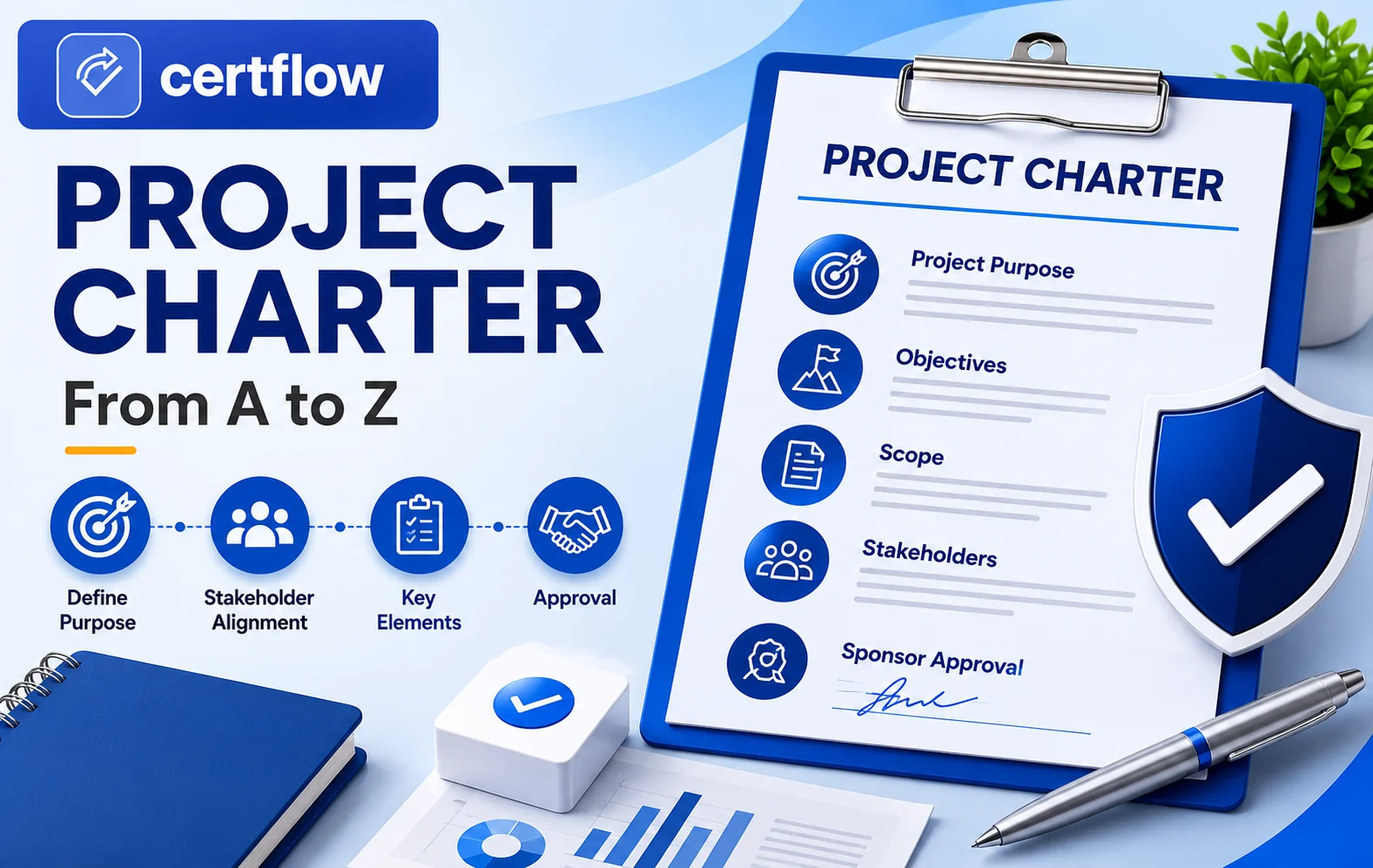
The 8 Essential Components of a Project Charter
- Purpose and justification (a condensed business case)
- Measurable objectives and success criteria
- High-level scope (in scope and out of scope)
- Key milestones
- Estimated budget
- Key stakeholders
- High-level risks, assumptions and constraints
- PM authority and sponsor approval
A good charter doesn't need to be long. Mine usually fit on 2–3 pages.
1. Purpose and justification
Answer "Why are we doing this project?" Tie it to a specific business need: the problem it solves or the opportunity it captures. If you can't write a convincing reason here, question whether the project is worth doing.
2. Objectives and success criteria
This is where I spend the most time, and it's the gap PMI's research identifies as the leading cause of failure. Make objectives SMART: specific, measurable, achievable, relevant and time-bound. Instead of "improve the customer experience", write "reduce order processing time from 48 hours to 24 hours before Q4".
3. High-level scope
List what the project will deliver and, just as important, what it won't. The out-of-scope section is often skipped, yet it's your strongest defense against scope creep. Spell out the items people tend to assume are "obviously included".
4. Key milestones
Only the major milestones: start date, key stages and expected delivery. The detailed schedule comes later during planning.
5. Estimated budget
An order-of-magnitude estimate and the funding source. It doesn't need to be precise yet, but it must show the scale of the commitment.
6. Key stakeholders
Who the sponsor, PM, end users and approvers are. I add a column for each person's role and authority to avoid disputes over decision rights later.
7. Risks, assumptions and constraints
The major risks you can already see, the assumptions the project depends on (for example, "the vendor delivers equipment on time"), and hard constraints such as legal deadlines or budget caps.
8. PM authority and approval
State the PM's authority (spending limits, which resources they can direct) and include the sponsor's approval signature. A charter without sponsor approval has no formal standing.
A 6-Step Process for Writing a Project Charter
1. Gather inputs. The business case, contracts (for client projects), agreements and organizational strategy documents. Never write a charter in a vacuum.
2. Talk to the sponsor and key stakeholders. I always hold at least one session with the sponsor to understand what they really expect. What they write in emails often differs from what they actually want.
3. Draft it. Fill in the eight components in plain language, avoiding deep technical jargon, since several levels of leadership will read it.
4. Review with stakeholders. This is when disagreements surface — and that's a good thing. Resolving them on paper is far cheaper than during execution.
5. Finalize and get sponsor approval.
6. Share it widely. The approved charter must reach the whole team and every stakeholder. A charter sitting in a drawer achieves nothing.
The Project Charter in Agile and Hybrid Projects
Agile projects still need authorization and someone with authority to commit resources, but the charter is usually much lighter:
- Lightweight charter: focuses on the product vision, why the work matters, success criteria and budget or time limits. Detailed scope lives in the product backlog and evolves each iteration.
- Team charter (working agreement): different from the project charter. It's the team's internal agreement on values, communication, decision-making and the Definition of Done. The project charter authorizes the project; the team charter helps people work together.
- Hybrid: often a full charter at project level, with agile teams inside it keeping their own team charters.
The Project Charter on the PMP Exam
The 2026 ECO has no task called "create the project charter", but charter thinking runs through several tasks: developing a shared vision with stakeholders (People), defining scope and obtaining agreement on it (Process), and defining success metrics and governance (Business Environment). Common scenarios:
- The project has started without a charter: the PM should work with the sponsor to get an approved charter rather than carry on as if nothing were missing.
- A stakeholder wants to change objectives or scope recorded in the charter: route it through change control; changes to the charter need sponsor approval.
- The PM lacks authority to secure resources: check the authority granted in the charter; if it isn't enough, take it to the sponsor.
- Who issues the charter? The sponsor or initiator — not the PM.
Common Mistakes When Writing a Project Charter
- Too much detail, turning the charter into a project plan.
- Vague success criteria, such as "the project succeeds when the client is satisfied" with no definition of satisfied.
- Skipping out-of-scope — the leading cause of scope creep.
- The PM drafts it and treats it as approved without the sponsor's sign-off.
- Write it and forget it, never using it again for change requests or key decisions.
Project Charter vs Project Management Plan vs Scope Statement
Criterion | Project charter | Project management plan | Project scope statement |
|---|---|---|---|
Purpose | Authorizes the project and empowers the PM | Describes how the project will be executed, monitored and controlled, and closed | Describes the scope, major deliverables, assumptions and constraints |
Answers | What and why | How | Exactly what is included |
Level of detail | High level, 1–3 pages | Detailed, with subsidiary plans | More detailed than the charter on scope |
Issued/approved by | Sponsor or initiator | Built by the PM, approved by stakeholders | Built by the PM with the team and stakeholders |
When | First (Initiating) | After the charter (Planning) | After the charter (Planning) |
Put simply: the charter authorizes the project; the plan explains how to deliver it; the scope statement pins down what's included. The charter always comes first. Read more: Developing the integrated project management plan in PMBOK 8.
Project Charter Template
Section | Content |
|---|---|
Project name | |
Sponsor / Project manager | |
Date / Version | |
Purpose and justification | |
Objectives and success criteria (SMART) | |
In scope | |
Out of scope | |
Key milestones | |
Estimated budget and source | |
Stakeholders and roles | |
Risks / Assumptions / Constraints | |
PM authority | |
Sponsor approval (name, signature, date) |
Filled-In Project Charter Example (Software Project)
The example below is a hypothetical project used to show the right level of detail.
Section | Content |
|---|---|
Project name | Online customer onboarding portal |
Sponsor / PM | Head of Retail Banking / Delivery lead |
Purpose | Paper-based account opening takes 3 days on average and customers abandon it. Going digital raises conversion and reduces branch workload. |
Objectives | Cut account opening time from 3 days to under 15 minutes; 60% of new accounts opened online within 6 months of launch. |
In scope | Web sign-up, electronic identity verification, core system integration, branch staff training. |
Out of scope | Mobile app, business products, changes to the core system. |
Key milestones | Kickoff in January; internal pilot in April; launch in June; project close in July. |
Budget | Estimate ±25%, funded from this year's digital transformation budget. |
Stakeholders | Retail Banking (product owner), IT, Legal and Compliance, Information Security, branches. |
Risks / Assumptions / Constraints | Risk: delayed legal approval for e-KYC. Assumption: core system APIs ready by February. Constraint: must launch before the June campaign. |
PM authority | Directs the 9-person project team; approves spending within 10% of budget; larger changes go to the sponsor. |
Frequently Asked Questions (FAQ)
What is a project charter?
A project charter is a document issued by the sponsor or project initiator that formally authorizes the project and gives the project manager authority to use organizational resources. It records the objectives, high-level scope, stakeholders and success criteria.
Who issues the project charter?
According to PMI, the project initiator or sponsor issues the charter, not the project manager. The PM usually drafts it and submits it to the sponsor for approval.
How long should a project charter be?
Usually 1–3 pages. If it's longer, you're probably mixing in content that belongs in the project management plan.
Can the project charter change after approval?
Yes, but carefully. Changes to the charter go through change control and need sponsor approval, because they affect the foundation of the whole project.
Do small or agile projects need a charter?
Yes, in a condensed form. Even half a page is enough to align objectives and limits and empower the person in charge. Agile projects often add a team charter to agree how the team works together.
How is a project charter different from a scope statement?
The charter authorizes the project and describes scope at a very high level. The scope statement comes later and details the scope, major deliverables, assumptions and constraints.
Conclusion
The project charter is a small investment at the start of a project that saves a great deal of time, money and conflict later. A few hours spent on a clear charter — measurable objectives, scope that includes what you won't do, and sponsor approval — is worth far more than weeks spent managing the fallout of a project launched in ambiguity.
Now that you know how to write a project charter, it's time to practice with real exam-style questions.
Next article: Developing the integrated project management plan in PMBOK 8
Introduction to project management: what every PM needs to know
Try free PMP practice questions →
Official PMI sources:
PMI, Pulse of the Profession® 2017: Success Rates Rise (PDF)
PMI Lexicon of Project Management Terms