Great PMs don't hide risks — they know how to present risks at the right time, to the right audience, in the right format.
Sprint 3 just ended. You identified a risk: a key vendor may delay delivery of the payment module by two weeks. You sent the sponsor an email: "Red risk — vendor delay detected." Fifteen minutes later, your phone rings — the sponsor has called an emergency meeting with the entire leadership team. The reality: you already had a backup vendor on standby, ready to onboard in three days. The information was correct. The packaging was wrong.
Knowing how to report project risks to clients PMP-style is not simply forwarding entries from your risk register. It is the discipline of choosing the right content, the right format, the right timing, and the right recipient — so stakeholders understand the situation clearly and make informed decisions, rather than reacting emotionally. This guide walks PMP® candidates through building a professional risk communication practice aligned with PMI® standards.
Key takeaways
Not every risk needs to be escalated to the client — classify first by impact and ownership level.
Executive sponsors need to hear business impact and your recommendation, not technical root causes.
Every risk report should include a mitigation plan — a risk without a response plan is incomplete bad news.
Proactive reporting builds trust; a surprise red destroys it in ways that take months to repair.
PMI® mindset: a PM who communicates proactively is meeting a professional obligation, not doing extra work.
Why how you present a risk matters as much as the risk itself
Two PMs identify the same risk: a 40% probability that Vendor A will deliver a key module two weeks late, pushing Milestone 3. The first PM sends an email titled "URGENT: Vendor delay risk" with three dense technical paragraphs. The second sends a focused paragraph: "Vendor A may run two weeks late (probability ~40%). We have Backup Vendor B on standby — estimated three days to onboard. No milestone impact expected. I need your sign-off on the contingency budget of X."
Result: the first PM triggers an unnecessary emergency meeting. The second gets budget approval within two hours and the project moves on.
According to the PMBOK® Guide Eighth Edition, the PM is responsible for managing uncertainty proactively, including how risks are communicated to stakeholders. Each stakeholder has a different risk appetite (overall willingness to accept uncertainty) and risk threshold (the specific trigger point for action). A sponsor with low risk appetite needs to hear the response plan before the probability figure. A technical lead needs the opposite. Matching your format to your audience is not a soft skill — it determines whether the right decision gets made.
See also: Risk management in PMBOK 8 for the full framework of risk identification and analysis before reporting.
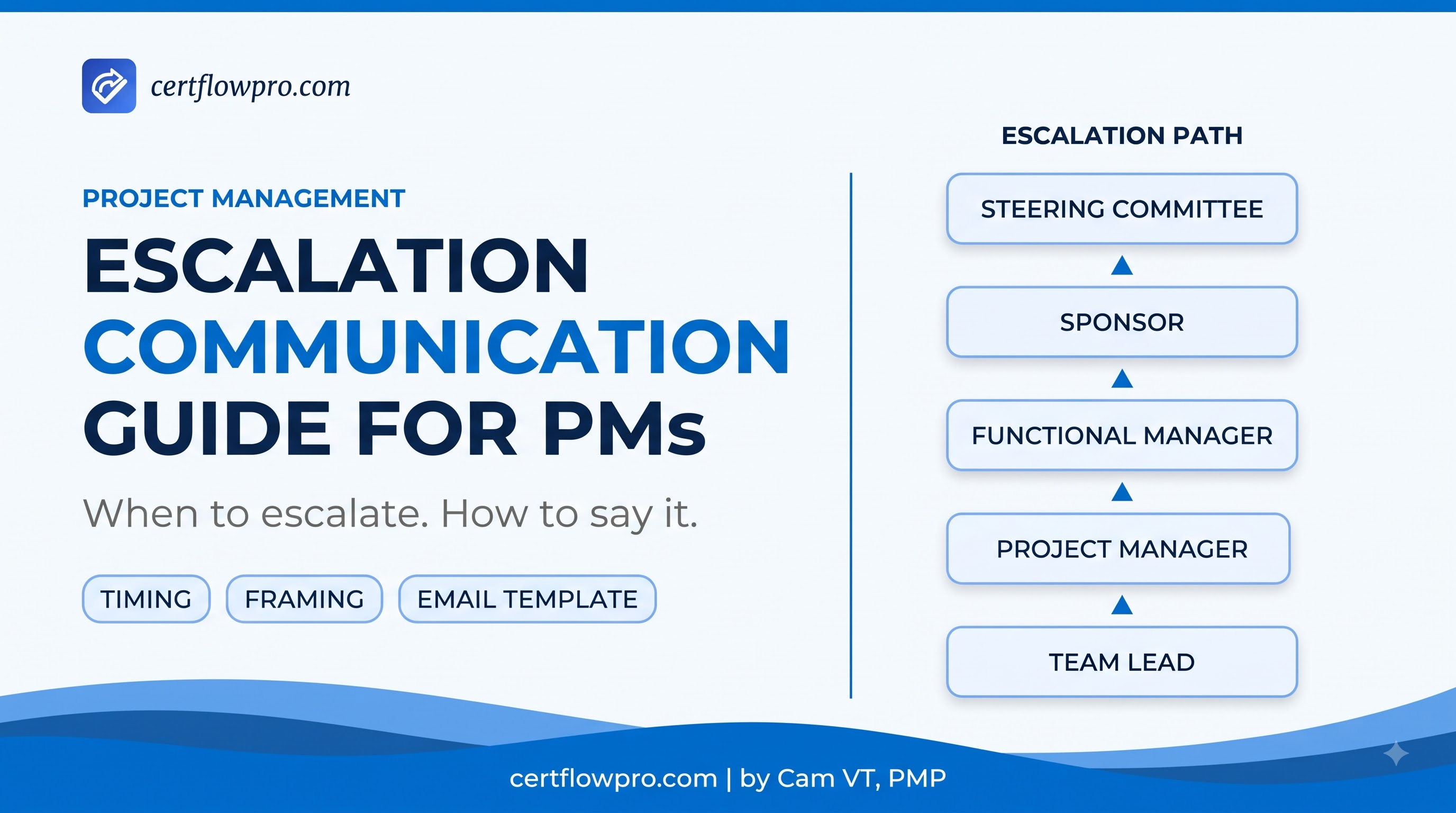
Classify Risks Before Reporting: Escalation Criteria
A typical IT project's risk register may contain 30 to 50 items. Reporting all of them to the client creates noise and wastes everyone's time. The first step is classifying by escalation level.
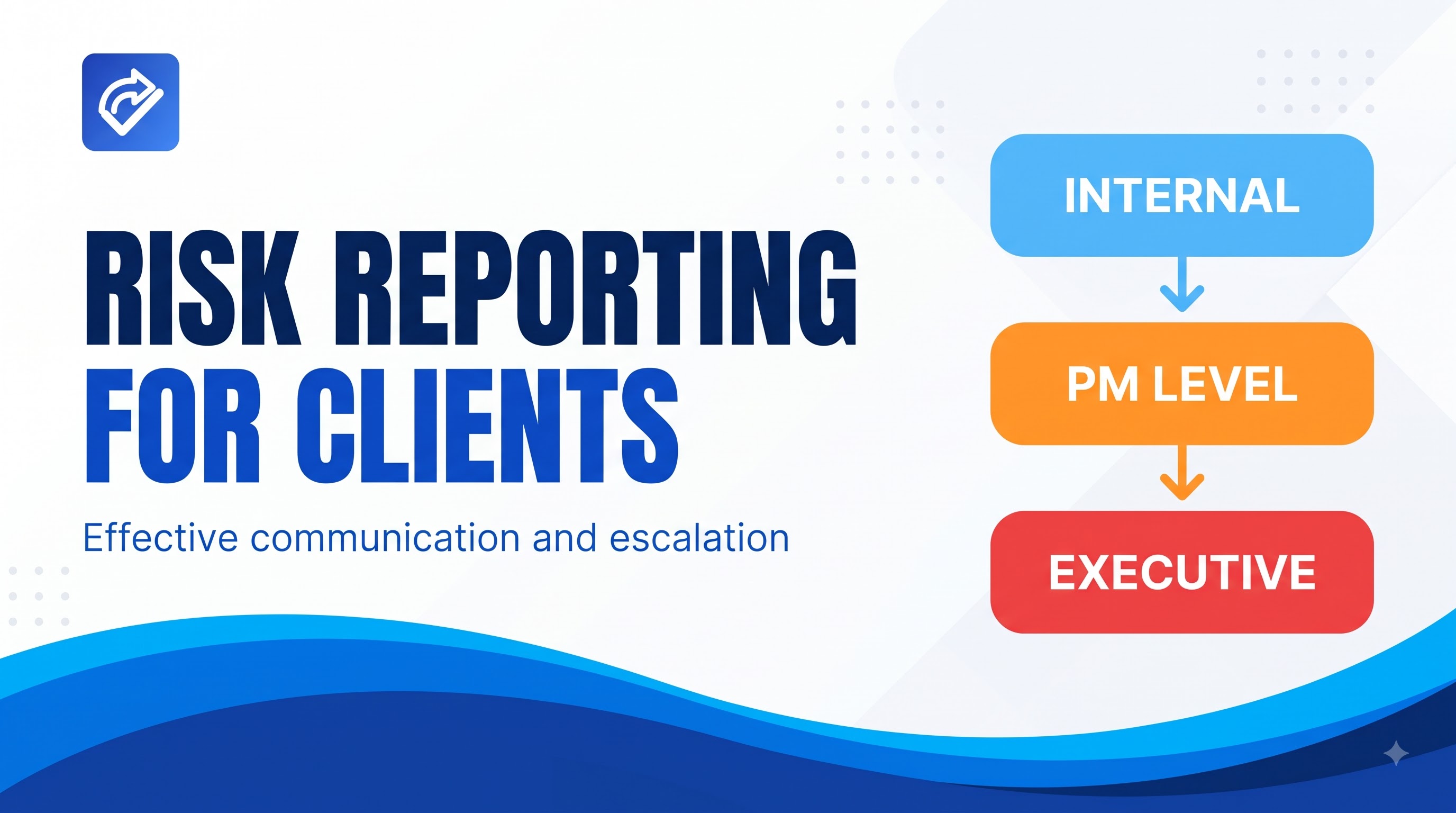
Three escalation levels
Internal (team-owned): Low probability or impact contained within the technical scope; the team has the authority and resources to handle it without additional approvals. Example: a bug that needs one extra day to fix but doesn't affect the sprint goal.
PM level (notify): Affects schedule or budget within the PM's authority, but the client needs to know to adjust expectations. Report in the regular status update — no emergency meeting needed.
Executive level (decision required): Exceeds the PM's authority or requires a decision from the client side (budget approval, scope change, accepting residual risk). Requires a dedicated, timely report.
Criteria for escalating to executive level
Criterion | Example | Action |
|---|---|---|
Impact ≥ 10% of budget or ≥ 1 week on schedule | Vendor delay pushes milestone by 2 weeks | Report immediately with options |
Decision required from client | Accept scope reduction to preserve deadline | Schedule decision-making meeting |
Risk exceeds agreed risk threshold | Probability >70% and High impact | Report per communication plan |
Legal / compliance / reputational risk | User data at risk of exposure | Report immediately, regardless of probability |
Risk has materialized (now an issue) | Vendor missed the deadline | Issue report — no longer a risk report |
The distinction between a risk (uncertain, not yet occurred) and an issue (confirmed, now being resolved) matters because the two require different communication formats and urgency levels. See: Risk identification and response framework.
Language and format for risk reporting by audience
The same risk described to two different audiences needs two completely different write-ups. Writing for the wrong audience is the most common reason risk reports produce unintended reactions.
Writing for the executive sponsor
Executive sponsors care about business outcomes, not technical processes. An effective risk report for a sponsor contains four elements:
Specific business impact: "If this risk occurs, the project will be delayed by X days / cost an additional Y / reduce scope by Z."
Probability in plain language: "High (~70%)", "Moderate (~40%)", "Low (~15%)" — not technical probability scores.
Current mitigation plan: What the PM is doing to reduce likelihood or impact, and how effective that plan is expected to be.
Decision needed from sponsor (if any): This is the most critical component. If no decision is needed, say so explicitly — sponsors need to know whether they're expected to act or just be informed.
Writing for the technical team
The technical team needs enough information to act: root cause analysis, probability and impact scores from the probability-impact matrix, specific action items with assigned owners and due dates, and the chosen risk response strategy (avoid, mitigate, transfer, or accept).
Risk section template for a status report
Field | Content | Example |
|---|---|---|
Risk | Brief description in business language | Vendor A may delay delivery of the payment module |
Probability | Low / Moderate / High | Moderate (~40%) |
Impact | Specific consequences if it occurs | Milestone M3 delayed by approximately 2 weeks |
Mitigation | Current action or contingency | Backup vendor B on standby, 3-day onboarding time |
Owner | Person responsible for monitoring | PM (Cam VT) |
Status | RAG: Green / Amber / Red | Amber — monitoring |
RAG status definitions must be agreed upon at the start of the project within the communication plan. If a sponsor doesn't know that "Amber" means "being monitored, no immediate action needed," every Amber report becomes a potential crisis.
Timing — when and how often to report risks
Both extremes cause problems. Reporting too frequently creates noise. Reporting too infrequently creates "surprise red" moments — when a client first hears about a serious problem after it has already occurred. Surprise red breaks trust faster than any risk itself.
The proactive reporting principle: Report a risk when you have enough information to provide context, not when you have certainty. If you wait for 100% certainty, you are reporting an issue, not a risk.
Cadence guidelines by risk type:
Active risks (being monitored): Update in the weekly or sprint status report. Escalate separately only when status changes significantly.
Emerging risks (newly identified): Notify within 24–48 hours if the impact is at executive level, with an initial assessment and planned next steps.
Long-term risks (horizon monitoring): Update at milestone reviews unless probability or impact changes materially.
Closed risks: Document in retrospective or lessons learned — valuable information for future projects.
See: Project governance and escalation paths for building a formal escalation process.
Common mistakes PMs make when reporting risks
Mistake | Consequence | Fix |
|---|---|---|
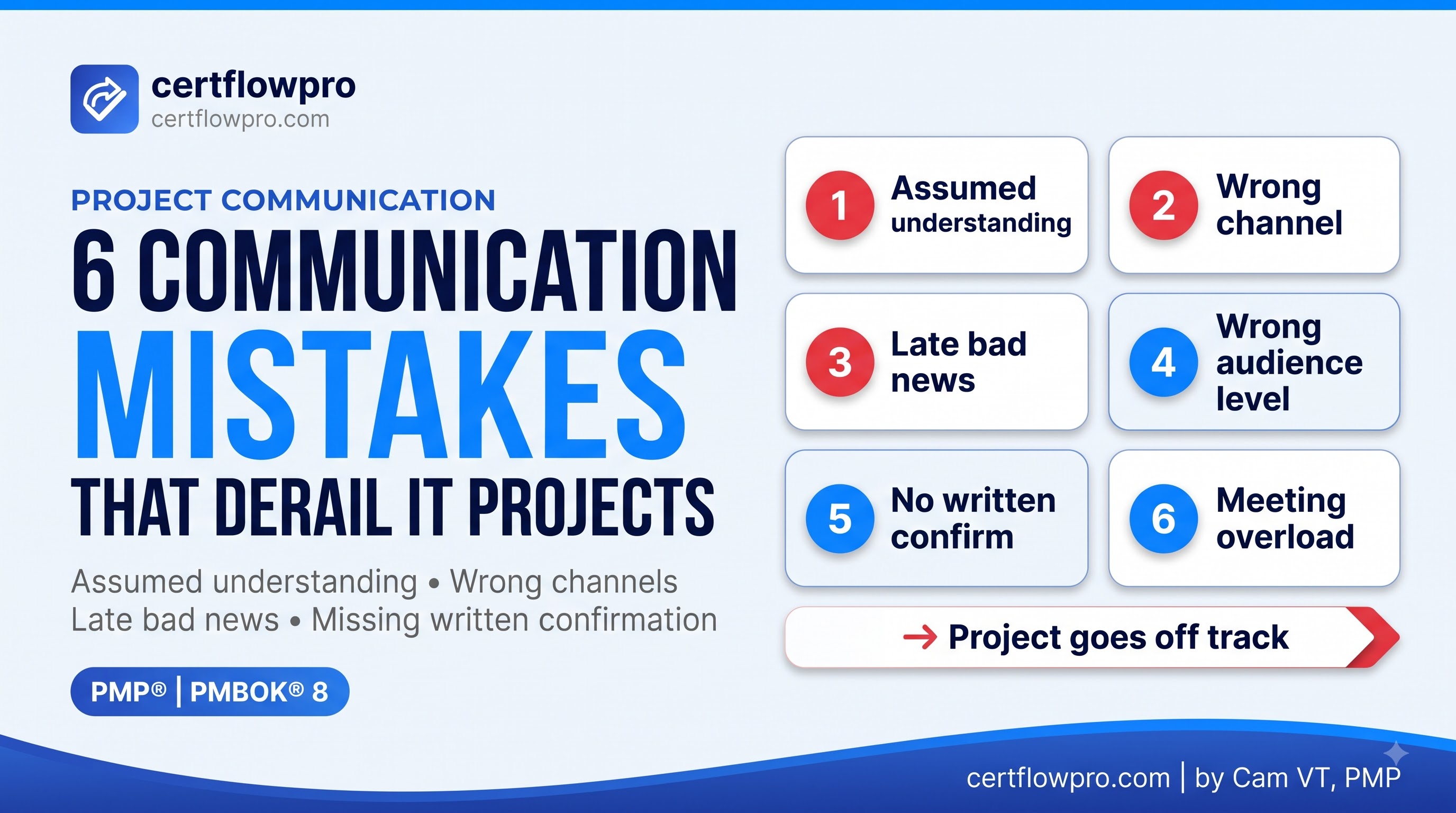
Vague wording: "There may be some timeline issues" | Sponsor doesn't grasp severity; no action taken | Be specific: "If X occurs, the deadline will slip by Y days" |
No mitigation plan: Reporting a risk without a response | PM appears reactive; creates anxiety | Always include at least a preliminary mitigation or contingency plan |
All risks equal priority: Listing 15 risks with identical severity | Client doesn't know where to focus | Highlight top 3–5 risks requiring attention; use RAG to differentiate |
Waiting too long: Holding an urgent risk until the next scheduled meeting | Client feels they were kept in the dark | Emerging high-impact risks: notify immediately, don't wait for the meeting |
Technical jargon for executives: "P50 estimate for critical path is affected by float depletion" | Sponsor cannot understand or decide | Business language: "There is a risk of a 2-week delay if we don't decide on the vendor this week" |
PMP exam tips: PMI mindset on risk communication
PMP® exam questions on risk communication typically test two things: does the PM communicate proactively, and does the PM communicate to the right person at the right time?
Core PMI mindset: The PM communicates proactively — not waiting to be asked. When a scenario places you in a situation where "the sponsor doesn't know about risk X," the correct answer is almost always "inform the sponsor immediately."
Key principles that appear frequently in PMP exam scenarios:
Escalation is a duty, not a political move: When a risk exceeds the PM's authority threshold, escalating is the correct professional response. Withholding information to "handle it internally" violates the transparency principle.
Opportunities are risks too: The PMBOK® Guide defines risk as any uncertain event with a positive or negative effect. PMs are expected to report upside risks (potential to finish early, save budget) alongside negative ones.
Residual risk must be communicated: The risk remaining after a response plan is applied (residual risk) must be disclosed to and accepted by the client — the PM cannot accept residual risk on their behalf.
The communication plan defines how risks are reported: In exam scenarios asking "who gets what information," the answer is always "per the approved communication plan."
See also: Managing stakeholder expectations and Stakeholder management: keeping everyone aligned.
3 Scenario-based questions
The questions below follow the PMP® exam format. Read the scenario carefully, choose your answer, then review the explanation.
Question 1: Predictive
A PM is running a fixed-price software project. During a risk review, the team identifies that a third-party API the product depends on may be deprecated in 4 months — before the project ends. The probability is estimated at 55% and the impact would require a 3-week rework sprint. The PM has identified an alternative API. What should the PM do FIRST?
A. Immediately escalate to the project sponsor and request additional budget for the rework sprint
B. Document the risk in the risk register with probability, impact, and the alternative API as a contingency plan, then report it in the next status report
C. Begin migrating to the alternative API now to eliminate the risk proactively
D. Wait until the API deprecation is confirmed before taking any action
Answer: B. With a 55% probability and manageable impact, this risk should be documented and communicated through the regular status report — not escalated as an emergency. Option A jumps to sponsor escalation before completing analysis and without a completed mitigation plan. Option C unilaterally changes technical scope without approval. Option D is reactive, not proactive. The PMBOK® Guide requires maintaining the risk register and communicating risk status per the communication plan.
Question 2: Agile
A Scrum team is in Sprint 4 of 8. The team identifies a blocker: the security review process, owned by an external compliance team, is running 3 weeks behind. This directly threatens the sprint goal and potentially the release date. The Product Owner is not aware of this delay. What should the Scrum Master do?
A. Inform the Product Owner immediately so they can adjust the sprint backlog and communicate the delay to stakeholders
B. Resolve the blocker internally first before informing the Product Owner to avoid unnecessary concern
C. Remove the security review items from the sprint backlog and move them to the next sprint
D. Escalate directly to the compliance team manager and demand faster processing
Answer: A. The Scrum Master's role includes removing impediments and ensuring transparency. A blocker that threatens the sprint goal must be surfaced to the Product Owner immediately so they can make informed decisions about the backlog and communicate with stakeholders. Option B withholds information, violating the transparency principle. Option C modifies the sprint backlog without PO authority. Option D escalates without informing the PO first.
Question 3: Hybrid
A PM is running a hybrid project for a financial services client. During a sprint review, the team realizes that a new data-handling feature may not comply with a regulatory change taking effect in 2 months. The PM is unsure of the exact requirements. The client's legal team has not been involved. What should the PM do?
A. Continue with the current implementation and address compliance after the regulation takes effect
B. Immediately halt all feature development until full regulatory clarity is obtained
C. Document the compliance risk, escalate it to the client's project sponsor, and recommend engaging the client's legal team to assess the regulatory impact
D. Hire an external legal consultant at the PM's discretion to analyze the regulatory risk
Answer: C. Compliance and regulatory risks must always be escalated to executive level regardless of probability — the PM does not have the authority to assess or accept legal risk on behalf of the client. Option A ignores the risk entirely. Option B halts work without sponsor approval, which exceeds PM authority. Option D spends client money without authorization. Option C is the correct PMI response: document, escalate, and recommend — allowing the stakeholder with appropriate authority to decide.
Practice more scenario questions by domain: try 10 free PMP questions at CertFlow PRO.
Summary
Effective risk reporting is not about saying more or less — it is about saying the right thing. Classify before escalating. Format for your audience. Report early when you have enough context. Always include a mitigation plan. That discipline is how PMs build client trust through every sprint, not just when things go wrong.
Strong risk communication starts with strong risk management. If you haven't yet worked through the full framework for identifying and analyzing risks per PMBOK 8, see Risk management in PMBOK 8: from identification to monitoring.
Frequently Asked Questions (FAQ)
When to report a risk immediately vs. wait for the status report?
Report immediately when any of these four conditions apply: (1) the impact exceeds your authority threshold, (2) a client decision is needed to continue, (3) it is a legal, compliance, or reputational risk, or (4) status jumps from Green or Amber to Red unexpectedly. Risks being steadily monitored can be updated in the regular status report.
Risk appetite vs. risk threshold in client communication
Risk appetite is the client organization's overall willingness to accept uncertainty — expressed through culture and strategy. Risk threshold is the specific trigger point for action — for example, "any risk with probability above 50% and High impact must be escalated." PMs need to know both to decide which risks to report and at what urgency level.
How do you report a risk when you don't yet have a mitigation plan?
Report immediately with what you do know: risk description, estimated probability and impact, and current status as "mitigation options under analysis." Include a timeline for when you expect to have a concrete plan. Waiting for a complete plan before reporting costs the client response time they may need — and raises questions about why they weren't told sooner.
References
Project Management Institute. (2026). PMP® Examination Content Outline – July 2026. PMI. pmi.org
Project Management Institute. (2025). A Guide to the Project Management Body of Knowledge (PMBOK® Guide) – Eighth Edition. PMI. pmi.org
Project Management Institute. (2017). A Guide to the Project Management Body of Knowledge (PMBOK® Guide) – Sixth Edition. PMI. (Section 11.7: Monitor Risks)
Schwaber, K., & Sutherland, J. (2020). The Scrum Guide. scrumguides.org. (Transparency principle)