PMI-standard status report structure, consistent RAG status usage, writing for the right audience, and 5 common PM mistakes to avoid.
It's Thursday evening and you've just received a message from your project sponsor: "Where does the project stand? I need to brief the Board on Monday." You open a blank document, stare at the cursor, and don't know where to start. This happens to most project managers early in their careers — not because they don't understand the project, but because they lack a clear structure for organizing information. This guide covers how to write project status report PMP-style: structured, honest, and audience-specific.
A project status report is a periodic document that summarizes progress, risks, issues, and decisions needed, keeping stakeholders informed without requiring them to ask. Writing status reports effectively helps you manage expectations, surface problems early, and build credibility with your sponsor throughout the project lifecycle.
This guide walks through how to write a project status report that works: the 7-component PMI®-standard structure, consistent RAG status usage, tailoring content for different audiences, and 5 common mistakes to avoid — plus 5 PMP® scenario questions in authentic exam format.
Key takeaways
A status report is not a work journal — it answers "is the project on track?" in under 2 minutes of reading.
The 7-part standard structure: summary, accomplishments, upcoming milestones, risks/issues, decisions needed, budget/schedule, RAG status.
RAG thresholds must be defined clearly at the start of the project — not set by the PM's gut feeling when writing each report.
Executives read the summary and RAG; technical leads need the details — a well-structured report serves both audiences.
PMI® mindset: a PM communicates proactively and honestly, even when the news is bad — hiding problems is the real risk.
What a status report is and why it matters for project communication
According to the PMBOK® Guide Eighth Edition, communication is one of the core competencies of a project manager — and the status report is the most common form of push communication throughout the project lifecycle.
A status report is not simply a summary of work completed. Its real purpose is to ensure sponsors, steering committees, and key stakeholders are never surprised. Projects fail not because of technical problems alone; they often lose funding or executive support because information arrived too late or was incomplete.
In the PMP® ECO 2026 framework, reporting skills are tied to both the People Domain (42%) — specifically tasks related to stakeholder engagement — and the Process Domain (50%) — tasks related to monitoring and controlling. Expect status reporting concepts to appear across both domains in the actual exam.
Status reports differ from team meeting notes (downward communication — from PM to the team) and from dashboards (real-time data visualization tools). A status report is upward communication — from the PM to the sponsor, steering committee, and executives — written in the language of decision-makers, not technical language.
If you haven't yet established a communication plan for your project, read Project Communication Management Planning in PMBOK 8 first — a status report only delivers value when cadence, format, and audience have been agreed upon in advance.
The 7 components of a standard status report
There is no single universal template for a status report, but every effective one contains these 7 components. The order may vary by organizational template, but none of these sections should be missing.
1. Executive Summary
The first and most critical section. Limit it to 3–5 sentences answering: where the project stands relative to plan, the most significant issue to watch, and what's expected next week. Write in present tense, avoid technical jargon. A sponsor will decide within 30 seconds whether to read further — make those sentences count.
Effective example: "Project is on track (Green). The payment module shipped on schedule; a vendor API risk may cause 1-week delay — actively being managed. Budget approval of $30K needed by Nov 15 to avoid Sprint 4 delay." Three sentences, enough for the sponsor to decide whether to call a meeting.
2. Accomplishments
List specific deliverables, milestones, or tasks completed during the reporting period. Use concrete numbers where possible: "Completed 3 of 5 API modules, achieved 60% of sprint goal, deployed to staging environment on Nov 10." Avoid vague language like "continued system development" — it provides no actionable information to readers.
3. Upcoming Milestones
List the 3–5 most important milestones in the next 2–4 weeks, with target dates and owners. This section tells stakeholders when they need to review or make decisions. For agile projects, this typically includes the next Sprint Review or Product Increment date with specific timing.
4. Risks and Issues
Distinguish clearly between risks (potential future problems requiring mitigation) and issues (current problems requiring resolution). Each entry should include: a brief description, potential impact, response plan, owner, and current status. Stakeholders need to know which problems you're handling and which ones require their decision.
5. Decisions Needed
This is the section most project managers skip. If you need sponsor approval for additional budget, a scope change, or resolution of a cross-departmental dependency — state it clearly with a decision deadline. Writing "awaiting approval" is passive and ineffective; "Budget increase of $50K needs approval by Nov 15 to prevent Sprint 4 delay" creates urgency and accountability.
Even when no decisions are required, write: "No decisions needed this week" — so stakeholders know you checked rather than simply omitted the section.
6. Budget and Schedule Status
Summarize budget (spent/remaining/forecast to complete) and schedule position (SPI, days ahead/behind if using Earned Value Management). For agile projects, substitute velocity trend and burn-down summary. You don't need a detailed cost breakdown — just enough to confirm whether the project is within acceptable thresholds.
7. RAG Status
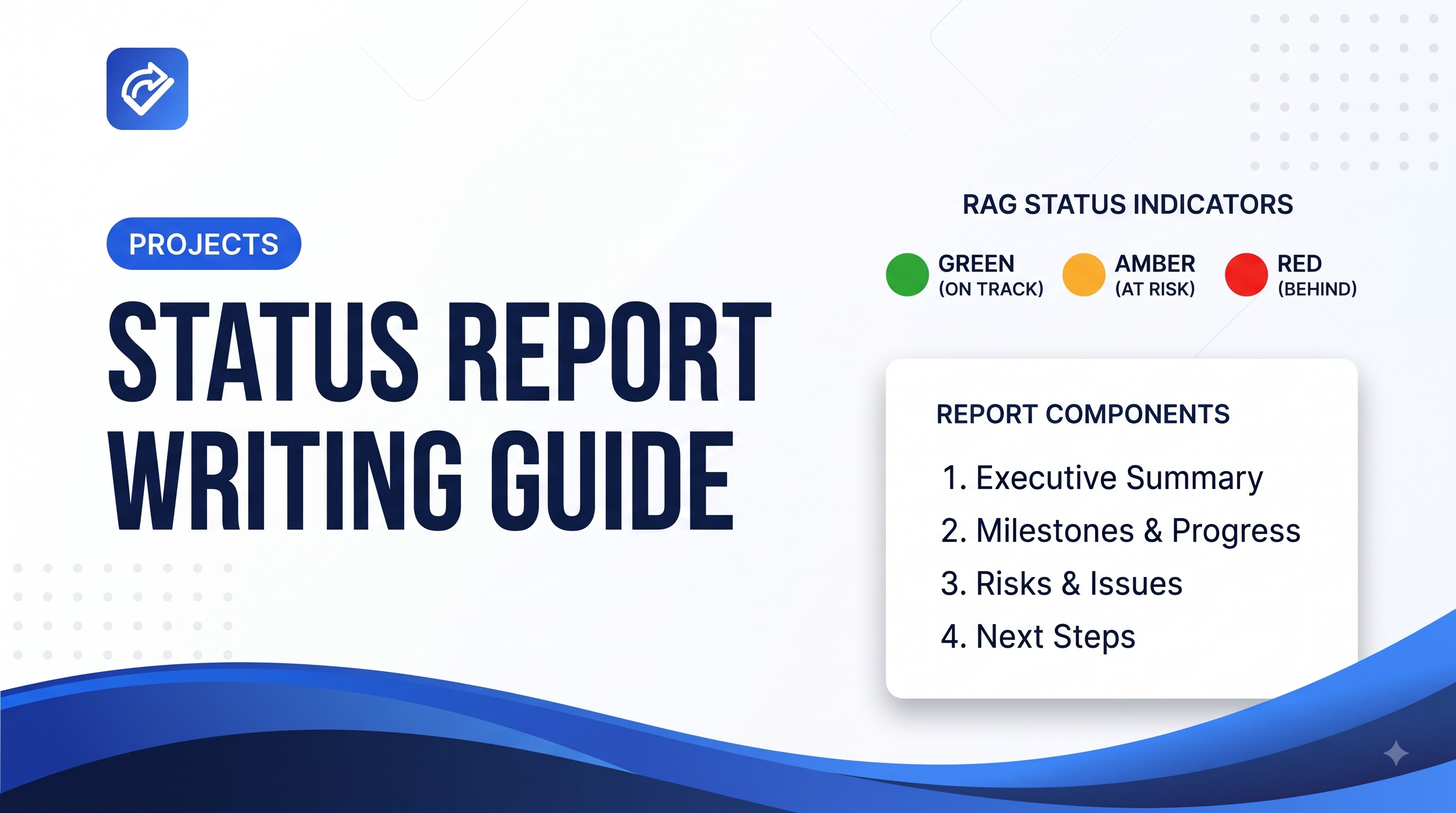
Red/Amber/Green is the first thing most stakeholders look at. The thresholds must be defined in the communication plan from the Initiating Phase and applied consistently throughout the project. This component is analyzed in depth in the next section.
RAG status — the traffic light system project managers misuse
RAG (Red/Amber/Green) gives stakeholders an instant read on project health. Its value depends entirely on whether the thresholds are defined consistently and applied honestly.
Color | Standard meaning | Example quantitative threshold |
|---|---|---|
Green | Project on track, no significant concerns | SPI ≥ 0.95, no High or Critical issues open |
Amber | Risks or issues exist and are being managed; baseline not yet impacted | SPI 0.85–0.94, High-priority issue with an active plan |
Red | Serious problem affecting scope, timeline, or budget; immediate escalation required | SPI < 0.85, Critical issue with no resolution path identified |
The most common mistake is defaulting to Amber — avoiding Red to escape scrutiny, while avoiding Green out of excessive caution. The result: Amber becomes meaningless noise, and stakeholders stop trusting the RAG indicator and start forming their own assessments.
Another frequent error is applying different thresholds to the same situation across different reports. The fix: document quantitative thresholds in the communication plan from project kickoff, and walk the sponsor through the definitions in the kickoff meeting to establish shared understanding.
When status shifts from Green to Red: never skip Amber. A sudden jump from Green to Red signals that the PM was not reporting honestly in prior periods — damaging trust far more than an early Red flag would have.
Writing for the right audience — executives versus technical teams
The same project has two very different readerships. Writing a status report that serves both is one of the most difficult skills in project reporting.
Executives (sponsors, steering committees): They read the summary and RAG, then check decisions needed. Use business language: cost, schedule, risk in business terms. Instead of "API gateway timeout occurs when traffic exceeds 500 req/s," write "System may not handle peak-season load; scaling decision needed by Nov 20 to protect launch date."
Technical leads (if the report is forwarded down): They need specific numbers, module names, ticket IDs, test coverage data. But this detail doesn't belong in the main status report to leadership — it belongs in team meeting notes, a separate document with a different audience and purpose.
A practical structure many experienced PMs use: a 2-layer approach. Executive Summary on page 1 (or less), technical detail in an appendix or separate attachment. Each reader self-selects the depth they need.
One more principle for executive communication: how many problems exist matters less than what you're doing about them. "5 open issues: 3 have active plans, 2 require sponsor decision" is more useful than a detailed list of 5 issues with no associated actions.
For a deeper look at stakeholder classification and tailoring communication by engagement level, see Aligning Stakeholder Expectations: Classification to Consensus.
5 common status report mistakes
Mistake | Consequence | Fix |
|---|---|---|
Too much technical detail | Executives can't follow it; they stop reading | Use business impact language; move technical detail to an appendix |
Reporting only good news | Stakeholders are blindsided when a major problem surfaces | Report early warnings with mitigation plans as soon as risks are identified |
Inconsistent RAG status | The signal loses meaning; stakeholders form their own views | Define quantitative thresholds in the communication plan at project start |
No "decisions needed" section | Decisions stall; PM is seen as not escalating on time | Always include this section — even as "No decisions needed this week" |
Late or skipped reports | Stakeholders stop reading; PM credibility drops | Automate delivery cadence (calendar, tools); never skip even when things are going well |
The second mistake — reporting only good news — is more widespread than most people admit. Many project managers fear that reporting problems will make them look incompetent. Research on project failures, and PMI® guidance, consistently shows the opposite: stakeholders lose trust in a PM not because the project has problems, but because they learned about those problems too late. Transparent reporting is a mark of professional maturity.
PMP exam tips: a PM reports proactively — not reactively
In PMP exam questions about reporting, the PMI mindset being tested is consistent: a project manager communicates proactively, not reactively. PMs don't wait to be asked — they inform.
Three principles that appear regularly in scenario questions:
Proactive communication: When a significant problem is identified, report it immediately — don't wait for the next scheduled status report if the issue requires urgent stakeholder attention.
Escalation is a duty, not a political move: When an issue is beyond the team's ability to resolve, the PM must escalate to the sponsor or steering committee. This is a core responsibility, not a sign of failure.
Follow the communication plan: Frequency, format, and audience of status reports must follow the approved communication plan. PMs cannot unilaterally change reporting arrangements without going through change control.
An important distinction for the exam: a status report (periodic report per communication plan) differs from an issue log (tool for tracking open issues) and from a change request (formal process for scope/baseline changes). Many scenario questions test whether you know which tool to use in a given situation.
For agile projects: Sprint Review does not substitute for a status report to executive stakeholders. Sprint Review is an internal Scrum event for the Product Owner and team. If the organization requires a periodic status report, the PM must maintain it even on Scrum or Kanban projects.
Practice your understanding with 10 mixed-domain scenario questions at CertFlow PRO — 10 free questions, no account needed.
5 Scenario questions
Question 1: Predictive project — RAG status accuracy
You are the PM of a software implementation project running in predictive mode. Last week's status report showed Amber. This week, all major risks have been resolved and the project is ahead of schedule. Your sponsor asks for the weekly status report. What should you do?
A. Keep the status as Amber to manage expectations and avoid raising false hopes.
B. Change the status to Green and document the reason for the change in the report.
C. Escalate to the steering committee before changing the RAG status.
D. Wait until next week to confirm the positive trend before changing the status.
Question 1. Answer: B — Change to Green and document the reason
RAG status must reflect the project's actual current state. When conditions improve, the PM must update the status and explain the change so stakeholders understand the full context. Keeping Amber dishonestly (A) destroys the value of the RAG system. Escalation (C) is not needed for positive news. Waiting another week (D) means reporting inaccurate status — not acceptable under PMI's transparency standards.
Question 2: Agile project — communication plan compliance
You are a Scrum Master on a product development project. The project sponsor attends Sprint Review every two sprints but tells you they still feel "out of the loop." Your organization's communication plan requires a weekly status report. What is the best course of action?
A. Invite the sponsor to attend every Sprint Review instead of sending status reports.
B. Send the sprint backlog and velocity chart to the sponsor as the weekly status report.
C. Continue sending weekly status reports per the communication plan, tailored for the sponsor's information needs.
D. Request a change to the communication plan to remove weekly status reports since Sprint Review covers it.
Question 2. Answer: C — Continue per the communication plan, with improved content for the sponsor
The approved communication plan must be followed. Sprint Review does not replace a status report — they serve different audiences and formats. The PMI-aligned response is to continue reporting per the plan while improving content to better meet the sponsor's needs. Changing the plan requires change control (D cannot be done unilaterally). Sending the sprint backlog (B) is technical detail inappropriate for executive-level communication.
Question 3: Hybrid project — proactive reporting
You are the PM of a hybrid project (predictive planning, agile delivery). During this week's status report preparation, you identify that a critical vendor dependency will likely cause a 3-week delay to the project baseline. The issue is not yet officially confirmed by the vendor. What should you do?
A. Wait until the delay is officially confirmed by the vendor before including it in the status report.
B. Mention the risk in the current status report with current information, impact assessment, and your mitigation plan.
C. Escalate to the sponsor immediately via phone before sending the written report, then follow up in writing.
D. Remove the vendor dependency from the project scope to avoid the delay and report the project as Green.
Question 3. Answer: B — Report the risk now with current information and your mitigation plan
PMI mindset: report early warnings as soon as they are identified — do not wait for official confirmation. Surfacing a risk with an impact assessment and mitigation plan is proactive communication. Waiting for confirmation (A) may leave stakeholders without enough time to respond. Phone escalation first (C) is warranted only when an immediate executive decision is needed within hours — 3 weeks provides sufficient time for standard channels. Removing the dependency from scope (D) is a scope change requiring formal change control.
Question 4: Communication frequency — updating the communication plan
You are the PM of a 6-month IT project. The approved communication plan specifies monthly status reports. After month 2, the sponsor mentions they feel uninformed about weekly progress and would prefer more frequent updates. What is the best action?
A. Start sending weekly emails informally without changing the communication plan.
B. Explain that the communication plan was approved and cannot be changed mid-project.
C. Submit a change request to update the communication plan to weekly reporting, then implement after approval.
D. Ask the sponsor to attend the weekly team stand-up instead of receiving status reports.
Question 4. Answer: C — Submit a change request to update the communication plan
The communication plan can be changed — but only through the change control process. Sending informal weekly emails without updating the plan (A) creates inconsistency and reduces accountability. Refusing to change (B) contradicts PMI's stakeholder-centric principles — when a stakeholder has a legitimate need, the PM must address it. Inviting the sponsor to stand-up (D) is downward team communication, inappropriate for executive-level reporting needs.
Question 5: Status report vs. immediate escalation
You are the PM of a predictive project. During a team meeting on Tuesday, you discover that a key module has a critical defect that will add 2 weeks to the schedule — the most significant risk the project has faced. Your next scheduled status report is on Friday. What should you do?
A. Document the issue in Friday's status report as planned, since you need more information before escalating.
B. Inform the sponsor immediately about the issue, then include full details in Friday's status report.
C. Have the team work overtime to resolve the issue before Friday so it doesn't appear in the report.
D. Raise the issue only if the team cannot resolve it before the schedule impact occurs.
Question 5. Answer: B — Inform the sponsor immediately, then document fully in Friday's report
For significant issues affecting the project baseline, PMI expects the PM to communicate immediately — not wait for the next scheduled report. Waiting until Friday (A) costs the sponsor 3 days of response time. Working overtime to hide the issue (C) lacks transparency and may create far greater technical debt. Waiting to see if the impact materializes (D) contradicts PMI's early warning reporting principle — risks should be reported as soon as identified, not after they become problems.
Conclusion
An effective status report is not a long one — it's the right information, for the right audience, at the right time. The 7-part structure ensures nothing important is missed. Consistent RAG status keeps stakeholders trusting your signal. And writing for the right audience means your report actually gets read — and acted on.
To build a complete understanding of project communication systems in PMBOK 8, read Project Communication Management Planning in PMBOK 8. For how PMs evaluate project health through metrics and artifacts, see Project Status Assessment: Metrics and Reporting in PMBOK 8.
Frequently Asked Questions (FAQ)
How often should a project manager send status reports?
Frequency depends on the communication plan and stakeholder needs — typically weekly for short-to-medium projects, or biweekly for longer ones. Consistency matters most: regular delivery builds stakeholder reading habits and PM credibility. For agile projects, reports often align with sprint cycles. Cadence should be agreed in the communication plan at project start, not adjusted ad hoc.
What is the difference between a status report and a progress report?
A status report is a point-in-time snapshot: current state, open risks, decisions needed. A progress report focuses on what has been accomplished relative to the original plan. Many organizations use the terms interchangeably; what matters is that any project report covers both angles — "what has been done" and "what is the current overall status."
Should a status report include bad news?
Absolutely. A report containing only good news is a warning sign — stakeholders will lose trust in the PM when a major problem surfaces with no prior warning. PMI emphasizes that the PM has a responsibility to report honestly, even when information is unfavorable. The key is to accompany bad news with a mitigation or resolution plan — not just a list of problems with no path forward.
References
Project Management Institute. (2026). PMP® Examination Content Outline – July 2026. PMI. pmi.org
Project Management Institute. (2025). A Guide to the Project Management Body of Knowledge (PMBOK® Guide) – Eighth Edition. PMI. pmi.org
Project Management Institute. (2017). A Guide to the Project Management Body of Knowledge (PMBOK® Guide) – Sixth Edition. PMI. (Section 10.2 Manage Communications)
Schwaber, K., & Sutherland, J. (2020). The Scrum Guide. Scrum.org. (Sprint Review event definition)