Trust doesn't build itself — PMs must actively cultivate it. 5 practical techniques from PMBOK 8, plus 7 PMP scenario questions.
Imagine you're assigned to lead an eight-person integration project. Technically the team is solid — strong CVs, proven skills. But two weeks in, members work in silos: no one flags risks early, no one asks for help when stuck, and meetings are one-way status updates. You have the tools and the schedule. What you're missing is trust.
Building trust in project teams is the deliberate process by which a PM and team members create an environment where people feel safe to share, challenge, and depend on each other — enabling high-performance collaboration toward a shared goal. This is not surface-level friendliness; it is the behavioral foundation that allows a team to operate at its best.
In this article you will learn: why trust is critical for the PMP® 2026 exam, the two trust models every PM needs to know, and five practical techniques you can apply in real projects.
Key Takeaways
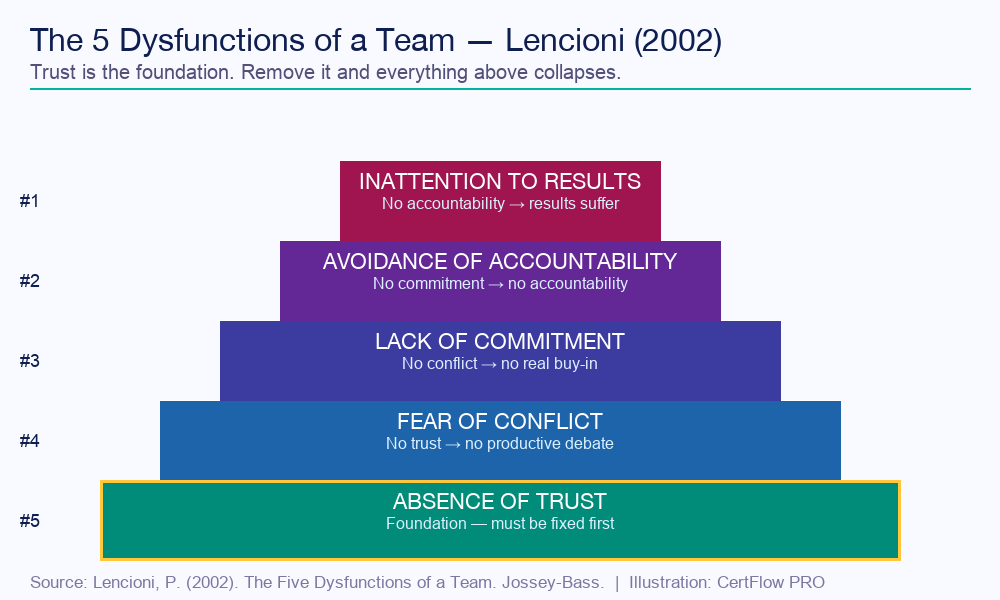
Trust is the base layer in Lencioni's model — without it, every process and tool underperforms.
PMBOK® Guide 8 emphasizes the principle "Build an Empowered Culture"; People Domain Task 3 requires PMs to actively lead their team, which includes building trust.
Psychological safety is the condition that allows trust to emerge — it lets team members speak up without fear of judgment.
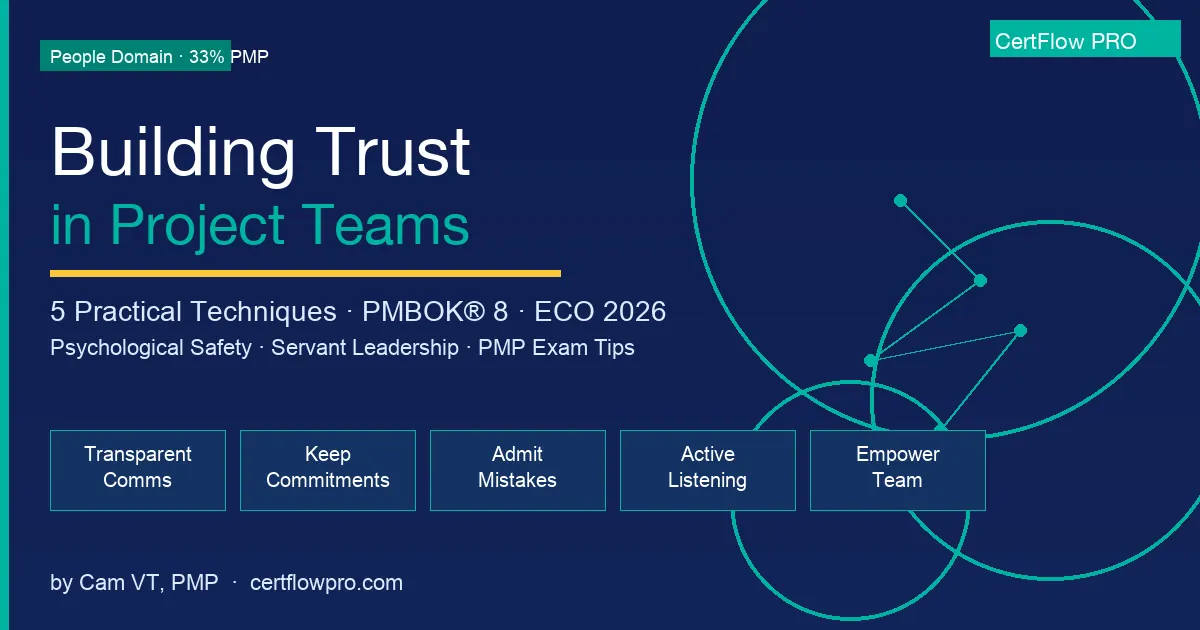
Five practical techniques: transparent communication, follow through on commitments, acknowledge mistakes, active listening, empower with clear accountability.
On the PMP exam, when a team lacks trust, PMI favors the PM addressing root causes and creating safe space — not imposing top-down controls.
Why Trust Is the Foundation of High-Performing Project Teams
Patrick Lencioni identifies Absence of Trust as the first and most fundamental dysfunction of a team. Without trust, team members won't admit weaknesses, won't ask for help, and won't engage in productive debate — leading to avoidance of necessary conflict, lack of commitment, accountability failures, and ultimately poor results.
For a PM, the consequences are concrete: risks get hidden until they escalate, technical issues aren't reported early, and meetings become rituals rather than real decision points. PMI® acknowledges this by placing the People Domain — which covers leading and developing the team — at 33% of the PMP 2026 exam weight according to the PMP Examination Content Outline July 2026.
Trust in PMBOK 8 and ECO 2026
PMBOK® Guide 8 establishes "Build an Empowered Culture" as one of its six core principles. An empowered culture cannot exist without trust — team members will only make autonomous decisions when they believe that mistakes are treated as learning opportunities, not punishments.
In ECO 2026, People Domain Task 3 — Lead the project team — requires PMs to go beyond task management to genuinely lead people: building cohesion, developing capabilities, and creating an environment where each member performs at their best. Trust is the prerequisite for all of this.
For a deeper look at leadership competencies, see our article on leading the project team: 7 PM competencies in PMBOK 8.
Two Trust Models Every PM Needs to Know
Vulnerability-Based Trust — Lencioni
Lencioni distinguishes between predictive trust (knowing what someone will do) and vulnerability-based trust — trust that requires the courage to admit weaknesses, mistakes, and the need for help. This is the only form of trust that builds genuinely high-performing teams.
For a PM, this means: if you want team members to proactively flag risks, you must be the first one to say "I'm not confident about this decision — what does everyone think?" in the room.
Psychological Safety — Edmondson
Amy Edmondson defines psychological safety as a team's shared belief that the environment is safe for interpersonal risk-taking — meaning members can speak up, ask questions, and admit mistakes without fear of humiliation or punishment. Google's Project Aristotle confirmed this as the number-one factor in effective teams.
PMs have the most direct influence on psychological safety through how they respond to bad news: if you "shoot the messenger," the team learns not to tell the truth.
Tuckman Stages and Trust
The Tuckman model (Forming → Storming → Norming → Performing) shows that trust is not a fixed state — it must be actively built over time. During Forming, members are cautious and polite; during Storming, conflict surfaces and trust is tested most severely. PMs must actively intervene during Storming to guide the team toward Norming — where real trust forms — rather than avoiding conflict and leaving the team stuck.
5 Techniques for Building Trust in Project Teams
1. Open and Transparent Communication
Share context — the reasoning behind decisions, the constraints you're working within, the real status of the project — rather than just assigning tasks. Team members trust a PM not because they always have all the answers, but because they don't withhold important information. In an IT outsourcing project, this means: if scope is at risk of change, tell the team first — don't let them hear it from the client.
Practical tools: regular retrospectives, standups where members can raise real blockers (not just status updates), and no-blame post-mortems after incidents.
2. Follow Through on Commitments
Trust is built one kept promise at a time — even small ones. If you say "I'll resolve this budget issue by end of week" and don't, your credibility erodes and the team learns that PM commitments aren't reliable. The principle: under-promise, over-deliver. And when you can't keep a commitment, proactively communicate before the deadline — don't wait for it to be missed.
3. Acknowledge Weaknesses and Mistakes
This is the most counterintuitive technique: a PM who says "I misjudged the complexity of this module" doesn't appear weaker — they create the conditions for the entire team to do the same. Vulnerability-based trust starts with the leader. If the PM always projects certainty, team members won't feel safe admitting when they're stuck.
In the context of servant leadership, this reflects humility — one of the core traits of a servant leader.
4. Active Listening
Active listening is not waiting for your turn to speak. It includes: confirming understanding ("What you're saying is… is that right?"), asking open-ended questions ("What's the biggest obstacle for you right now?"), and suspending judgment when you hear a different perspective. PMBOK 8 identifies active listening as an essential communication skill, especially in projects with multiple stakeholders holding different views.
In practice: in 1-1 meetings with team members, try spending 80% of the time listening rather than directing — you'll start hearing the issues they haven't raised in group meetings.
5. Empower with Clear Accountability
Trust cannot grow if the PM controls every small decision. Empowerment means assigning real ownership — not just tasks — and trusting members to find solutions within agreed boundaries. This applies in both predictive environments (owning a deliverable end-to-end) and Agile (the team decides how to achieve the sprint goal). When delegating, be explicit: who does what, by what criteria, with what authority.
Trust in Predictive, Agile, and Hybrid Environments
Aspect | Predictive | Agile | Hybrid |
|---|---|---|---|
Primary trust-building mechanism | Consistency in planning and reporting; PM ensures information flow | Sprint retrospectives, pair programming, shared ownership; self-organizing team | Predictive structure for governance + Agile space for the delivery team |
PM's role in trust | Command-and-inform; PM actively shares context and shields team from stakeholder noise | Servant leader; removes impediments, does not direct technical decisions | Mediates between two worlds; protects Agile team from excessive predictive process pressure |
Feedback loop | Longer (milestone-based); risk log and status report are primary mechanisms | Short (sprint, daily standup); issues surface and are addressed faster | Short loops within the team; longer loops with stakeholders and sponsors |
Signs of high trust | Members report issues early before they become risks; no "green-washing" of status | Team proactively proposes changing sprint goals when needed; retrospectives are genuinely candid | Agile team not afraid to surface bad news to governance board; predictive PM doesn't over-control the Agile team |
Common Mistakes When Trying to Build Team Trust
Artificial team building (forced fun): organizing elaborate off-sites while maintaining a culture of blame and zero tolerance for mistakes back at work. Trust is built through daily behaviors, not one-time events.
Surface-level consistency: saying "I trust you" while checking every small detail (micromanagement). Actions speak louder than words.
Avoiding conflict: trying to create "harmony" by suppressing productive debate. Lack of healthy conflict is a sign of low trust, not high trust. See also: conflict management: 5 techniques from PMBOK 8.
Building 1-1 trust while ignoring team dynamics: a PM who is good at individual relationships but fails to create mutual trust among team members.
Inconsistency under pressure: trust built during normal project phases collapses when deadlines approach and the PM reverts to command-and-control.
PMP Exam Tips: PMI's Mindset on Trust and Teams
PMI mindset principle: PMI consistently favors PMs who address the root cause of team issues rather than imposing top-down control. When a team lacks trust, the correct PMI answer typically involves: creating a safe space for discussion, asking team members about barriers, or changing the PM's own behavior — not adding more control processes.
How to recognize trust-related questions on the PMP exam:
"Team members are not sharing information / not raising issues early" → root cause is usually lack of psychological safety.
"Team performance is declining despite high individual skills" → sign of missing collaboration and trust.
Common wrong answers: "Escalate to management" or "Enforce stricter reporting" — PMI prefers resolving at the team level first.
Common correct answers: "Meet with the team to understand concerns," "Lead by example," "Empower the team to resolve the issue."
7 Scenario Questions
Question 1. You have just been assigned as PM to a newly formed cross-functional team of 8 members from different departments. During the first team meeting, members barely interact and avoid expressing opinions. What should you do FIRST?
A. Set clear performance expectations and establish reporting requirements for each member.
B. Facilitate a team-building activity to help members get to know each other and share working styles.
C. Ask the sponsor to mandate collaboration between departments to resolve the situation.
D. Assign individual tasks immediately so members can demonstrate their competence.
Question 2. On your Agile project, during sprint retrospective, team members give only positive feedback and avoid raising real issues. You suspect the team does not feel safe voicing concerns. What is the BEST first step?
A. Make retrospectives mandatory with a written report submitted to management.
B. Acknowledge that the team may not feel safe raising concerns and invite private one-on-one discussions with each member.
C. Cancel future retrospectives since they are not producing useful feedback.
D. Ask the team to submit anonymous written feedback before the next retrospective.
Question 3. Your project team consistently misses deliverable deadlines. When you investigate, you find that members knew about delays weeks before but did not report them. What is the MOST LIKELY root cause?
A. The team lacks the technical skills required to complete the deliverables.
B. The project schedule was unrealistic from the beginning.
C. Team members do not trust that raising issues early will be responded to constructively.
D. Communication channels between the team and PM are not clearly defined.
Question 4. A senior team member publicly blames a junior member for a critical bug in a status review meeting in front of the sponsor. The junior member becomes visibly upset and withdrawn. What should you do FIRST?
A. Investigate the bug immediately and determine who is technically responsible.
B. Defend the junior member publicly by explaining that bugs are a team responsibility.
C. Redirect the meeting and address the interpersonal issue privately with both parties afterward.
D. Report the senior member's behavior to HR for disciplinary action.
Question 5. Your project is behind schedule. The sponsor pressures you to require the team to work weekends and reduce retrospective time to "save time." The team is already showing signs of burnout. According to PMI principles, what should you do?
A. Comply with the sponsor's request — schedule recovery is the top priority.
B. Protect the team from unsustainable practices and negotiate scope or timeline with the sponsor instead.
C. Ask for volunteers among the team to work overtime, but make it optional.
D. Reduce retrospective time only, while keeping weekend work as is.
Question 6. You are managing a distributed team across three time zones. Two senior members from different locations have a serious misunderstanding causing tension visible to the entire team. Trust between them has eroded. What is the BEST approach?
A. Allow time for the tension to resolve naturally — relationships improve as the project progresses.
B. Replace one of the members to remove the conflict source.
C. Facilitate a structured direct conversation between the two members, using conflict resolution techniques, to address the root issue.
D. Email both members separately with feedback and ask them to behave professionally.
Question 7. Your key stakeholder begins sending direct task instructions to individual team members, bypassing you as PM. Team members feel confused about priorities and start losing trust in your authority. What is the BEST action?
A. Instruct team members to ignore any communications from the stakeholder that do not go through you.
B. Escalate the issue to the project sponsor immediately.
C. Meet with the stakeholder to clarify communication protocols and reinforce the PM's coordination role, while acknowledging the stakeholder's concerns.
D. Allow the stakeholder direct access since their input may be valuable to the team.
Answers and Explanations
Question 1: B. The team is in the Forming stage — members are cautious and unfamiliar with each other. The priority is helping them connect and establish the foundation of trust. Why the others are wrong: A (imposing requirements immediately) increases pressure instead of building trust; C (escalating to sponsor) bypasses PM responsibility; D (assigning tasks immediately) may create competition rather than collaboration before the team has formed.
Question 2: B. The clearest sign of low psychological safety is uniformly positive feedback. The first step is to acknowledge the problem and create a safer channel (private 1-1s) to understand what team members really think. Why D is not the best answer: Anonymous feedback is a workaround, not a root-cause solution; B is more direct and allows the PM to understand specific issues.
Question 3: C. When members know about problems but don't report them, this is the classic sign of low psychological safety — they fear the consequences of delivering bad news. Why A, B, D are incorrect: A and B may be true independently but don't explain the concealment behavior; D addresses the communication channel, not the reason members chose not to use it.
Question 4: C. The PM's priority is: (1) prevent the formal meeting from escalating further, and (2) resolve the interpersonal issue through the right channel (privately). Publicly defending the junior member (B) may be well-intentioned but adds tension in front of the sponsor. A and D immediately skip past the human element.
Question 5: B. PMI® prioritizes sustainable pace and protecting the team. PMBOK 8's "Build an Empowered Culture" principle includes the PM protecting a healthy work environment. This aligns with servant leadership: the PM serves the team, not only the sponsor. Why A is wrong: Complying with requests that harm the team contradicts PM responsibility as defined by PMI.
Question 6: C. PMI® favors direct conflict resolution using structured techniques (confrontation/problem-solving). Why A is wrong: Avoiding conflict doesn't resolve it; trust doesn't self-repair if the root cause is unaddressed. B is a last resort, not a first step. D (separate emails) doesn't address the relationship between the two people.
Question 7: C. This is a communication protocol and role clarity issue — both preconditions for team trust. The PM must address the stakeholder directly but without confrontation, while demonstrating interest in the stakeholder's concerns. A (blocking the stakeholder) creates more conflict; B (immediate escalation) is premature before attempting direct resolution.
Want to practice more People Domain scenario questions under timed conditions? Try 10 free PMP questions — no sign-up required.
Summary
Trust in project teams is not a "nice to have" — it is the precondition for every other tool and process to work. PMBOK® Guide 8 and ECO 2026 make this explicit through the principle "Build an Empowered Culture" and the requirement that PMs actively lead the project team, not just manage tasks. The five core techniques — transparent communication, following through on commitments, acknowledging mistakes, active listening, and empowering with clear accountability — are not just PMP exam knowledge; they are the foundation of effective PM practice.
Continue to the related article: building a shared project vision — an element inseparable from trust when leading a team.
Frequently Asked Questions (FAQ)
How long does it take to build trust in a project team?
There is no fixed timeline — trust depends on interaction frequency, consistent PM behavior, and team context (new versus established). According to the Tuckman model, teams typically need to move through Storming (often the first two to six weeks) before genuine trust begins to form in the Norming stage.
What is the difference between trust and psychological safety?
Trust is an individual's overall assessment of another person's reliability — predicting their behavior. Psychological safety is the team's collective belief that the environment is safe for interpersonal risk-taking. Psychological safety is the condition that allows individual trust between members to emerge and be sustained within the group.
Can a PM build trust in a remote or distributed team?
Yes, but it requires more deliberate effort. Effective techniques include: regular 1-1 check-ins, higher-frequency short check-ins, creating space for non-work connection (virtual coffee), and above all, proactive transparency — distributed teams lack ambient context and need more explicit information sharing.
How does PMI view trust in the context of the PMP exam?
PMI views trust as foundational to servant leadership and empowered environments. On the exam, when a team lacks trust, PMI typically favors the PM creating a safe space for discussion, addressing root causes, and leading by example — rather than imposing top-down controls or immediately escalating to management.
References
Project Management Institute. (2026). PMP® Examination Content Outline – July 2026. PMI. pmi.org (accessed: 07/10/2026)
Project Management Institute. (2025). A Guide to the Project Management Body of Knowledge (PMBOK® Guide) – Eighth Edition. PMI.
Lencioni, P. (2002). The Five Dysfunctions of a Team: A Leadership Fable. Jossey-Bass.
Edmondson, A. C. (1999). Psychological Safety and Learning Behavior in Work Teams. Administrative Science Quarterly, 44(2), 350–383.